

2000 to 2007 — Creation of Trans Support and Social Groups, South Africa
Between 2000 and 2007, before Gender DynamiX (South Africa’s first trans advocacy group) was founded in 2005, the need for support groups for trans people led to the creation of support groups, which at the time were advertised as transsexual, transgender and transvestite people.*
The first support group was founded in Johannesburg in around 2000. These groups followed the Phoenix Society, an underground group that existed between 1982 and 1990 during the apartheid era.
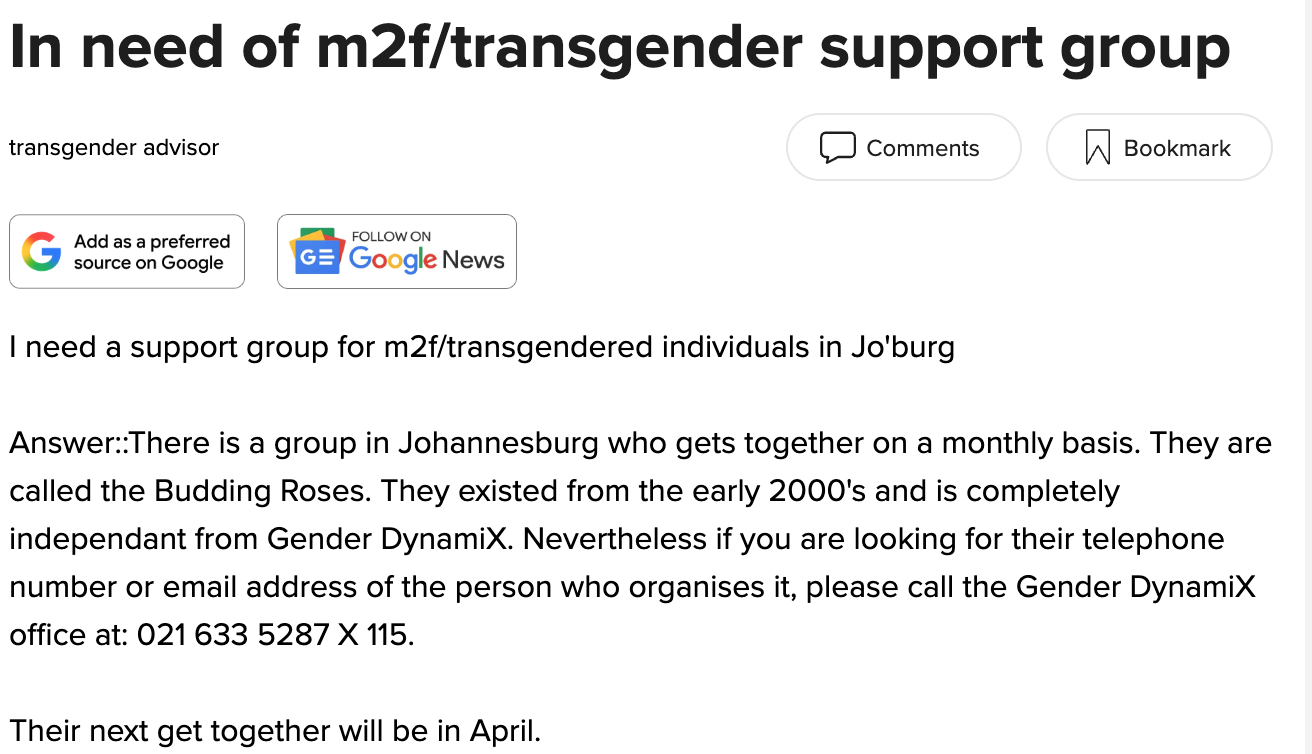
2002 — Budding Roses support group founded
The Budding Roses support group was a monthly get together rotating at members’ houses.
Circa 2002—2006 — Triangle Project support group
Started in around 2002, the support group hosted by the Triangle Project gathered momentum in 2006 when Ronald Addinall, a psychotherapist, joined the group as a facilitator. In the quote below from Ronald, he shares about the collaboration between the Triangle Project and Gender DynamiX (GDX):
“On the 3rd of May 2013 the TG Support group had invited GDX as the speakers for the guest speaker session. The TG support group has grown significantly in the last year and many of the newer members had not yet had the opportunity to engage with GDX and there was a need on the part of members to get a better understanding of the role of GDX as an NGO acting in the interests of Transgender persons as well as the scope of their services. There has also for some time been of our longer standing members, especially members who engaged with GDX when it was initially established, who felt that GDX appeared to be losing touch with the constituency locally and on the ground and they were questioning what role today, GDX played for them.
The aim and intention of inviting GDX to the TG support group meeting at Triangle Project was to have an opportunity of reconnecting and connecting between Transgender persons locally and GDX. An opportunity for new members to get better acquainted and longer standing members to get re-acquainted with GDX. It would also serve as an opportunity for GDX to present to the members how the organisation as evolved since its establishment until presently. To inform members of the programmes and projects GDX is actively involved in and how the focus and prioritised goals and objectives of GDX as an advocacy organisation has developed.
The group, Liesl and S’bu engaged actively, constructively and very positively during the session. Liesl shared the history, evolution and the primary goals and objectives of GDX as it is presently, with the emphasis being on advocacy and activism on behalf of the Transgender community at the broader societal level and nationally. She shared how GDX realised that they needed to prioritise the limited resources the organisation had to its maximum impact for the broader Transgender community. S’bu supported Liesl in sharing the overview and also shared particularly the ongoing challenges they are facing and engaging in at a national level with the DHA. The issue of DHA clearly a collective and very contentious issue for all became a particular point of discussion. As the facilitator I found myself observing and was heartened by hearing and seeing the collective camaraderie between Liesl, S’bu and the group members as they passionately engaged and shared on the topic of DHA.
The group session was truly successful in that the aim and intention was achieved. The different roles and services of Triangle Project, the TG Clinic at GSH and GDX were clarified. GDX also made it clear, that even though their focus is primarily at addressing the more macro and national issues of advocacy and activism on behalf of the Transgender community, that members are always welcome to make contact with GDX, be it visiting the offices, calling, e-mailing, messaging on Facebook, etc.”
— Ronald Addinall; facilitator of the Triangle Project support group
2004 — Creation of the T-Junction support group
The T-Junction support group was created by the founders to be (2005) of Gender DynamiX, Lex Kirsten and Liesl Theron. The group met on a monthly basis in the form of a braai (barbecue) and board games at members’ homes. To ensure as wide as possible representation and attendance, both Liesl and Lex would drive across the Cape Peninsula (from Muizenberg, Kenilworth, Mowbray, and Tableview) to pick up and drop members. Initially T-Junctions were held on Friday evenings once a month, but when the need arose to fetch community members from across the Peninsula, it was moved to Saturday afternoons. T-Junction and Ronald additional from Triangle Project ensured on their annual calendar’s to not have clashing dates, which gave members two opportunities per month to socialise. The peak years of the T-Junction support group were around 2006 and 2007, with the largest attendance of around 15—18 people.
* The TIHA Digital Archive reports on events as accurately as possible to give justice to the language of the day, as this in itself shows progress and opportunity for reflection. The TIHA Digital Archive does not assume a position other than neutrality in this regard – only reporting.