An archive of histories/herstories/theirstories affecting and influencing the trans, gender diverse and intersex movements in Africa
This Timeline of our archive of histories/herstories/theirstories of the trans, gender diverse and intersex movements in Africa and in the Diaspora emerged through the grassroots experiences and memories of the contributing African activists and organisations.
It is often updated with new stories and the Timeline is continually growing.
How to navigate the Timeline
Categories are displayed alphabetically at the top of the Timeline and can be used to filter the results to focus on the research theme chosen. For example, ‘All’ will show you all topics, while ‘Intersex’ will display all entries related to intersex movements and moments.
Alternatively, use the search bar in the menu at the top and bottom of screen to find more specific information.
Categories relating to gender, sex characteristics and sexual orientation have flag icons and colour groups to visually distinguish them from one another:
All
Wanaharakati
Wote
Sanaa
Watafuta hifadhi/Wahamiaji/Wakimbizi
Sauti na Video
Ballroom
Jumuiya
Mikutano
Mavazi ya Msalaba
Depathologisation
Diaspora
Drag
Films
Jinsia Mbalimbali
Jinsia Kutozingatia
Huduma ya Afya ya Kuthibitisha Jinsia
Healthcare
HIV/AIDS
Homeless people
Katika Kumbukumbu
Jinsia
Mahojiano
LBQ
LBTI
LBTQ
Sheria
LGBTQIA+
Media
Isiyo ya binary
Mashirika
People living with HIV
Persons with Disabilities
Machapisho
Kazi ya Ngono
Michezo
SRHR
TIHA Articles
Trans
Trans & Intersex
Transfeminist
Transmasculine
Transsexual
Transvestite
Youth
Julai 2016 — Uanzishwaji wa Mtandao wa Afya na Utetezi wa Watu wa Jinsia Tofauti Afrika Mashariki (EATHAN), Afrika Mashariki
Julai 2016 — Uanzishwaji wa Mtandao wa Afya na Utetezi wa Watu wa Jinsia Tofauti Afrika Mashariki (EATHAN), Afrika Mashariki
In July 2016, The East Africa Trans Health and Advocacy Network (EATHAN) was formed by founding member Barbra Wangare in Kenya as a network of trans-diverse activists and organisations in East Africa working to improve the livelihoods of gender-diverse persons in East Africa. Member organisations represent 34 activist and trans community organisations across Burundi, Kenya, Rwanda, Tanzania and Uganda.
Dhamira
EATHAN’s mission is to equip and enable East African trans* diverse individuals and institutions, to organise and advocate for the improvement of their health, the recognition of their gender, and the protection of their human rights, utilising informed research and documentation, particularly on health and HIV, and by enhancing their livelihoods through capacity strengthening and empowerment. In 2021 EATHAN celebrated International Women’s Day by hosting their first-ever Live Show on the topic of Trans Womanhood.
EATHAN’s Board. From EATHAN’s Facebook page.
Maeneo ya Kazi
The organisation’s main mandate is to support its members. It does this through technical support with fundraising proposals and attending conferences, as well as budget writing. It also offers capacity strengthening initiatives so that member organisations are able not only to fundraise, but to build the capacity to handle donations and carry out the projects funding was sought for. Member organisations are also trained in financial management and financial accountability.
EATHAN also engages in global trans activism and is one of the organising committee members of the United Nations Trans Advocacy Week that is held yearly.
Resource Hub
The EATHAN Resource Hub is a space where, among other things, its research is documented, providing community members with information on transitioning, legal gender recognition, challenges, as well as documents on legal and human rights advocacy and policy changes affecting trans and intersex communities.
Watch our interview with EATHAN’s Executive Director, Barbra Wangare
On 15 October 2024, TIHA’s Victor J. Mukasa and Barbra discussed her personal journey as a trans woman and the early history of trans awareness in Kenya, her role in the founding of Kenya’s second trans organisation, Jinsiangu and the work that she and EATHAN do in Kenya, East Africa and globally.
July 2016 — Founding of East Africa Trans Health and Advocacy Network (EATHAN), East Africa In July 2016, The East Africa Trans Health and Advocacy Network (EATHAN) was formed by founding member Barbra Wangare in Kenya as a network of trans-diverse activists and organisations in East Africa working to improve the livelihoods of gender-diverse persons […]
2016 — Founding of Intersex Advocate Trust Zimbabwe (IAZ), Zimbabwe
Intersex Advocate Trust Zimbabwe (IAZ) was founded in 2016 and registered in 2020. IAZ envisions an inclusive society where there is non-discrimination and there is equal treatment of everybody and rights of intersex persons are upheld with unity, dignity and respect. IAZ advocates for the human rights of intersex persons in their diversity leading to productive and fulfilling lives.
Goal
To advocate for a Zimbabwean society that upholds the human rights of intersex persons in their diversity.
Maono
A Zimbabwean society that upholds the human rights of intersex persons in their diversity. IAZ advocates for the human rights of intersex persons in their diversity leading to productive and fulfilling lives.
Values
Integrity
Innovativeness
Excellence.
Maeneo ya Kazi
IAZ’s goal is to raise awareness on intersex conditions and build a strong resilient intersex community that has voice and agency.
The organisation’s core business is to champion the rights of intersex persons, raise awareness and recognition on intersex issues and rights, lobby and advocate for inclusion as well as an end to genital mutilation.
IAZ also offers psychosocial support and care to children and adults born intersex and those living with HIV.
IAZ has also vested interests in focusing on intersex children abandoned by parents in different health facilities in the Matabeleland provinces including Bulawayo metropolitan province.
Over the past years, IAZ’s programming has evolved to include designing interventions to reach out to parents and other caregivers of intersex children and persons as well as the society at large.
Some of the activities have seen the organisation providing a wide range of sexual and reproductive health and rights-based information.
The organisation also runs project activities targeting school teachers, religious institutions, health care providers, traditional leaders and healers and medical practitioners through sensitisation, anti-stigma and discrimination campaigns to further protect the SRHR of intersex persons.
Their ultimate mission is to work towards achieving equality, inclusion and justice for the intersex persons in Zimbabwe through advocacy and collaborative actions.
2016 — Founding of Intersex Advocate Trust Zimbabwe (IAZ), Zimbabwe Intersex Advocate Trust Zimbabwe (IAZ) was founded in 2016 and registered in 2020. IAZ envisions an inclusive society where there is non-discrimination and there is equal treatment of everybody and rights of intersex persons are upheld with unity, dignity and respect. IAZ advocates for the […]
August 2016 — Founding of Crème de la Crème House of Fame Foundation (CDLC), Nigeria
In August 2016, Crème de la Crème (CDLC), was founded in Nigeria, focusing on trans and non-binary rights. CDLC was registered on 18 September 2018. The organisation was founded by Ejiogu Franklin Chigozie, a non-binary person who led other trans persons to formulate the vision of the organisation. CDLC started as an in-house group in the year 2016, where they celebrated a pride event that had over 200 LGBTQI persons in attendance. Following this pride, the group acquired a Safe Shelter to help evacuate trans and non-binary persons who were in dire need of accommodation and gender-affirming treatment. The group extended the safety of the Shelter to other LGBTQI persons in need of shelter in Nigeria.
Maono
To see a well-informed trans society free of violence and marginalisation with highly responsible people making history in all works of life.
Dhamira
To contribute to the improvement of lives of the trans persons in Nigeria towards Access to healthcare Services, Rights. safety and education through strong Activism, advocacy, vocational training, and sensitisation.
The staff of CDLC. Taken from their website.
Goal
To provide safe platforms where marginalised persons can be trained and empowered to give full expressions of their talents.
Watch our interview with Franklin Ejiogu
We recorded this conversation with Franklin on the 12th of December 2025:
August 2016 — Founding of Crème de la Crème House of Fame Foundation (CDLC), Nigeria In August 2016, Crème de la Crème (CDLC), was founded in Nigeria, focusing on trans and non-binary rights. CDLC was registered on 18 September 2018. The organisation was founded by Ejiogu Franklin Chigozie, a non-binary person who led other trans […]
Septemba 2016 — Mbunge Anashinikiza Jinsia ya Tatu, Kenya
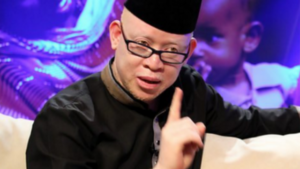
In September 2016, Isaac Mwaura, a Kenyan Parliamentarian, wanted the Kenyan Parliament to pass the option of a third gender into Kenyan law in order to legally recognise intersex people. Mwaura also asked for public funding for gender-affirming surgeries and a public awareness campaign to end the stigmatisation of intersex people. Read more here.
September 2016 — Parliamentarian Pushes for Third Gender, Kenya In September 2016, Isaac Mwaura, a Kenyan Parliamentarian, wanted the Kenyan Parliament to pass the option of a third gender into Kenyan law in order to legally recognise intersex people. Mwaura also asked for public funding for gender-affirming surgeries and a public awareness campaign to end […]
Trans Hope was founded in 2017 by Sazi Jali. Trans Hope was formally registered on 6 June 2019, making it the first trans-led organisation in the province of Kwa-Zulu Natal in South Africa. Trans Hope seeks to raise awareness about gender and gender identity and create an environment that is safe and inclusive for gender-diverse people. Sazi Jali saw a need within the community to not just help the members of the support group but to provide support and services to the transgender and gender-diverse community in the KwaZulu-Natal province as a whole. In 2019, with the encouragement of Prof. Zanele Muholi and Dr Chris McLachlan, Trans Hope was registered as a Non-Profit Organisation,
The dream was to mainstream gender diversity in the community through providing safe spaces within both public and private institutions, and to give trans and gender-diverse communities access to education and advocacy. Part of the aim of Trans Hope was to not isolate trans people, so the board and working team included a number of cisgender individuals to assist in the fight for the mutual understanding of diversity within the greater community, to ensure the acceptance of trans and gender-diverse people through creating awareness, and to provide education about trans and gender-diverse issues and to advocate for their human rights.
“We empower our community by providing knowledge about LGBTQIA+ issues and health care. We educate schools, clinics, hospitals and churches in order to provide a safer place for transgender and gender diverse people. We also provide training and conduct workshops.”
Maono
To advance the constitutional rights for the LGBTQIA+ community, ensuring they have a safer space within but not limited to the Republic of South Africa.
Dhamira
Trans Hope seeks to:
Increase knowledge about gender identity and sexual orientation expression as well as sexual characteristics (SOGIESC).
Create safe spaces for people who are gender diverse, through killing stigma against LGBTQIA+ people by building our community and empowering them with understanding about the diversity of humankind.
Malengo
Create a safe space for queer people within the cishetoronormative spaces.
Fight the anti-gender group to ensure communities are empowered with knowledge.
Trans Hope informally started in 2017 and two years later, on June 2019 received their registration papers. Prof. Muholi played an important role in the beginning years, encouraging and facilitating group members to meet and work towards forming Trans Hope
Action Santé Trans* Bénin (ENVOL) is a human rights organisation founded in 2017 in Benin. It was officially registered in 2019. ENVOL is committed to creating an enabling environment for the health and well-being of discriminated against and marginalised trans people in order to fight for the respect of their human rights through the organisation’s actions, service offerings of education, prevention and care related to STI and HIV/AIDS advocacy.
Maono
ENVOL aspires to a more egalitarian world, creating and shaping a world where all people regardless of sexual identity or orientation are fulfilled and empowered. It aims to develop better actions and supportive policies that promote the health, well-being, education, leadership and collective power, respect, dignity and equality of trans and gender non-conforming people in all their diversity, and to change and impact the world.
Dhamira
Accompanying, helping and supporting trans people, young people and in order to contribute to their well-being and fulfillment, ENVOL works to end gender-based violence, fight inequality and respect human rights while promoting empowerment, dynamism, collective power in the community and greater participation through new approaches to inclusive intervention, equality and solidarity, while also promoting behavioural change.
Some of the members of the board of directors and executive board of ENVOL
Goals
To fight for the respect of human rights through:
Fighting transphobia (discrimination, marginalisation and all kinds of violence and other forms of oppression against Trans* people.
Fighting against STIs and HIV/AIDS.
Fighting for the full development of Trans* and marginalised people within the general population.
Enabling the community to access a safe space.
Promoting solidarity and support within the trans community, and between this community and the cisgender community in Benin.
From the integration and awareness-raising football match between the trans and intersex communities and civil society organisations
Some of the members of the board of directors and executive board of ENVOL
Self-defense and community-based first aid workshop
Well-being and expression workshop
Economic Empowerment & Leadership Workshop
Empowerment through photography workshop
Miss Intelligentsia Queen Bénin: Running since 2017, the Miss Intelligensia Pageant is aimed at promoting a trans- and intersex-inclusive society, sustainable social and personal change, and it also raises awareness. The candidates debate the anti-gender movement, all sensitive issues to the community Benin, human rights and how to fight against gender-based violence and access to justice to assert one’s rights. The pageant is also aimed at creating role-models for young trans and intersex people in the country.
2017 — Action Santé Trans* Bénin / ENVOL Association Founded, Benin Action Santé Trans* Bénin (ENVOL) is a human rights organisation founded in 2017 in Benin. It was officially registered in 2019. ENVOL is committed to creating an enabling environment for the health and well-being of discriminated against and marginalised trans people in order to […]
2017 — Trans and Intersex Rising Zimbabwe (TIRZ) Founded, Zimbabwe
Trans and Intersex Rising Zimbabwe (TIRZ) was founded in 2017 by Q Bee Chihera Meki and Tinoashira Chukuni. TIRZ was registered on 4 May 2021.
Maono
TIRZ envisions a Zimbabwean society that treats trans-diverse and intersex people equally, and empowers trans and intersex persons to live to their full potential.
Dhamira
Fulfilling this vision through activism, service- provision, advocacy, and community development and empowerment.
Malengo
Providing various forms of support to meet the needs of the sex- and gender-diverse community of Zimbabwe
Increasing awareness, and advocating for the rights and identities of the sex- and gender-diverse community of Zimbabwe.
Advocating for the equitable access for the sex- and gender-diverse community of Zimbabwe to socio-economic services.
Maeneo Yanayolengwa
Activism and sensitisation work in the health sector around the needs of trans and intersex persons.
Developing trans and intersex leadership and entrepreneurial skills.
Grassroots-level research on the needs of the trans and intersex communities.
Sharing the narratives of trans and intersex persons.
HIV-related services for the trans and intersex community.
Fostering relationships between the various trans and intersex communities and organisations in Zimbabwe.
2017 — Trans and Intersex Rising Zimbabwe (TIRZ) Founded, Zimbabwe Trans and Intersex Rising Zimbabwe (TIRZ) was founded in 2017 by Q Bee Chihera Meki and Tinoashira Chukuni. TIRZ was registered on 4 May 2021. Vision TIRZ envisions a Zimbabwean society that treats trans-diverse and intersex people equally, and empowers trans and intersex persons to […]
2017 — Publication of ‘Southern Africa Trans Diverse Situational Analysis’, Southern Africa
In 2016, the Southern African Trans Forum, with the aid of Accountability International, undertook a situational analysis of the barriers faced by trans diverse people in Africa in accessing healthcare. The specific focus of the analysis was the intersections between legal and policy frameworks that create these barriers for people in 5 Southern African countries: Botswana, Namibia, Swaziland, Zambia and Zimbabwe. The report, ‘Southern Africa Trans Diverse Situational Analysis: Accountability to Reduce Barriers to Accessing Health-Care | 2016’, took place during 2016 and was published in 2017.
Survey Results
Barriers faced by trans diverse Southern Africans (Source: page 5 of the Report)
Lacking identity documentation aligned to their preferred gender, trans-diverse persons experience extreme discrimination at school, at church, and in other social settings at the hands of their peers who are ignorant of and uncomfortable with their gender identity;
Facing active discrimination from family and church leaders – who are likely to sexually molest many trans diverse people – their experience finally drives trans diverse people out of school before completion of their studies, and also out of home (another key site of sexual abuse);
Trans diverse people are at a permanent disadvantage against former peers in seeking work in that we are underage, underqualified, can’t progress further in their studies, and cannot secure basic documents such as a driver’s license (a significant minority of those few that manage to secure work are likely to experience sexual harassment at work, or to lose their jobs as a result of their gender identity) so most of them wind up unemployed;
Lack of education, employment, plus official and societal discrimination against the trans diverse usually means we cannot access housing and wind up on the street, which drives them into underground subsistence activities including petty criminality and especially sex-work in order to survive;
That demi-monde existence in turn makes them even more vulnerable to abuse by members of the public and the police (including arbitrary assault, arrest, and detention), to substance abuse and self-harming behaviour including suicide attempts, and to disease including but not limited to STIs, HIV/Aids, TB and viral hepatitis;
so ill and in desperate need of medical attention and psychological assistance (not to mention hard-to get hormones and almost unreachable transitional surgery), the trans diverse turn to the healthcare system – but encounter yet more ignorance, prejudice and even abuse.
Lived experiences of trans diverse Southern Africans
The Survey documented the following results in a period of 12 months relating to the lived experiences of trans diverse Southern Africans:
34% (1 in 3) experienced sexual violence, including attempted or completed rape.
Of these, only 19% (1 in 5) received the necessary medical attention.
22% experienced attempted or completed rape by an intimate partner.
Of these, only 14% reported intimate partner sexual violence.
18% reported physical abuse by a religious or faith healer.
Only 11% of these reported the sexual abuse by a religious or faith healer.
53% experienced violence.
Of these only 30% received the medical attention they required.
Only 24% of these experiences of violence were reported.
53% avoided healthcare because of stigmatisation by staff.
Only 45% taught their healthcare provider about trans diverse issues.
Key findings of the situational analysis
The summary of the Report is as follows:
“The trans diverse communities in the five countries studied (Botswana, Namibia, Zambia, Zimbabwe, and Swaziland) represent a remarkable constellation of communities characterised by extreme vulnerability because of their intersectional location as among their countries’ most excluded – unemployed or criminalised, susceptible to disease and despair, targeted for sexual assault and hate crimes, and cut off from education, housing, health-care, sports and social activities, and many the basic benefits of citizenship and amenities of society.
And yet trans diverse people are possessed of remarkable strengths in terms of their survival skills and tenacity in overtly hostile environments were because of having to either face social erasure or are actively persecuted as a group that “should not” exist.
The power of trans diverse agency should not be underestimated, as two remarkable examples will make clear: a) although many members of the trans* community who answered this survey have experienced prejudice in, including expulsion from, their childhood homes, 38% of those surveyed started their own families; and b) although many trans diverse persons experienced prejudice in, including expulsion from, school, fully 18% of those surveyed completed tertiary education – higher than the national average in at least three of the countries surveyed.
However, a total policy vacuum regarding the existence, nature and needs of the trans diverse community mars all the countries studied. This invisibility not only allows for blanket ignorance to reign among officialdom and the broader populace, on the one hand disabling trans persons’ ability to access ordinary (and specialised) health-care and legal remedies, while on the other hand enabling casually vicious discrimination up to and including violent hate crimes and police home invasions (the latter experience restricted to Zambia). Even the protections that the trans diverse supposedly possess under constitutional equality/human rights legislation appears to fall away in most real-life circumstances.” Source: https://accountability.international/projects/trans-diverse-africans-situational-analysis-2016-2019/
2017 — Publication of ‘Southern Africa Trans Diverse Situational Analysis’, Southern Africa In 2016, the Southern African Trans Forum, with the aid of Accountability International, undertook a situational analysis of the barriers faced by trans diverse people in Africa in accessing healthcare. The specific focus of the analysis was the intersections between legal and policy […]
2017 — Trans Support Organization (TSO) Founded, Kenya
Trans Support Organization (TSO) was formed as a community-based organisation (CBO) in 2017 by a group of three transgender, intersex, and gender-non-conforming (ITGNC) individuals from Western Kenya who met during the Human Rights and Advocacy Programme by ASTRAEA Lesbian Foundation for Justice through the NYARWEK Network (Nyanza Rift Valley and Western Kenya Network). TSO was founded with a focus on human rights and sexual reproductive health and rights to respond to the needs of ITGNC individuals, as well as to create visibility, increase opportunities for and enhance the well-being of these individuals in rural areas of Western Kenya. TSO was registered in November 2019.
Maono
A vibrant and radically inclusive society that supports intersecting identities, where all community members can thrive as their authentic selves, liberated from stigma, violence and oppression.
“Above all TSO consists of trans folks brought together by collective experiences and a deep desire to change the landscape so that ITGNC persons joining us may lead more dignified lives. We address scars of discrimination and first-hand experience of what it means to be invisible in our community and country. Our bodies bear testimonies to the worst that can happen to a trans person including being raped, locked in jails, beaten to a pulp by a mob and mocked everywhere. We exist to provide hope that all can be well and that being trans is not an abnormality. TSO is committed to embodying the values of diversity, equity, and inclusion.”
2017 — Trans Support Organization (TSO) Founded, Kenya Trans Support Organization (TSO) was formed as a community-based organisation (CBO) in 2017 by a group of three transgender, intersex, and gender-non-conforming (ITGNC) individuals from Western Kenya who met during the Human Rights and Advocacy Programme by ASTRAEA Lesbian Foundation for Justice through the NYARWEK Network (Nyanza […]
March 2017 — SistaazHood’s Leigh Davids Makes Famous “Trans Violent Exclusion” Speech, South Africa
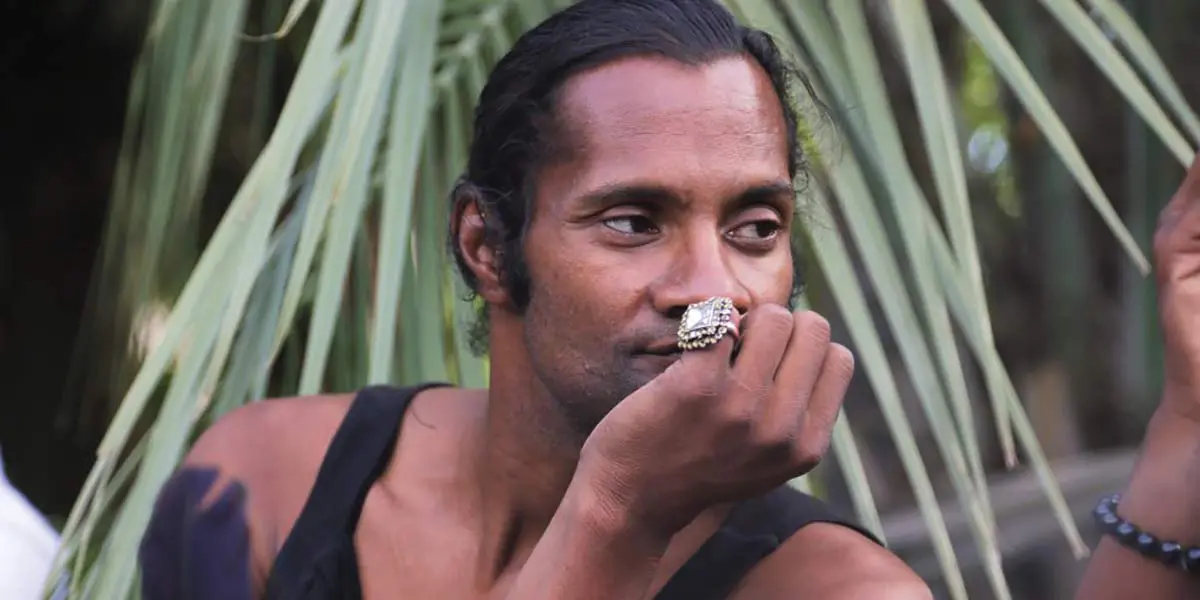
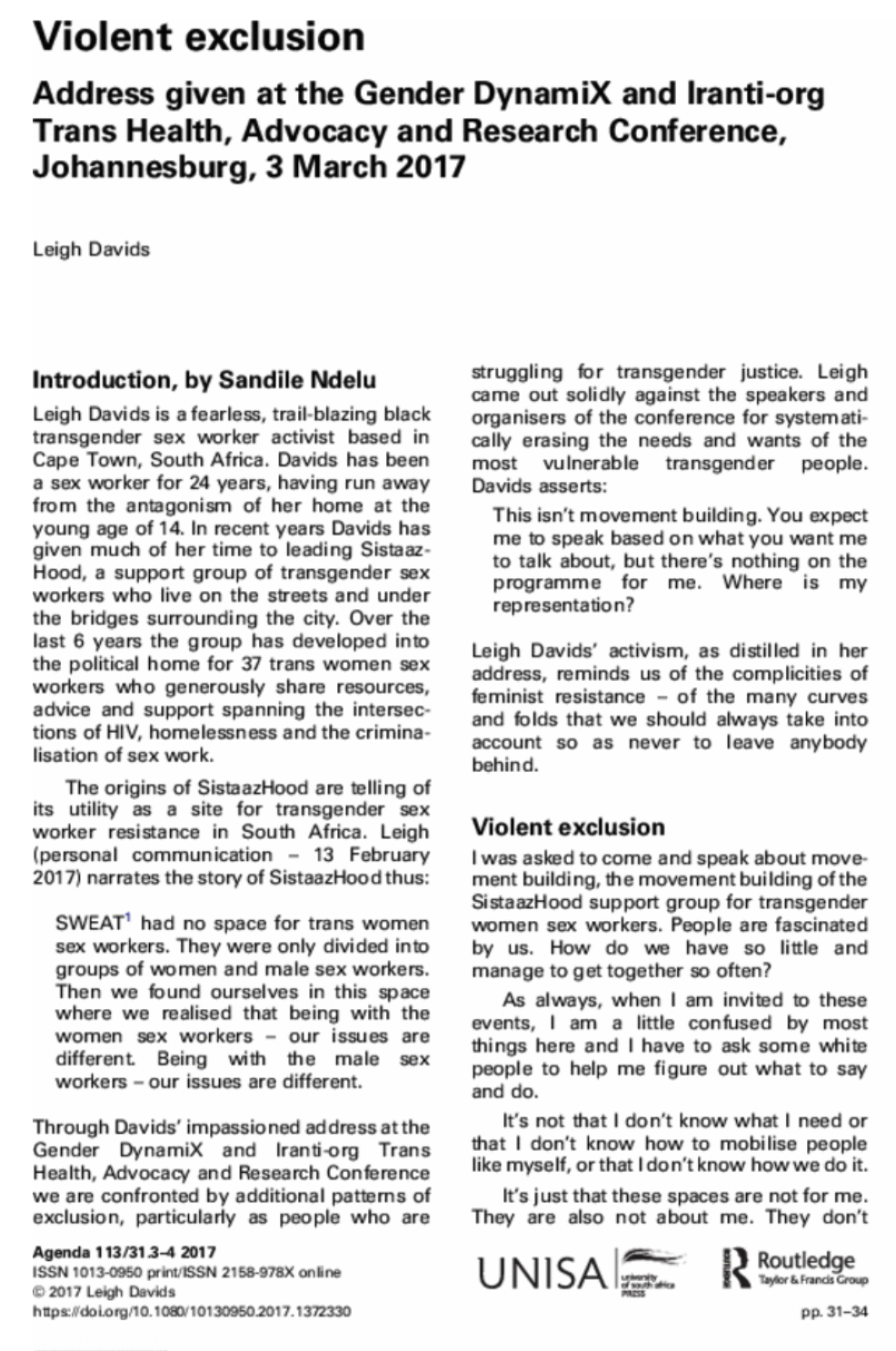
In March 2017, trans sex worker activist, Leigh Davids from SistaazHood, made the now famous “Trans Violent Exclusion” speech at the 3rd Trans Health, Advocacy and Research Conference, hosted by Jinsia DynamiX (GDX) and Iranti.
Under the Conference theme, “Decolonising and Depathologising Transgender Identities”, Leigh delivered a powerful critique, which was published afterwards.
The speech highlighted the different income and social classes and levels of access within trans organisations and among trans women and activists. She spoke about living on the street, and she challenged the audience to think about what it means being a trans woman sex worker and how this Conference (or any other) is at all meaningful for trans women sex workers. In the speech Leigh mentioned that trans women sex workers do not live to be older than 40 years.
Leigh passed away two weeks before her 40th birthday, on 27 February 2019. Read the tributes to Leigh after her passing.
Transcript of snippets from a speech Leigh made in 2018 at the Kewpie Heritage Day
“Thank you for coming to the place where we live. We do not often invite people here. Like anybody else we enjoy our privacy and as you might imagine we don’t have a lot of that here. This is what NOT PRIVACY looks like. This is what NOT HOME looks like. This is what parents threaten their children with if they don’t do their homework. This is what Capitalism imprints in your mind to make you work harder, to spend your money, to make you work for the man. This is……. THE STREETS.
The human mind and will is amazing. Even when it is hungry. Even when it is in pain all the time. Even when it’s spirit has been attacked all it’s life. It will find and make community, under the worst stress. The SistaazHood and our allies have been living on this spot for decades. Over there is our lounge and our kitchen. Over here is where we sleep together. This is home for us. Well it was until the part of apartheid that never died came and evicted us last week, evicted us yet again from District 6. The first time was because of philosophy called apartheid. Ooh and we hate that word hey? All of us! Black white poor rich. Say it with all the hate in yourself, all the disgust, feel appalled! Wasnt it terrible? It was so terrible that once upon a time a government, a city could throw poor black people out of their homes, demolish them, send the people to the outskirts of the city. What terrible prejudice, human rights violation. That one could lose your home because of the colour of your skin, your culture, how you were born. Shocking hey? But let me tell you that Big Brother Apartheid might be dead but his father is still with us. We never killed his father. His father’s name is the CLASS SYSTEM and his father’s job is GENTRIFICATION. In the name of gentrification the father of apartheid is still chasing poor black people from District Six.
And so? How many of you are working class? How many of you are middle class? Do you occupy the street to walk to work or do you occupy the street when you go for a jog or do you drive in it? If you answer yes to any of those you are more or less safe from the father of apartheid and his job – gentrification. But me and my sisters. He is coming for us. He came for us last week on his first round through Woodstock. He chased us around the corner. Next week he will take us to a concentration camp in a place called Wolwehoek. What is this? It sounds like a TV drama. But it is not. It is my life. It is our life. And maybe you wonder why I can sleep in the street, how can sleep on a piece of property I don’t own, how I can complain when I am evicted from a space I don’t own. Are you wondering that? Are you wondering if I am a nuisance to people here? Do I make a noise? Do I use drugs, sell sex, urinate on the street? And isn;t it time for me to get my act together, find a job? First of all – I HAVE A JOB. Sex work is work. You made it illegal. Second of all. I don’t live here by accident. I am not poor by accident. I am not without a home by accident.
There are places in the world where democracy does it’s job, nobody sleeps on tar and cardboard there. There are places in the world where Capitalism works, does it’s job – people don’t sleep under plastic on cement there. There are places in the world where dynamic communities with all the classes are designed by city planners. People from every class is together in one neighbourhood, diversity makes them thrive! Believe it! Those neighbourhoods work! And the most vulnerable? There are shelters for them…..right there in the same neighbourhood where one guy jogs on the street, the other one walks on it to work and the one with mental health challenges sits on a bench under a beautiful tree, protected, maybe even healing. There are places like that in the world.
And do you know how they happened? They did not happen because poor people got their act together. They did not happen because poor people got themselves jobs. They did not happen because poor people got organised. They happened because people with power started doing their job. They built a society for everybody with their power. The middle class agreed to it. Insisted on it. That’s how it happened.
So please leave us now and go do you job. Use your power. Get us off the street without evicting us. Gentrify with us in our heart and mind, not like we are trash that needs to be taken out…..of town.”
March 2017 — SistaazHood’s Leigh Davids Makes Famous “Trans Violent Exclusion” Speech, South Africa In March 2017, trans sex worker activist, Leigh Davids from SistaazHood, made the now famous “Trans Violent Exclusion” speech at the 3rd Trans Health, Advocacy and Research Conference, hosted by Gender DynamiX (GDX) and Iranti. Under the Conference theme, “Decolonising and Depathologising […]
8 March 2017 — Founding of Alliance for Dynamics Initiative (ADI), Ghana
Founded on 8 March 2017, the Alliance for Dynamics Initiative (ADI), is a trans-specific NGO which addresses the needs of trans persons in Ghana. ADI is a member organisation of AFED, the Alliance for Equality and Diversity.
Maono
A Ghana where trans persons have equal rights, free from stigmatisation and discrimination and regarded as human beings.
Dhamira
To address stigmatisation and discrimination, violence, extortion and blackmailing of trans persons in Ghana through education and empowerment to build the capacity of individuals, improve health care services and human rights for trans persons.
From the organisation’s Facebook page
Maeneo ya Kazi
Human rights and advocacy training.
Self-acceptance, self-awareness and identity training.
8 March 2017 — Founding of Alliance for Dynamics Initiative (ADI), Ghana Founded on 8 March 2017, the Alliance for Dynamics Initiative (ADI), is a trans-specific NGO which addresses the needs of trans persons in Ghana. ADI is a member organisation of AFED, the Alliance for Equality and Diversity. Vision A Ghana where trans persons […]
17 Machi 2017 — Shirika la Equal Shiners Initiative Uganda Limeanzishwa, Uganda
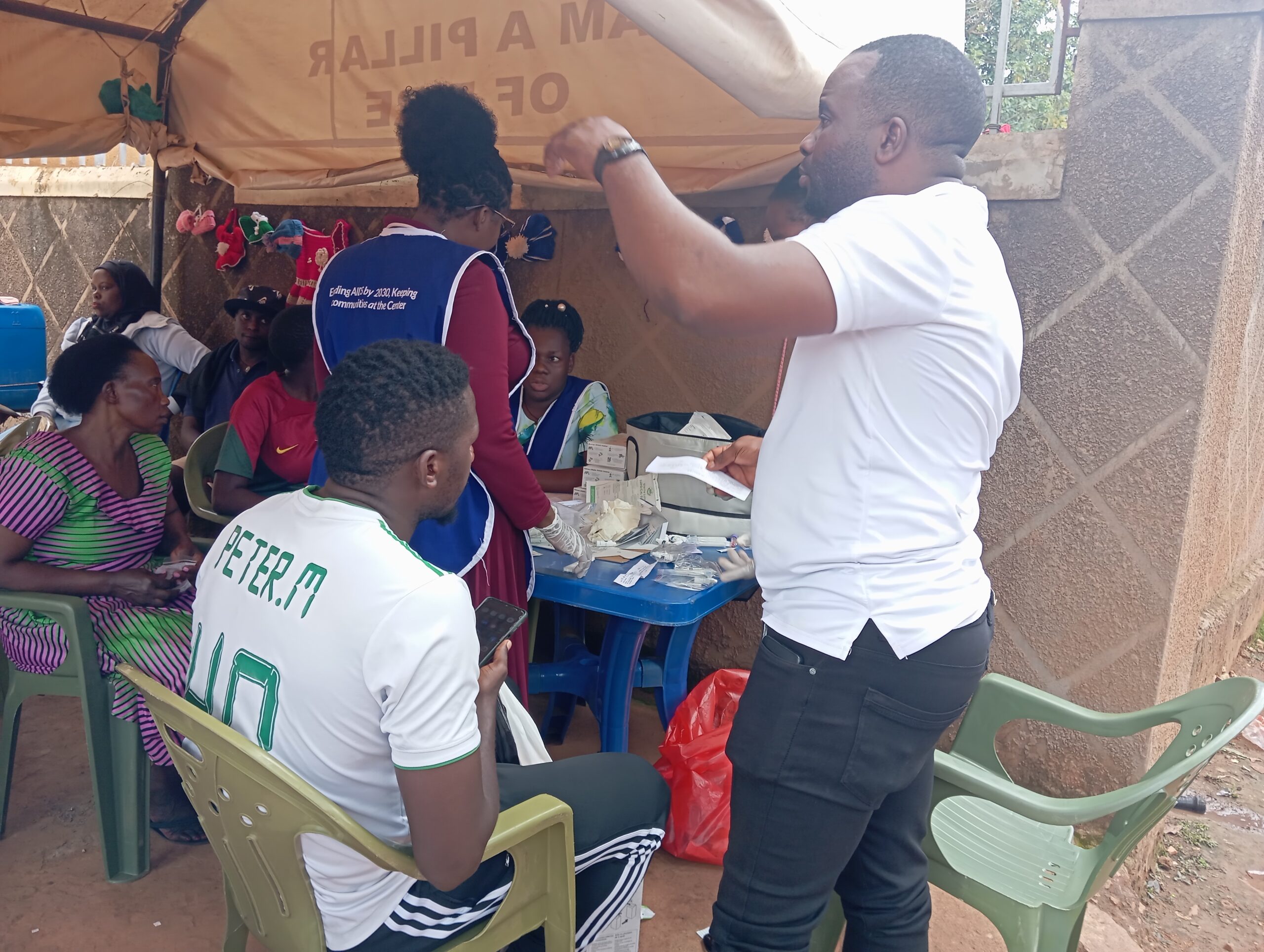
Ilianzishwa tarehe 17 Machi 2017 na Bukenya Musa, Equal Shiners Initiative Uganda hufanya kazi na watu wa LGBTQIA+, kwa kuzingatia mahususi watu wa jinsia tumbo, wenye hermafroditi, wafanyakazi wa ngono na wanajamii wengine walio katika mazingira magumu, hasa wale walioathiriwa na unyanyapaa, ubaguzi, kukosa makazi, na UKIMWI. Shirika hutoa msaada wa jamii, uhamasishaji, utetezi, na upatikanaji wa huduma muhimu. Mbinu yao ya shirika ni
Utetezi na programu zinazoongozwa na jamii na zinazoendeshwa na rika
Mbinu zinazolinda haki, zinazothibitisha jinsia, na zinazojumuisha wafanyakazi wa ngono
Utetezi wenye msingi wa ushahidi unaojengwa juu ya uzoefu halisi
Mifumo madhubuti ya rufaa, ushirikiano, na ushirika
Uwajibikaji kwa jamii zinazohudumiwa
Shirika lililoshajiriwa kama NGO mwaka 2017. NGO hiyo hapo awali ilikuwa CBO iitwayo Kuchu Shiners.
Maono
Jamii salama, jumuishi, na yenye usawa ambapo kila mtu anaheshimika na kuwezeshwa.
Dhamira
Kusaidia na kuwawezesha jamii za LGBTQIA+ kupitia utetezi, elimu na programu jumuishi.
Malengo/Madhumuni
Promote usawa na haki za binadamu.
Toa nafasi salama na huduma za kusaidia.
Ongeza uelewa na upunguze unyanyapaa.
Wawezeshe wanajamii.
Maeneo ya Kazi
Kazi ya shirika inalenga utetezi wa haki za binadamu, msaada wa afya ya akili, uwezeshaji jamii na programu maalum zinazowaunga mkono watu wa jinsia mbili na watu wa jinsia ya kati. Utetezi, haki za binadamu na ushiriki wa sera ndiyo nguzo kuu ya kazi ya shirika, inayoshughulikia ukosefu wa usawa wa kimuundo, uhalifu, unyanyasaji, na kutengwa kwa wanawake wa kile-jinsia wanaofanya kazi za ngono kwa kusikiliza sauti za jamii na kushirikisha wale waliopewa jukumu, watungaji sera, na taasisi. na umma.
Hatua muhimu za utetezi
Uandikishaji na kuripoti ukiukaji wa haki za binadamu unaowahusu wanawake wa kike wanaojiuza kwa ajili ya kujikimu
Kampeni za utetezi zinazoongozwa na jamii zinazolenga uhalifu, vurugu za polisi, unyanyapaa, na ubaguzi.
Ushirikiano na watunga sera, mamlaka za mitaa, taasisi za afya, na mashirika ya haki za binadamu.
Ujenzi wa vyama na ushiriki katika mitandao ya utetezi wa kitaifa na kikanda
Mawasiliano ya kimkakati, usimulizi wa hadithi, na ushiriki wa vyombo vya habari kulingana na uzoefu halisi
Utetezi wa mifumo ya afya, kisheria na sera inayothibitisha wanaume na wanawake wasio wahusika wa jinsia zao, ikijumuisha wafanyakazi wa ngono.
VVU, afya ya uzazi na haki za uzazi
Equal Shiners Uganda inaimarisha upatikanaji wa huduma za VVU na SRHR kupitia utoaji huduma kwa wawezao, rufaa, na mifumo ya ufuatiliaji inayowahakikishia wafanyakazi wa sex wa jinsia trans wanapata huduma wanazostahili, kwa siri, na bila ubaguzi. Huduma zinajumuisha:
Marejeleo ya upimaji wa VVU na ushauri
Upimaji wa PrEP, kuanzishwa, upataji wa dawa tena, na usaidizi wa ufuataji
Rufaa za utawala za PEP
Upimaji wa magonjwa ya zinaa na rufaa za matibabu
Ushauri nasaha na usaidizi wa kufuata matibabu
Ufuatiliaji wa wateja na uendelevu wa utunzaji
Uhamasishaji wa jamii, kuzuia na uwezeshaji
Shirika linaendesha miradi ya ushawishi na uwezeshaji inayoongozwa na rika ambayo inatanguliza kupunguza madhara, kufanya maamuzi kwa kuelimishwa, usalama, na utu. Shughuli ni pamoja na:
Usambazaji wa kondomu na losheni za kiume
Usambazaji wa vifaa vya kujipima VVU
Elimu ya afya, kinga dhidi ya VVU, na uhamasishaji wa haki za afya ya uzazi na ngono
Uhamasishaji wa haki na mijadala ya jamii
Uhamasishaji na usaidizi wa rika kwa rika
Msaada wa kibinadamu na kiuchumi
Shirika lina nafasi ya malazi iliyoanzishwa vyema kutoa makazi kwa wanawake wa jinsia tofauti wasio na makazi au waliofukuzwa vibaya. Inakuja na huduma za nyumbani na usalama. Wote wanaokaa makazi wamejiandikisha katika shughuli za masomo ya kiuchumi kama vile ufugaji kuku ili kuwaandaa kwa ajili ya kujitegemea kiuchumi watakapoondoka shirika.
Msaada wa kisheria na mwitikio wa dharura
Equal Shiners Uganda inajibu ukiukwaji wa haki na dharura zinazoathiri wanawake wa kinyume na wanaofanya ngono kupitia rufaa, kusindikiza, na ushirikiano na taasisi za kisheria na haki za binadamu. Hatua zinazochukuliwa ni pamoja na:
Marejeleo ya msaada wa kisheria na ufuatiliaji wa kesi
Usaidizi wakati wa kukamatwa, unyanyasaji, ulaghai, na ghasia
Utawala na nyaraka za visa vya unyanyasaji
Programu mahususi za watu wa jinsia tofauti na waliobadili jinsia
Mprogramu za shirika zinazolenga watu wa jinsia transgender na intersex zimeundwa na kuongozwa kwa ushiriki wa moja kwa moja kutoka kwa wanawake wa jinsia transgender na watu wa intersex ili kuhakikisha zinajumuisha, salama, na zinajibu mahitaji yao. Equal Shiners hutumia mbinu ya rika kwa rika, utoaji huduma kwa jamii, na maeneo salama kujenga uaminifu na kuhakikisha ushiriki wenye maana.
Uhamasishaji wa Afya na Upatikanaji wa Huduma: Wanafanya shughuli za kuwafikia wanajamii na vikao vya kutoa elimu kuhusu kinga dhidi ya VVU, afya ya uzazi na kingono, na afya ya akili. Shirika pia linawaunganisha watu wa jinsia hizo mbili na wasio na jinsia maalumu na vituo vya afya vinavyotanguliza urafiki kwa ajili ya upimaji, matibabu, na huduma za ushauri nasaha.
Makazi Salama na Usaidizi wa Dharura Equal Shiners hutoa makazi ya muda na msaada wa dharura kwa wanawake wanaojiona kama wanaume na watu wa jinsia mbili ambao hawana makazi, wamehamishwa, au wanakabiliwa na vurugu na kukataliwa na familia.
Ufadhili na Uhamasishaji wa Haki za Binadamu Shirika linajihusisha na utetezi wa kutangaza haki, utu, na ushirikishwaji wa watu waliobadili jinsia na walio na hali ya intersex. Hii inajumuisha mijadala ya jamii, kampeni za uhamasishaji, na kufanya kazi na wadau wa ndani kupunguza unyanyapaa na ubaguzi.
Usaidizi wa Kisaikolojia na Kijamii Wanatoa vikundi vya usaidizi rika na ushauri nasaha ili kushughulikia kiwewe, changamoto za afya ya akili, na upweke wa kijamii unaopatikana kwa walengwa wetu.
Uwezeshaji wa KiuchumiShirika linaunga mkono maendeleo ya ujuzi na shughuli ndogo za kuzalisha kipato ili kuwasaidia watu kufikia uhuru na kuboresha maisha yao.
17 March 2017 — Equal Shiners Initiative Uganda Founded, Uganda Founded on 17 March 2017 by Bukenya Musa, Equal Shiners Initiative Uganda works with LGBTQIA+ individuals, with a specific focus on trans, intersex, sex workers and other vulnerable community members, particularly those affected by stigma, discrimination, homelessness, and HIV/AIDS. The organisation provides community support, awareness, […]
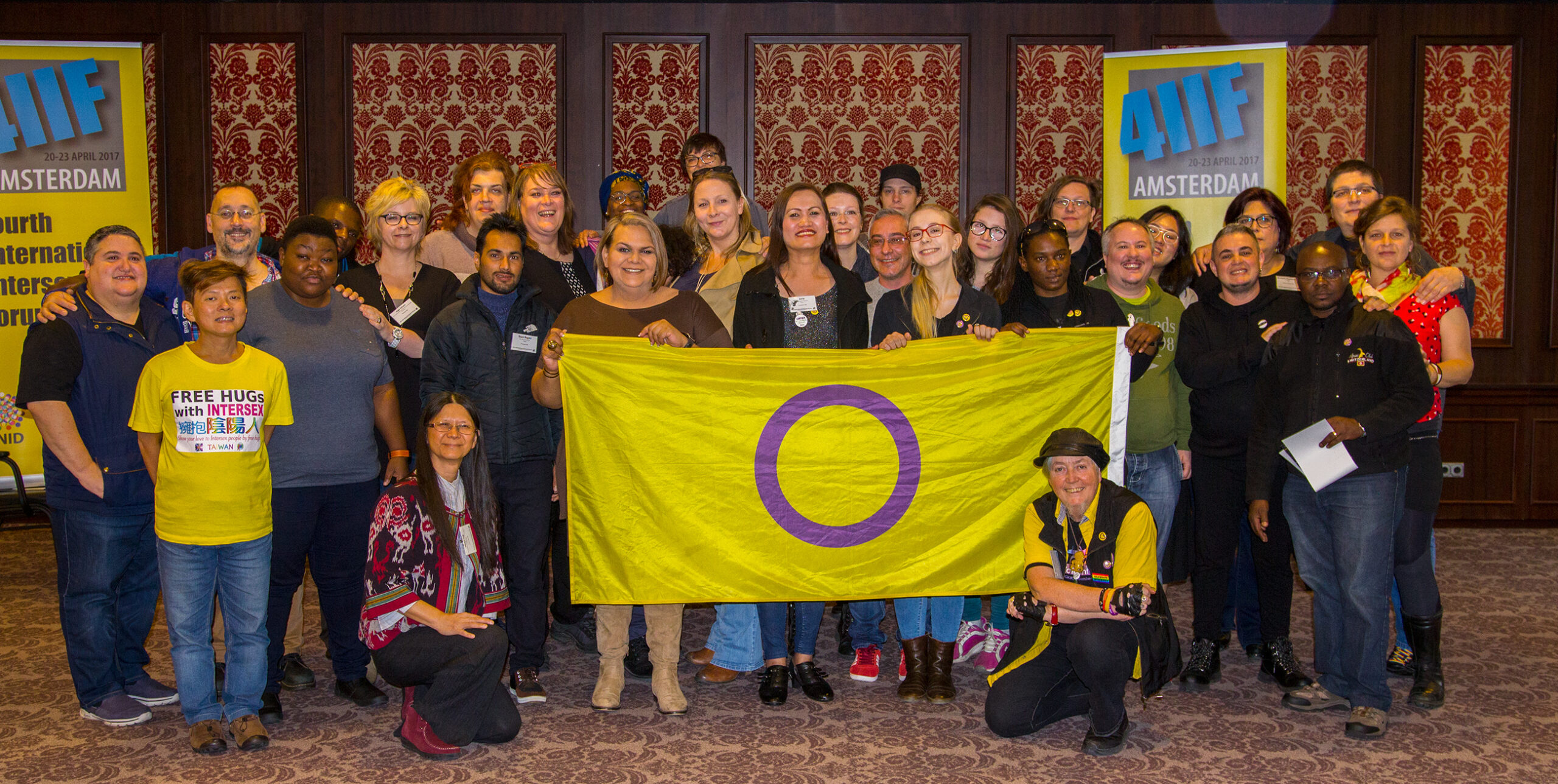
23 April 2017 — Fourth International Intersex Forum
The Fourth International Intersex Forum was held between the 20th and 23rd of April 2017 in Amsterdam in the Netherlands. It was the largest intersex human rights meeting up to that date, with 40 representatives across all regions, including Africa.
Intersex human rights issues such as infanticide, intersex genital mutilation and other harmful medical practices, lack of appropriate and consented health care as well as discrimination in access to education, other services and employment were discussed. Read more. The Third International Intersex Forum resulted in the Malta Declaration.
23 April 2017 — Fourth International Intersex Forum The Fourth International Intersex Forum was held between the 20th and 23rd of April 2017 in Amsterdam in the Netherlands. It was the largest intersex human rights meeting up to that date, with 40 representatives across all regions, including Africa. Intersex human rights issues such as infanticide, intersex […]
Juni 2017 — Kuzaliwa kwa African Intersex Movement (AIM), Kenya
In June 2017, a historic moment unfolded as 22 African intersex human rights defenders from 7 countries across the African continent convened in Kenya under the theme “Visibility… Voice… Freedom”, from the 24th to the 26th of June to establish the African Intersex Movement (AIM). The landmark initiative aimed at sharing information, skills and resources while advancing the rights and visibility of intersex individuals across Africa. The convention made a pivotal step forward by the African region collectively addressing unique challenges faced by the intersex community in the region and amplifying their voices on the global stage.
Hosted in a spirit of solidarity and association, the formation of AIM brought together IHRDs and allies from across Africa including Kenya, Malawi, Uganda, Zimbabwe and Zambia. The convention created a platform to allow individual connections with fellow intersex activists in ways that fostered movement wellness, built trust and affirmed a collective vision for the change desired for the African intersex community. Activists shared their experiences, discussed common struggles, identified specific regional needs and structured a united front in advocating for dignity, equality and recognition for intersex persons.
AIM’s logo
The main theme of the convention was the recognition of intersex rights as human rights. Participants reaffirmed the principles enshrined in both the International and regional human rights instruments, including the Universal Declaration of Human Rights, the Yogyakarta Principles and the African Charter on Human and Peoples’ Rights, which affirm the right of intersex individuals to self-determination, bodily autonomy and non-discrimination. They also spoke about countries like Malta, Australia and Portugal, which have taken steps to legally protect intersex persons, as well as examining why Africa as a region and the different state parties have little or very close to no interest in legislating to protect their own intersex communities from the severe violations and abuses as reported by the activists.
Throughout the proceedings, speakers underscored the urgent need to challenge harmful practices such as infanticides, discrimination, non-consensual surgeries and ‘normalising’ interventions now more commonly referred to as Intersex Genital Mutilation (IGM) imposed on intersex children. These practices, rooted in stigma and ignorance, have long perpetuated violence and trauma against intersex individuals, often resulting in lifelong physical and psychological harm. Some of the widely highlighted challenges directly involved in intersex activism included the absurdly low funding of intersex organising in Africa and how the African governments continue to ignore the intersex communities in their countries, despite clear knowledge about their existence and the severe violations and abuses of the human rights of intersex individuals. Participants concurred that one of the most effective approaches to addressing these issues could be through improving messaging and outreaches, while utilising the National Human Rights Institutions which operate autonomously from the government but possess the capacity to exert influence upon it; a strategy that proved to work for the Kenyan activists.
The convention also provided a platform for intersex activists to highlight the intersections of intersex identity with other forms of oppression, including child abuse, female genital mutilation, gender-based violence, discrimination and marginalisation. This intersectional approach is important to fully address all forms of oppression without dismantling a person’s identity into distinct dimensions that don’t affect one another. Discussions were therefore focused on the importance of building inclusive movements that centre the voices and experiences of intersex people, particularly those from marginalised communities whose oppression and discrimination is an inextricably blended experience. The diverse expressions will serve to challenge the prevailing narratives of shame and secrecy surrounding intersexuality and affirm the inherent dignity and worth of every individual.
The key outcomes of the convention were the election of a starring committee of the African Intersex Movement made up of four members, overseen by Julius Kaggwa and Hlompho Mokoena (formerly known as Nthabiseng) and a statement that was guided by the 2017 Statement from the first African intersex meeting in Johannesburg, South Africa. The genesis of the establishment of the AIM can be traced back to this meeting where ideas of the necessity were formalised by the participants.
The 2019 Statement, an outcome of the conference held in Naivasha, Kenya in 2019, is a public statement to extend demands aiming to end discrimination against intersex people while ensuring their right to bodily autonomy and self-determination. This statement announced the launch of the African Intersex Movement offering themselves as the African intersex reference of intelligence for stakeholders and allies who are interested in strengthening the ongoing liberation work for intersex people’s rights and autonomy. The statement demands a wide range of rights including legal recognition, access to healthcare, employment, education and sport, marriage, bodily autonomy, information, especially to medical records and surroundings, inclusion and, mainly, the right to life. It also calls upon community leaders, human rights organisations and resource partners to support the African intersex people.
Key to the convention’s success was the active participation and leadership of the pioneers of intersex activism in Africa whose first-hand experiences provided invaluable insights and drove the agenda for change. Their courage in sharing their activism stories of resilience, survival, and self-affirmation served as a powerful catalyst for collective action among attendees.
The formation of the African Intersex Movement was a critical milestone in the ongoing struggle intersex rights and recognition. The movement stands as a testament to the power of collective action. Recognising the need to promote unity, solidarity and cooperation among African nations was the first step towards wider visibility and long-term impact. The movement has grown to have an impressive coverage of all the African regions and as it continues to gain momentum and evolve. Its members remain steadfast in their commitment to challenging oppression, fostering solidarity, and creating a world where all intersex persons can live authentically and without fear. Soma zaidi about AIM.
The Movement amplifies intersex voices and affirms to the world that, in all African Countries: WE EXIST.
June 2017 — The Birth of the African Intersex Movement (AIM), Kenya In June 2017, a historic moment unfolded as 22 African intersex human rights defenders from 7 countries across the African continent convened in Kenya under the theme “Visibility… Voice… Freedom”, from the 24th to the 26th of June to establish the African Intersex […]
June 2017 — Founding of West Africa Trans Forum (WATF), Liberia
West Africa Trans Forum (WATF) was founded in June 2017. It is a network of trans people and/or groups from West Africa led by trans, intersex and non-conforming people whose work requires a strong movement both nationally and regionally because they face a great threat in issues of violations and discrimination. Their membership currently includes 18 member association organisations. WATF aims to combat violence, stigma and discrimination against trans people in West Africa through regional advocacy and awareness raising. Their aim is also to enhance the capacity of trans-led organisations in the region through capacity building initiatives.
combat violence, stigma and discrimination against trans people in West Africa through regional advocacy and awareness raising;
to ensure the provision of specific health and HIV treatment services through sensitisation of health providers and key state and non-state actors;
and, to enhance the capacity of individuals and organisations through capacity building initiatives.
Strategic Objectives
Support the creation of new trans organisations and strengthen the capacity of existing and new member organisations.
Strengthen the capacity of healthcare providers in the region to offer trans-specific health and HIV services.
Conduct local, regional and international advocacy with member organisations to improve understanding of the rights and needs of trans people in West Africa.
Create and maintain research and documentation of trans people in West Africa.
Values and Principles
Zero stigmatisation and discrimination.
Visibility of trans people.
Commitment to the support and respect of members’ rights.
Mutual respect for the diversity of our trans identities.
June 2017 — Founding of West Africa Trans Forum (WATF), Liberia West Africa Trans Forum (WATF) was founded in June 2017. It is a network of trans people and/or groups from West Africa led by trans, intersex and non-conforming people whose work requires a strong movement both nationally and regionally because they face a great threat in issues […]
On 26 July 2017, Key Watch Ghana was founded by Lawrence Shone Edem Adjei. Key Watch is registered as an NGO, but not as a trans/intersex/LGBTQIA+ organisation due to legal issues in Ghana about registering organisations that work with gender diversity and sexual orientation. The organisation is an intersex-led and focus organisation that has been actively involved in raising awareness and advocating for the rights of intersex individuals in Ghana.
Founded as a support group in 2015 and formally registered as an NGO in 2017, Key Watch Ghana was created to offer solidarity, protection, and peer support for intersex individuals facing stigma, violence, and erasure. Today, the organisation leads national efforts in advocacy, empowerment, visibility, and research. From an initial baseline of just six (6) intersex identifying members, Key Watch now serves 133 intersex persons directly through tailored support programs and outreach efforts. With operational presence across all 16 regions of Ghana, Key Watch engages in community mobilisation, public education, and policy dialogue at all levels.
On February 17, 2022, during a parliamentary hearing, Shone Adjei and Key Watch Ghana made a historic appeal to remove intersex persons from Ghana’s anti-LGBTQI+ bill, affirming that intersex variations are biological traits, not sexual identities. The organisation also condemned any clauses that would legalise forced surgeries on intersex infants or criminalise advocacy.
Shone Adjei is the Founder and Executive Director of Key Watch Ghana (also known as Intersex Ghana) and also serves as Chairperson of the Intersex Movement Ghana. With over a decade of experience advocating for the rights of marginalised communities, Shone has become a leading voice in the fight for equality and justice for intersex and gender-diverse persons. As a passionate human rights defender and expert in HIV prevention and treatment services, they have played a key role in designing and implementing life changing programmes for vulnerable populations in Ghana and beyond.
More about the organisation from their Executive Director, Lawrence Adjei:
“Through a multifaceted approach, the organization has made significant strides in promoting understanding and acceptance of intersex issues within various sectors of society.
At the grassroots level, Key Watch Ghana has engaged directly with intersex persons, providing them with support and empowering them to speak out about their experiences. Additionally, the organization has reached out to traditional leaders, recognizing their influential role in shaping attitudes and perceptions within their communities. By fostering dialogue and education at the grassroots level, Key Watch Ghana has worked towards creating a more inclusive and supportive environment for intersex individuals.
Recognizing the importance of involving key stakeholders in advocacy efforts, Key Watch Ghana has also collaborated with the National Queen Mothers Platform. By sensitizing and mobilizing this influential group of leaders, the organization has leveraged their collective voice to champion the rights of intersex persons across the country.
This strategic partnership has enabled Key Watch Ghana to extend its reach into traditional areas and rural communities, where awareness and education about intersex issues may be limited.
In addition to grassroots engagement, Key Watch Ghana has been proactive in influencing policy at the national level. The Executive Director spearheaded a petition to the Parliament of Ghana, urging lawmakers to reject the inclusion of intersex persons in the Anti-LGBTQI bill. As a result of these advocacy efforts, intersex individuals were successfully removed from the bill during the second reading, safeguarding their rights and dignity.
Furthermore, Key Watch Ghana has utilized community engagement and social media platforms to disseminate information and raise awareness about intersex issues among healthcare workers and the general public. By fostering dialogue, challenging stigma, and promoting understanding, the organization continues to make strides in advancing the rights and well-being of intersex individuals in Ghana.
Overall, Key Watch Ghana’s comprehensive approach to advocacy and awareness-raising has been instrumental in driving positive change and creating a more inclusive society for intersex persons in Ghana.”
Image from the organisation’s website
Maono
A society that is empowered to attain and protect the fundamental human rights of all irrespective of gender, sex characteristics or intersex variations, and beliefs.
Dhamira
To change attitudes and foster acceptance and respect for intersex persons as well as all humanity through empowerment, education, advocacy, data collection and dissemination.
Watch our interview with team members from Key Watch Ghana
We interviewed Shone Adjei and Salamatu Yakubu on the 25th of July. Watch it here:
Salamatu Yakubu serves as Management Lead of Key Watch Ghana and is an Executive Council Member of the Intersex Movement Ghana. With more than five years of advocacy experience, Salamatu has helped shape the organisation’s national strategy and built strong networks across traditional leadership, government institutions, and civil society. Her work continues to inspire action and inclusivity in the ongoing struggle for intersex recognition and protection.
26 July 2017 — Key Watch Ghana Founded, Ghana On 26 July 2017, Key Watch Ghana was founded by Lawrence Shone Edem Adjei. Key Watch is registered as an NGO, but not as a trans/intersex/LGBTQIA+ organisation due to legal issues in Ghana about registering organisations that work with gender diversity and sexual orientation. The organisation […]
27 July 2017 — Art Exhibition Shows Life in the Home of Young Trans Woman in Freetown, Sierra Leone
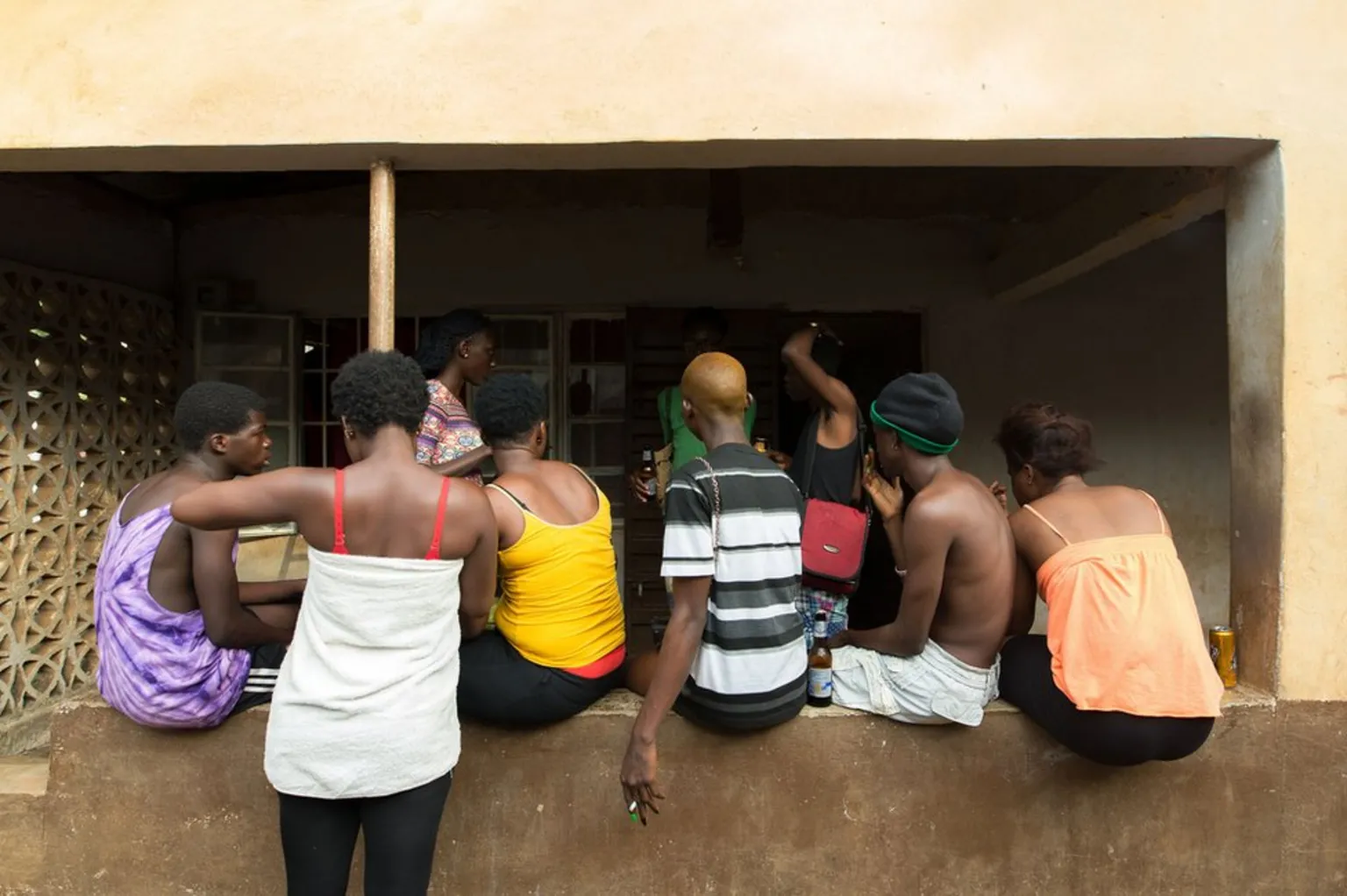
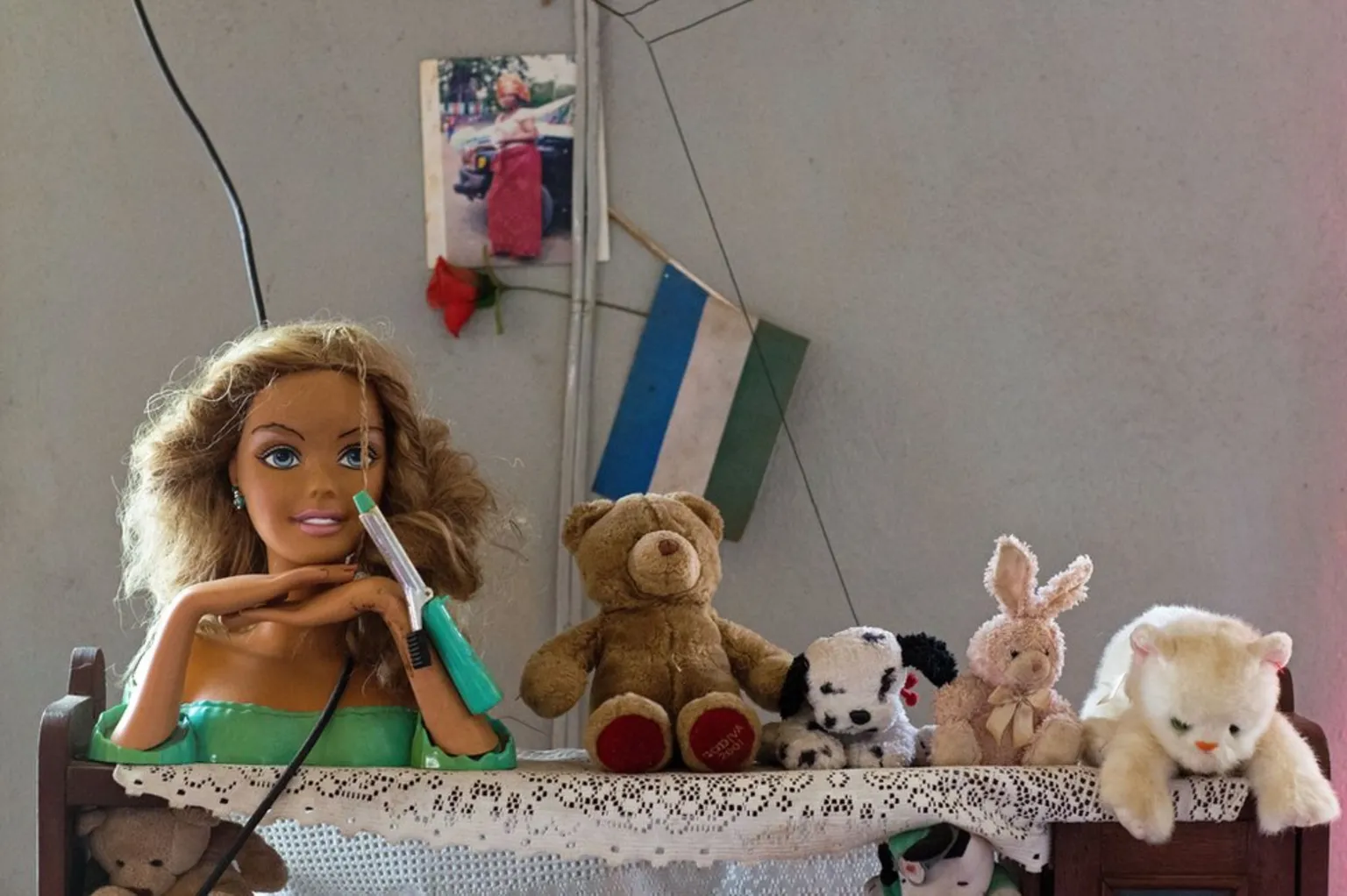
On 27 July 2017, “The House of Kings and Queens” exhibition opened at the Humber Street Gallery in Hull, United Kingdom. The exhibition was made up of photographs by Lee Price, focusing on members of the LGBTQIA+ community living in the home of a young trans woman in Freetown, Sierra Leone. The exhibition marked 50 years since homosexuality was decriminalised in England and Wales. The exhibition documents the lives of the queer community living in the house in a country where homosexuality is criminalised, and where gay and trans people bear the brunt of societal, police and legal inequality, discrimination and violence.
Note that in many countries where English is not a first language, or where Western terminology is not embraced, people use the word ‘gay’ to include trans people.
A visitor to the house, who wishes to remain anonymous for fear of persecution, said: “Life is tough for gay people in Sierra Leone and especially those who are transgender. We face a lot of problems here. Transgender people can be flogged in the streets and we don’t feel safe going out after dark in case we are attacked. When Ebola came to Sierra Leone, it was blamed on gay people. We suffer so much humiliation every day, but I am proud to be gay. The LGBT community faces harassment, ridicule, eviction and violence from people who believe homosexuality goes against their religious or cultural beliefs”.
Photographer, Lee Price said:
“The work, whilst a reminder of the progress still to be made with regards to international gay rights, is also a celebration of the inspiring defiance of oppression and segregation amongst the gay community of Sierra Leone.”
It is still illegal to engage in homosexual acts in 77 countries, including in Hull’s sister city Freetown, Sierra Leone where a maximum sentence of life imprisonment can be imposed.
While the law is rarely enforced, people of the LGBT+ community face persecution of a different kind. Harassment, ridicule, eviction and violence at the hands of people who say homosexuality goes against their religious or cultural beliefs. Therefore, the vast majority of LGBT+ people choose to keep their sexuality a guarded secret from the people around them.
However, within the heart of Freetown, lives a young transgender woman who offers a warm welcome to members of the LGBT+ community in need. Her home is a sanctuary where they do not have to hide who they are and can live without oppression whilst surrounded by those who understand and accept them. They call it ‘The House of Kings and Queens’.
Lee Price was commissioned by Hull 2017 to create this unique collection of photographs, which acts as a window into the lives of the house ‘s inhabitants and explores what it means to be gay in Freetown.
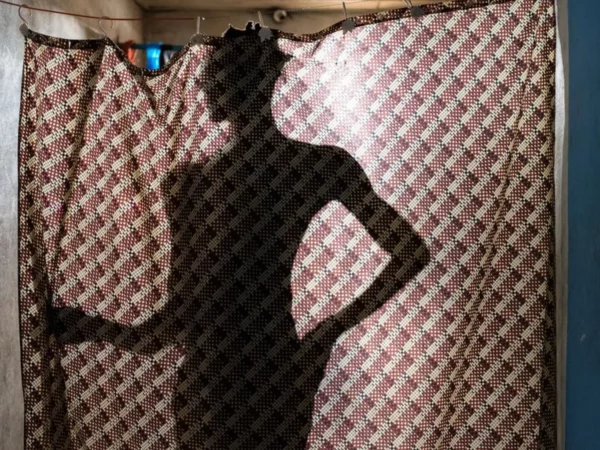
The photographs convey both the cloud of secrecy that the subjects of the images live under and the sense of liberation that they feel at being able to express themselves freely, even in such a restricted environment.
Lee said: “I was delighted to be asked to document such a poignant subject matter and to mark this important anniversary year of decriminalisation.
27 July 2017 — Art Exhibition Shows Life in the Home of Young Trans Woman in Freetown, Sierra Leone On 27 July 2017, “The House of Kings and Queens” exhibition opened at the Humber Street Gallery in Hull, United Kingdom. The exhibition was made up of photographs by Lee Price, focusing on members of the […]
2017 — The Proposal of The Intersex Model Law, South Africa
The Intersex Model Law, proposed in 2017, was a draft law that the Centre for Human Rights at the University of Pretoria put together with the aim of protecting the rights and well-being of intersex individuals. The law was developed in response to historical injustices faced by intersex individuals, therefore crucial for addressing issues such as non-consensual medical interventions, legal recognition, and anti-discrimination protections which are central for the dignity and autonomy of intersex people.
Efforts towards tabling the Model Law began with the first consultative meeting held by the Centre for Human Rights in South Africa to validate the draft Model Law on intersex persons. The meeting was attended by intersex rights activists from South Africa representing organisations including Iranti, AIDS Rights Alliance of Southern Africa (ARASA), Open Society Initiative for Southern Africa (OSISA), Transgender & Intersex Africa (TIA)and OUT Well-Being, as well as Justice John Chigiti from Kenya. According to a statement released by the Centre for Human Rights on 26 April 2017,
“there was a wide consensus during the consultative meeting on the need for states to enact laws and policies, review existing policies and repeal any laws to ensure that the rights of intersex persons are protected.”
The Centre for Human Rights planned to eventually table the Intersex Model Law at the African Commission on Human and Peoples’ Rights (ACHPR), specifically aiming for the Law to be used as a tool for advocating for law reform and stronger legal recognition and protection of fundamental rights and freedoms of intersex persons across Africa. Some of the legislative provisions in the Model Law included prohibition of all medical unnecessary surgeries and procedures on intersex children, prohibition discrimination of intersex person in all spheres of life, investigating and monitoring human rights violations against intersex persons through National Human Rights Institutions, ensuring that victims of such human rights violations have access to justice and some form of reparations, and providing easy administrative processes to make it easy for intersex persons to amend name and sex on a birth certificate or any other legal document.
SIPD Uganda held a panel discussion at the Changing Faces Changing Spaces conference in Kenya 2017, deliberating on the benefits of the draft Intersex Model Law, and panelists articulately expounded on why the law would be important. One of the panelists declared that,
“Intersex children and people cannot afford to continue to be mistreated and thrown to extreme margins of society and this is why the model law would be instrumental in pushing our advocacy for shifts in language from pathological to rights based terms and subsequent shifts in lived realities through an Africa-wide resolution in the short term and National legal in the long run. Whether via tools such as the law or policy the ultimate goal is to change societal attitudes and create a safe and just environment for intersex children and people in every sphere of life. So we are very keen on short term gains like improved living realities as much as long term gains such as national and continental legal reforms.”
Changing Faces, Changing Spaces logo
The second consultative meeting was held in Niamey, Niger at the NGO Forum preceding the 60th Ordinary Session of the ACHPR. During this session, the commissioners advised that the activists consider tabling a resolution to the Commission instead of proposing it as a law. The difference between a Model Law and a Resolution is not something you can refer to as insignificant, as they serve distinct purposes and have different impacts. A Model Law provides a detailed legal framework intended to guide or influence national legislation, making them more practical tools for legislative change while Resolutions, on the other hand, are formal expressions of opinion, recommendations, or policy positions. In this case, a Resolution was recommended because it would be more flexible, address a wide range of issues and easier to gain consensus on. Also, a Resolution could be passed more quickly than a Model Law, a difference which was crucial, especially at a time when the anti-gender movements were on the rise. The Resolution could also be a way to shape the discourse or put an issue on the agenda for further action including the possible future development of a model law or other binding agreements.
Countries might agree on broad principles expressed in a Resolution, making it influential and welcomed more openly than a Model Law in most African countries and yet still raise important visibility and help these countries set their own agendas for human rights protections for their native intersex people.
The ACHPR had previously adopted Resolution 275 in 2014, a resolution on the protection against violence and other human rights violations against persons on the basis of their real or imputed sexual orientation or gender identity, a great win for the LGBTIQ community. However, the resolution did not specifically mention intersex persons or sex characteristics, which is why it was very important to lobby for a resolution that would specifically speak to the intersex rights in Africa. All of this combined, prompted advocacy work which later facilitated the adoption of the Resolution on the promotion and protection of the rights of intersex persons in Africa – ACHPR/Res.552 (LXXIV) 2023.
The journey towards securing the rights of intersex individuals is far from over, but collaborative efforts between activists, legal experts and organisations across Africa represent a powerful force for change. It is crucial that the momentum for intersex rights be maintained. Advocates and allies must continue to push for both short-term victories and long-term reforms, ensuring that the rights of intersex persons are not only recognised but actively protected. The path forward will require persistence, solidarity and innovative strategies, but the goal remains clear: a future where intersex persons can live with dignity, free from discrimination and harm.
Article researched and written by our content contributor, Delphine Barigye
2017 — The Proposal of The Intersex Model Law, South Africa The Intersex Model Law, proposed in 2017, was a draft law that the Centre for Human Rights at the University of Pretoria put together with the aim of protecting the rights and well-being of intersex individuals. The law was developed in response to historical […]
12 September 2017 — Unity Association Togo Founded, Togo
Founded on 12 September 2017, UNITY Association Togo helps young trans people in Togo by advocating for their psychological and social well-being through cultural events, recreational and educational outings, educational talks, focus groups and assistance with socio-professional integration. UNITY also works towards fighting stigmatisation discrimination and all forms of gender-based violence. The association is based in Lomé and has branches in Aného and Kara. UNITY was registered in 2019.
Country Context
“The LGBT movement in Togo has undergone many changes since its creation. Despite this structuring of the LGBT movement and the changes made to improve the living conditions of LGBT people in Togo, Trans* people and their specific needs are not taken into account by existing classic LGBT associations. The majority of actions are either MSM-centered or do not take into account the specific needs related to Trans* people in terms of health and human rights. This is due on the one hand to a lack of knowledge of trans identity and on the other hand to a low visibility of Trans* people in the evolution of the LGBT movement.”
Maono
A trans-led organisation with the capacity and resources to address the health, human rights and social development needs of trans people.
Dhamira
To promote unity, visibility and the development of trans people and to address specific issues related to our sexual and gender identity.
Goals
Bringing together under its umbrella all trans people in Togo
Helping with the physical, psychological, social and economic development of trans people
Promoting the rights of trans people
Developing a spirit of mutual aid and solidarity between trans people in Togo and people living in the same conditions of marginalisation in Africa and around the world
Promoting trans leadership
Contributing to the visibility of trans people
Implementing inclusive programmes for trans people
Formulating approaches to solutions to the socio-legal and professional problems of trans people
Fighting for medical and psychological support for trans people on hormone therapy
Contributing to access to prevention, care, hormonal treatments and HIV and STIs for trans people
12 September 2017 — Unity Association Togo Founded, Togo Founded on 12 September 2017, UNITY Association Togo helps young trans people in Togo by advocating for their psychological and social well-being through cultural events, recreational and educational outings, educational talks, focus groups and assistance with socio-professional integration. UNITY also works towards fighting stigmatisation discrimination and […]
25 September 2017 — Founding of Droit A la Différence (DADI), Côte d’Ivoire / Ivory Coast
Founded on 25 September 2017, Droit A la Différence (DADI) is an NGO fighting against STIs/HIV/AIDS, tuberculosis, other pandemics and promoting human rights for trans people in Côte d’Ivoire.
Maono
From their website:
“We believe in a Côte d’Ivoire where in every family, in every business, every institution, every community, every school, on every piece of the national territory transgender people are no longer victims of rejection, stigmatization, discrimination in all its forms and are treated as full members with respect for their Human Rights for strong participation in the development of Côte d’Ivoire.”
Dhamira
Combating the proliferation of HIV/AIDS, STIs, tuberculosis and other pandemics among trans people.
Promoting material and moral mutual aid for trans people living with HIV/AIDS and tuberculosis.
Strengthening the capacities of professionals from key sectors supporting trans people living with HIV/AIDS.
Promoting positive living among trans people and uphold their dignity.
Collaborating with national and international institutions to improve the living conditions of trans people living with HIV/AIDS.
25 September 2017 — Founding of Droit A la Différence (DADI), Côte d’Ivoire / Ivory Coast Founded on 25 September 2017, Droit A la Différence (DADI) is an NGO fighting against STIs/HIV/AIDS, tuberculosis, other pandemics and promoting human rights for trans people in Côte d’Ivoire. Vision From their website: “We believe in a Côte d’Ivoire […]
July 20162016August 20161 September 201620172017201720172017March 20178 March 201717 March 201723 April 2017June 2017June 201726 July 201727 July 2017201712 September 201725 September 2017
You can include information about your African Organisation/Group
There are many African organisations and individuals who over the years have contributed in invaluable ways to the story of the trans, gender diverse and intersex movements who are not yet included on our Timeline.
Tunataka kutambua na kujumuisha michango yote inayoweza kuthibitishwa.
The Timeline is about your stories and voices. You can find out more about how to contribute by visiting our Contact Us page here.