An archive of histories/herstories/theirstories affecting and influencing the trans, gender diverse and intersex movements in Africa
This Timeline of our archive of histories/herstories/theirstories of the trans, gender diverse and intersex movements in Africa and in the Diaspora emerged through the grassroots experiences and memories of the contributing African activists and organisations.
It is often updated with new stories and the Timeline is continually growing.
How to navigate the Timeline
Categories are displayed alphabetically at the top of the Timeline and can be used to filter the results to focus on the research theme chosen. For example, ‘All’ will show you all topics, while ‘Intersex’ will display all entries related to intersex movements and moments.
Alternatively, use the search bar in the menu at the top and bottom of screen to find more specific information.
Categories relating to gender, sex characteristics and sexual orientation have flag icons and colour groups to visually distinguish them from one another:
All
Activists
All
Art
Asylum Seekers/Migrants/Refugees
Audio and Video
Awards
Ballroom
Community
Conferences
Cross-Dressing
Depathologisation
Diaspora
Drag
Films
Gender Diverse
Gender Non-Conforming
Gender-Affirming Healthcare
Gender-Based Violence
Healthcare
HIV/AIDS
Homeless people
In Memoriam
Intersex
Interviews
LBQ
LBTI
LBTQ
Legislation
LGBTQIA+
Media
Non-Binary
Organisations
People living with HIV
Persons with Disabilities
Publications
Sex Work
Sport
SRHR
Support Groups
TIHA Articles
Trans
Trans & Intersex
Transfeminine
Transfeminist
Transmasculine
Transsexual
Transvestite
Youth
2016 — Founding of The Fruit Basket (TFB), South Africa
2016 — Founding of The Fruit Basket (TFB), South Africa
The Fruit Basket (TFB), founded in 2016, is a trans- and migrant-led organisation based in Johannesburg South Africa. The organisation was founded by Thomars Shamuyarira, a trans migrant from Zimbabwe. TFB is a a Non-Profit Organisation that works to advance the welfare and rights of LGBTQI+ migrants, refugees, and asylum seekers who come to South Africa seeking protection. TFB hopes to have representatives in all countries that host LGBTQI+ migrants, refugees, and asylum seekers.
Context
From their website:
“The rights of LGBTQI+ persons on the African continent are severely constrained, leading many to leave their countries of birth and seek sanctuary elsewhere. South Africa is one of the few countries globally that grants refugee status on the basis of sexual orientation and gender identity, the system, however, does not work as it’s supposed to and many LGBTQI+ migrants, refugees, and asylum seekers find themselves undocumented. Without proper documentation, they cannot find employment or gain access to services and programs. The Fruit Basket helps restore the dignity of this marginalized community through assistance with the documentation process and information, skills development training, relief work, and, also working as a referral system, connecting the community with different service providers. We fight and will continue to fight for our region to be inclusive, where everyone regardless of nationality, immigration status, sexual orientation, gender identity, or beliefs has access to quality healthcare, meaningful education, and employment in their host country.”
Vision
To advocate and create a society and environment that allows for access to all services that are available to LGBTIQ+ migrants, asylum seekers, and refugees to be able to live up to their full potential and well-being.
Mission
To promote equality and opportunities in a safe and secure environment for LGBTIQ+ migrants, asylum seekers, and refugees.
To respect the gender, cultural and religious differences of all LGBTIQ+ migrants, asylum seekers, and refugees.
Tobe focused on the needs of all LGBTIQ+ migrants, asylum seekers, and refugees.
To keep absolute confidentiality on all matters relating to all LGBTIQ+ migrants, asylum seekers, and refugees.
First LGBTQI Safe House in South Africa
In September 2023, The Fruit Basket marked a historic milestone by opening the first LGBTQI+ Refugee Safe House in South Africa. This initiative came in direct response to the alarming passage of the Kill The Gays Bill in Uganda (Anti-Homosexuality Act, 2023), a law that has led to rampant persecution and violence against LGBTQI+ individuals. As news of the law spread, an influx of trans and queer persons from Uganda sought refuge in South Africa, looking for safety and security away from the oppressive environment of their home country.
Recognising the urgent need for support and safety, TFB took swift action to establish a safe haven for those fleeing persecution. The initial opening of the safe house provided accommodation for 10 trans and queer refugees, offering them not just shelter but a supportive community where they could begin to heal from the traumas they had endured. This was a groundbreaking moment, as no other organization in South Africa had undertaken such a significant step to directly address the needs of LGBTQI+ refugees.
Due to the overwhelming demand and the continued influx of individuals seeking refuge, TFB soon expanded the safe house to accommodate 16 persons. This safe space is not only a physical refuge; it represents a beacon of hope and a commitment to human rights for some of the most vulnerable members of the LGBTQI+ community.
At the safe house, residents have access to essential resources, including counseling, legal aid, and workshops aimed at empowerment and resilience-building. The sense of community fostered within the walls of the safe house has provided solace and support to those who have faced unimaginable hardships.
The establishment of the safe house is a testament to TFB’s dedication to championing the rights and dignity of LGBTQI+ refugees. It highlights the organisation’s pioneering spirit in addressing critical issues faced by marginalised communities and its unwavering commitment to advocacy and support. As TFB continues to grow and respond to the needs of LGBTQI+ refugees, the safe house stands as a symbol of resilience, hope, and the power of community in the face of adversity.
2016 — Founding of The Fruit Basket (TFB), South Africa The Fruit Basket (TFB), founded in 2016, is a trans- and migrant-led organisation based in Johannesburg South Africa. The organisation was founded by Thomars Shamuyarira, a trans migrant from Zimbabwe. TFB is a a Non-Profit Organisation that works to advance the welfare and rights of […]
In 2016, Sammie MacJessie founded the Ivy Foundation to create awareness especially for intersex persons to create a better environment which caters for their needs and is more understanding of their differences. The Foundation operates through the three major Cities in Malawi: Blantyre, Lilongwe and Mzuzu. The Foundation also advocates for the rights of young and old intersex individuals.
Vision
The Foundation strives to enhance sustainable development to improve social basic needs of and the inclusion of LBIQ persons in all spaces like education and health care. They seek to advance gender equality and the empowerment of all by promoting sexual and reproductive health as well as human rights.
Our Intersex Content Contributor Delphine Barigye had an informal chat with Sammie in April 2024, reflecting on the founding of the Ivy Foundation in Malawi, the events that led to the formation of the Foundation, and Sammie’s experiences growing up as an Intersex person in Malawi. As the Trans & Intersex History Africa Digital Archive sat down with them to unravel the threads of inspiration that led to the creation of the transformative organisation, their words painted a vivid picture of determination, resilience and unwavering passion.
Sammie is an intersex person born in Malawi to a Malawian mother and a South African father. They grew up mostly in Malawi but had a fair share of their life in South Africa. They are the Executive Director of Ivy Foundation and have been a human rights activist for over ten years. Apart from founding The Ivy Foundation, Sammie was co-chair of the Southern African Intersex Forum, a member of JASS (Just Associates: Global feminist movement-support organisation in the Global South), and current board member of the Iranti.org board, among many other involvements.
Sammie MacJessie, founder of the Ivy Foundation
What motivated you to start the Ivy Foundation?
“What motivated me to start was the lack of inclusivity for intersex persons, the lack of conversations, and the lack of acceptance! For so long, people have always just pretended that we don’t exist. When I asked questions, no one could give me the answers and they made it look like I was crazy. I started this organisation so that intersex people can get answers to questions they have about their differences in sex development especially in a world where we are still considered a taboo.”
Can you share a personal story or experience that sparked the idea for your organisation?
“Growing up, I was pretty much like everybody else until I was 12 and joined a boarding high school. This was a place where we had to bathe in a community bathroom and that is when I noticed the difference between me and the other girls there. At 14, I noticed how everybody else had got their menstrual period besides me. But this didn’t throw me off because this (the period) is not something I was looking forward to anyway. But at 19/20 I realised how late it was. Sex conversations with friends also highlighted how different I was. I had no idea what they were talking about, especially the sexual experiences because I had never felt any sexual sensation. One of my friends pointed out how different my coochie [genitals] was as well. So I decided to look for answers again. The doctors’ immediate guess was always hormonal imbalance and they prescribed hormonal therapy for 2 solid years until a doctor in South Africa NOT Malawi, after a pap smear confirmed that I had gone through a surgical procedure as a child and this consequently affected my sexual feeling. On questioning my mum about it, she reaffirmed. According to her, I was born with an abnormally large clitoris that they had to cut off. A certified doctor who didn’t understand the implications of what they were doing or what they were cutting off had done this. And now I am a grown-up who has never felt any sexual sensation at all. This experience of not being able to get answers in a country that did this mutilation pissed me off and I surely had to do something to protect others from the same experience.”
Were there any specific events or issues in your community that drove you to take action?
“Yes, there is a specific event in 2016 where an intersex individual in a high school from the rural area of Malawi in Kliwawa was brutally raped by the guards and the head prefect using objects. On reporting to the police, they made fun by asking the victim to show them what was in between their legs because the perpetrators had reported that the individual had two private parts.
The police continued to mock me by asking if it was true! The story went viral but no Human Rights activists cared enough to take action. I then reached out to the individual who seemed broken and did not want to open up. A week or later the individual finally jumped into Shire, a crocodile-infested river because she was a laughingstock in the village. This event truly broke my heart. Seeing a young person at the age of 15 go through so much and only end up losing their life at such a tender age because society didn’t care enough.”
Did you encounter any challenges or obstacles when starting your organisation, and how did you overcome them?
“First of all, we were not allowed to register because the government was sceptical about registering an intersex organisation. They argued that there was no data or statistics and hence hardly believed that there was a substantial number of intersex people in Malawi but also asserted that the Intersex people were part of the LGBTIQ community. I pointed out that if you think that intersex people are part of the LGBTIQ community then it’s true we exist and this is something you cannot take away only because for the longest time we have only been visible under this umbrella. But it is also very true that not all intersex people identify as LGBTQ. It was a long process of back and forth but I finally got help from UNDP and UNAIDs and finally got registered.”
What long-term goals do you hope to achieve through the Ivy Foundation?
“We are hoping that in the next at least 5 years (considering the pace of the Malawian government) we will have legislation protecting intersex people from the human rights violations and abuses they go through. We hope that the law can hold the perpetrators accountable for their actions because according to our research last year, nobody has been prosecuted for violating or abusing the rights of intersex persons in Malawi. We have already drafted the model law and policy to assist us in this journey.
We are also hoping to see more intersex people in Malawi take up leadership roles like Tabitha and her sister in the sports fraternity. The goal is to normalise being intersex and create a more inclusive society.”
Safety and Security Training
Mental health awareness workshop
Have you seen any unexpected outcomes or benefits from Ivy Foundation’s initiatives?
“We have seen an increase in the number of intersex people who are willing to speak up about the violations they go through and also the number of allies that have come up to support our cause. It is heartwarming.”
What advice would you give to others who are considering starting their own grassroots NGOs?
“You will have more downs than ups. Motivated young founders usually expect everything to be rosy by getting so many funding opportunities and immediate acceptance from people in the first year which is not usually the case. The first few years, it will just be you making noise without anyone listening. However, over the years, more people have been willing to work with you creating more noise, I mean, I may be fat but there are plenty. Patience and resilience will eventually get you there.”
How do you stay motivated and passionate about Ivy Foundation’s mission?
“Am not going to lie, it is hard to stay motivated. We are one of the least funded organisations in Malawi and this is the trend with most intersex organizations across Africa. It is exhausting to stay motivated but when you look at how far we’ve come we can surely make one more step ahead every day.”
Interview with Sammie by our Intersex Content Contributor, Delphine Barigye
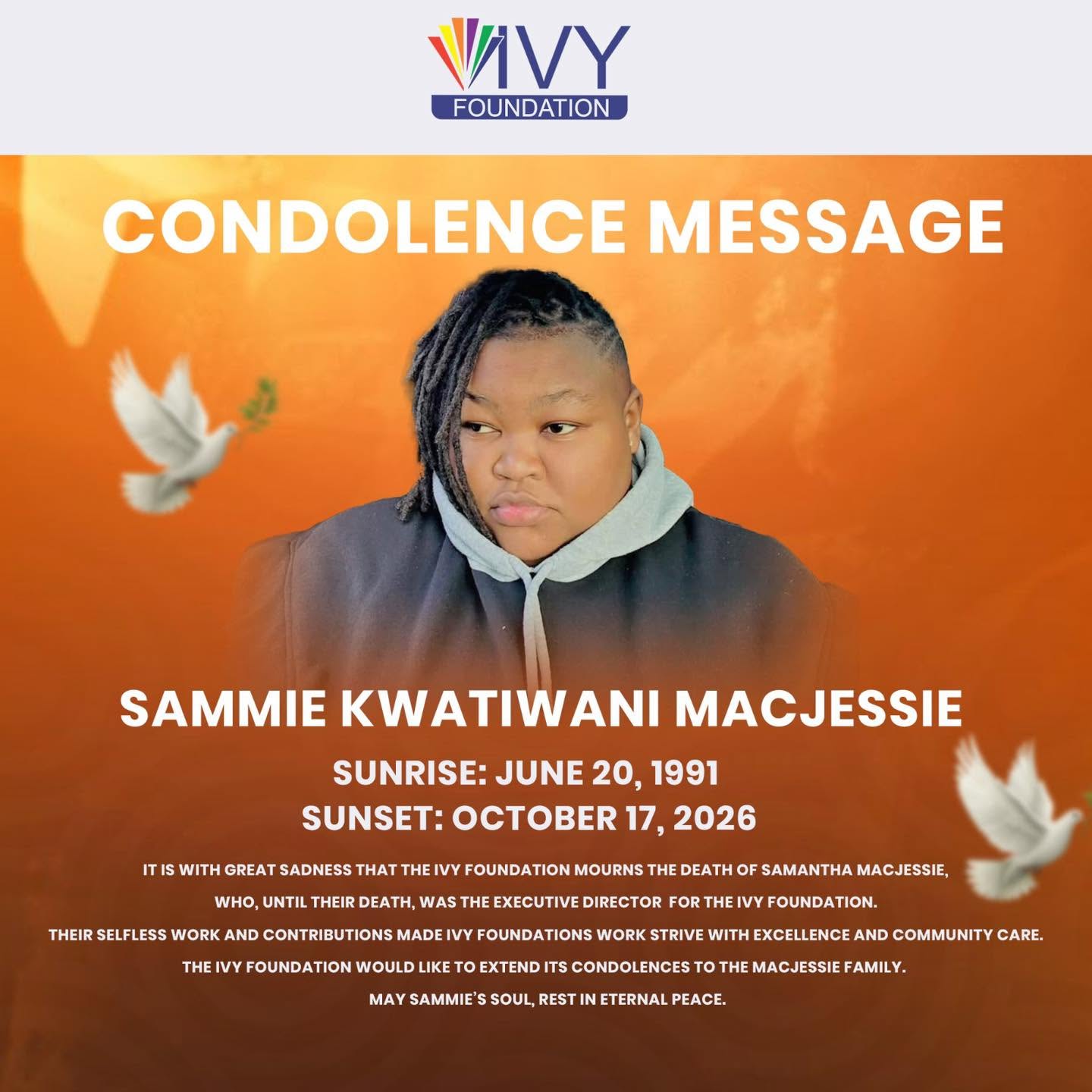
In memoriam: Sammie Kwatiwami MacJessie (20 June 1991 — 17 October 2026)
Tragically, Sammie Kwatiwami MacJessie died after a battle with cancer late Saturday night, 17th of October 2026, at the age of 35.
The outpouring of love after Sammie’s death has been tremendous. We share just a few of them here:
Messages from the Trans & Intersex History Africa (TIHA) Digital Archive team:
“Comrade Sammie, your voice, passion, activism, and invaluable contributions to African intersex movement will forever remain part of our collective history. Rest in power, Sammie. Your legacy lives on. With love and solidarity.” — Victor Mukasa (TIHA Co-Founder | Co-Founder of Sexual Minorities Uganda (SMUG)
”Sammie – you left a void and your legacy will live forward. Patient in awareness raising and training sessions, you led the way for intersex individuals, their parents, teachers and cross movement organisations. We are saddened and will miss you! Rest in Power Sammie MacJessie.” — Liesl Theron (TIHA Co-Founder)
“Sammie, I don’t have the words to make sense of this yet. You brought so much joy to everyone who knew you, and you will be deeply missed. Rest in peace.” — SR (TIHA Audio & Video Manager)
“Rest in peace, my dear friend. It is hard to believe that I have to say goodbye to you. Life can be so unfair, taking away the dearest people. Thank you for the memories, the laughter, and the moments we shared. Your presence in this world made a difference, and your absence leaves a pain that words cannot fully express.” — Delphine Barigye (TIHA Intersex Content Contributor | Programme Director at Support Initiative for People with Atypical Sex Development (SIPD) Uganda).
As a digital archive of African trans, intersex and gender diverse moments and movements, we at TIHA are so honoured and grateful that we have this conversation recorded as part of the history of the African intersex movements. In this clip from the interview, Sammie speaks about their journey through educating themself about intersex conditions, to educating others and raising awareness. Sammie also speaks about the evolution of the Ivy Foundation, as well as the situation for intersex children and youth, specifically those in rural areas, as well as about the legal landscape for intersex people in Malawi. The clip ends with them leaving an inspirational message for intersex people and the parents of intersex children.
Messages from the community:
“I met Sammie online in 2016, and we finally met in person in 2017. We connected instantly because of our childlike spirits, our shared ability to laugh, joke, and never take life too seriously. Over the past 10 years, we built a beautiful relationship and became family. Not just friends, but siblings in every sense of the word. Sammie had been ill for a while, but somehow, you could never see it in their face. They always had a joke to crack, a word of encouragement to offer, or a way of motivating me whenever I felt like giving up. Even while fighting their own battles, they continued to show up for others. That was Sammie. Sammie was a courageous intersex person, a fighter whose commitment to justice never wavered. Despite the many challenges they faced in Malawi, they continued to advocate for intersex rights and built an incredible team at the IVY Foundation. Their courage, leadership, and dedication to our community will never be forgotten. Sammie was my Co-Chair at the Southern African Intersex Forum, and leading alongside them was a dream. We shared feminist principles, a vision for our community, and a clear understanding of why we did this work. We knew what we were fighting for, and we knew that our people deserved better. I will forever cherish the work we did together, the conversations we shared, the laughter, and the dreams we held for our community. Right now, I am broken. I need a moment to breathe, a moment to gather myself, and a moment to begin facing the reality that you are no longer here. I honestly do not know how to make sense of a world in which I cannot call you, laugh with you, or hear one of your jokes again. But I know this: your spirit will live on forever. Your work will continue through the people you inspired, the community you helped build, and every intersex person whose life is touched by the path you helped pave. We will continue speaking about your incredible work, honouring your legacy, and fighting for the future we dreamed of together. Rest well, my sibling. Thank you for being my friend, my colleague, my co-conspirator, and my family. Thank you for showing up for me even when you were fighting battles of your own. I love you, Sammie. I hope you knew just how deeply you were loved. The world feels a little less bright without you in it. Until we meet again, my sibling. Your fight was never in vain. ” — Crystal Hendricks (Southern African Intersex Forum)
Crystal Hendricks and Sammie
“Lala ngokuthula nkokheli Sammie Macjessie. Feminists, queers, trans and lesbians across Malawi and the African continent are mourning the sad and untimely passing of yet another comrade, Sammie Macjessie. Comrade Sammie transitioned in early hours of Sunday, the 18th of October, following a struggle with cancer. At only 35 years of age, Sammie was a leading voice for rights, justice and freedom of all people, especially LGBTIQs in Malawi and across Africa. Sammie founded the Ivy Foundation to “create awareness especially for intersex persons to create a better environment which caters for their needs and is more understanding of their differences”. Living openly as an intersex person, Sammie’s activism always sought to build a society and world where belonging, regardless of sex, sexuality, genders is the cornerstone of human relations. Sammie challenged the contradictions of the notion of a friendly country – Malawi – and the hostility, discrimination and exclusions that LGBTIQ people experienced on the day-to-day. My earlier encounters with Sammie were through my work with our JASS Malawi team, Sibo and Miriam, especially through the work of the Our Bodies, Our Lives Movement (OBOL). As a feminist, Sammie engaged the OBOL feminists on cross movement work and solidarity across movement strategies. In both the 2023 JASS feminist movement building on the eve of the passing of the anti-homosexual act of Uganda, as well as the 2024 cross movement school, Sammie underlines the role of thinking across movement for developing joint strategies.
Sammie’s experiences growing up as an Intersex person in Malawi informs her convictions. At JASS, Sammie was not only an important ally and fellow plotter, but a facilitator, bridge builder and trusted friend. As the director of the IVY Foundation, Sammie enabled deep institutional partnerships fundamental for the struggles against the anti-rights expression across the African continent. To me, Sammie is a friend and comrade I love and appreciate very much, someone I could call when having an idea, a question and to check in. Ever concerned about activists relations, tensions sweeping among us whilst the ‘enemies’ are consolidating against us, Sammie felt deeply about the need to position within movement work strategies that are geared towards the inside. Sammie’s humour and ironic ways of talking will be memorable. Sharp and articulate, respectful of class difference and holding that as key for research and action, are some of the contributions I will miss. Knowing that Sammie was always there, for Malawian struggles, for African meaning, for intersex, trans and queers was a comfort; the kind that when you think ‘locally and act globally’ gives depth; the kind that is dependable. My love and comfort to Sammie’s village: immediate and extended family, comrades across Malawi and Africa, IVY foundation colleagues and comrades, collaborators and friends. This is a huge loss, a collective loss. Sammie will be carried to her final resting place on Tuesday. From afar, I join everyone in Lilongwe and Salina with a deep pain and sadness. With the convictions we always screamed: WE WILL WIN! Transition peacefully dear comrade, leader and friend Sammie McJessie and Rise in Power. Yours is done, we will continue holding the memories and lessons you taught us.” — Phumi Mtetwa (JASS — Just Associates: Global feminist movement-support organisation in the Global South)
Phumi Mtetwa and Sammie
“I met Sammie Macjessie in 2015, we held the first LBQ, trans and intersex workshop in Malawi. And from this workshop Sammie founded the Ivy Foundation, a feminist intersex led organization. Sammie’s passing, is a huge loss to her family, community and the region. Sammie was the calm weaver of relationships, networks, with deep and uncompromising values that has kept us all inspired, to keep working despite the multitude of tides that have hit our movements and impacted on us all so personally. My last meet up with Sammie was 2 weeks ago at the hospital in Nairobi. They remained true to form, determined to get well, filled with laughter and always making sure we all ok. Sammie thank you for sharing your life with us, for building the intersex movement to where it is today. Thank you for serving on the Iranti board, thank you for your service to the greater good. May we all learn from you. Rest in peace my dear friend.” — Jabulani Chen Pereira (Former Executive Director of Iranti.org)
In April 2024, our staff contributor Delphine Barigye had an informal chat with Sammie, reflecting on the founding of the Ivy Foundation in Malawi, the events that led to the formation of the Foundation, and Sammie's experiences growing up as an Intersex person in Malawi in the ...
5 January 2016 — Publication of “Always Anastacia: A Transgender Live in South Africa” by Anastacia Tomson, South Africa
Published in 2016, “Always Anastacia: A Transgender Live in South Africa” by Anastacia Tomson takes us on a journey of Anastacia’s inner struggle with gender dysphoria, and the challenges she has had to face when she decided to take the plunge and live her life authentically. Growing up in a Jewish family and raised as a boy, Anastacia knew that her discomfort in her own skin had less to do with her strict family upbringing, and more with the fact that she felt her body did not fit her identity. She went on to qualify and practice as a doctor and had a seven long year relationship with a female, but the experiences left her feeling hollow. ‘Coming out’ is to be her only salvation, despite the fact that running away from her life and assuming a new identity does seem appealing. Anastacia takes us through her gruelling transition experience from the daily mundane challenges, i.e., dealing with home affairs to the dogma she felt that was inherent in her faith. Anastacia practises as a doctor in Cape Town, South Africa, both as a general practitioner and an expert in trans healthcare.
5 January 2016 — Publication of “Always Anastacia: A Transgender Live in South Africa” by Anastacia Tomson, South Africa Published in 2016, “Always Anastacia: A Transgender Live in South Africa” by Anastacia Tomson takes us on a journey of Anastacia’s inner struggle with gender dysphoria, and the challenges she has had to face when she […]
April 2016 — Création de Synergie Trans Bénin / Synergy Trans Benin Founded, Benin
En avril 2016, Synergie Trans Bénin (STB) a été créée. Première organisation trans nationale au Bénin, elle œuvre pour les droits et le développement des personnes transgenres dans le pays. STB est une organisation communautaire basée à Cotonou, au Bénin, issue de la fusion de deux associations regroupant des femmes transgenres (ACCEPTST BENIN) et des hommes transgenres (AFSP). Leur mission est de mieux faire connaître les besoins et les réalités des communautés noires d’Afrique francophone.
In April 2016, Synergie Trans Benin / Synergy Trans Benin (STB) was established as the first national trans organisation in Benin, intervening for the rights and development of trans people in the country. STB is a community-based organisation headquartered in Cotonou, Benin, formed from the merger of two associations bringing together transgender women (ACCEPTST BENIN) and transgender men (AFSP). They campaign to increase the visibility of the needs and realities experienced in Black communities of French-Africa (Francophone Africa).
La vision / Vision
STB a pour objectif de contribuer à la visibilité et à l’épanouissement des personnes trans au Bénin et dans la région, de mettre en lumière la vulnérabilité spécifique des personnes trans pour permettre leur inclusion dans les politiques de santé, et de mener des actions de plaidoyer pour défendre les droits des populations les plus vulnérables, notamment celles qui subissent des violences en raison de leur identité de genre et celles vivant avec le VIH/SIDA.
Le STB mène des activités de sensibilisation et de dépistage du VIH/SIDA, propose des groupes d’entraide et suit les cas de violence et de violation des droits. Il œuvre également à l’insertion sociale et professionnelle des jeunes victimes de rejet familial.
STB aims to contribute to the visibility and development of trans people in Benin and the surrounding region, to highlight the specific vulnerability of trans people to enable their inclusion in health policies, and to conduct advocacy actions to defend the rights of the most vulnerable populations, particularly those experiencing violence due to their gender identity and those living with HIV/AIDS.
STB conducts HIV/AIDS awareness and screening activities, offers self-support groups, and monitors cases of violence and violations of rights. It also works to promote the social and professional integration of peers who are victims of family rejection.
April 2016 — Création de Synergie Trans Bénin / Synergy Trans Benin Founded, Benin En avril 2016, Synergie Trans Bénin (STB) a été créée. Première organisation trans nationale au Bénin, elle œuvre pour les droits et le développement des personnes transgenres dans le pays. STB est une organisation communautaire basée à Cotonou, au Bénin, issue […]
From the introduction of the booklet, the goal of the publication
“is to create a basic, accessible and user-friendly tool for understanding the links between access to gender affirming health-care, human rights, depathologisation of trans and gender diverse identities, and the current review process of the International Classification of Diseases (ICD). The ICD is an international classification that has been developed by the World Health Organization (WHO). It contains a complex list of diseases, disorders, injuries, and factors influencing contact with healthcare services. Some of the diagnoses in the ICD directly affect trans, gender diverse, and intersex communities.
We hope that this publication serves as an accessible guide to understanding the importance of depathologising trans health-care:
Is used across communities; by clinicians, by activists, by trans and gender diverse persons, intersex persons, scholars, NGOs, etc.
Ignites a growing interest in the campaign to depathologise gender affirming healthcare, getting
More people and organisations from the region involved.
Challenges the power dynamics that exist in the access to gender affirming healthcare.
Highlights the intersection between depathologisation and the decolonisation of our identities.”
2016 — Publication of ‘Ending Pathological Practices Against Trans and Intersex Bodies in Africa’ In 2016, South Africa’s Iranti, as well as the Global Action for Trans Equality (GATE), Asia Pacific Transgender Network (APTN), Stop Trans Pathologization 2012 (STP) team, and Transgender Europe (TGEU), hosted a workshop to share knowledge and learning and to form […]
July 2016 — Founding of East Africa Trans Health and Advocacy Network (EATHAN), East Africa
In July 2016, The East Africa Trans Health and Advocacy Network (EATHAN) was formed by founding member Barbra Wangare in Kenya as a network of trans-diverse activists and organisations in East Africa working to improve the livelihoods of gender-diverse persons in East Africa. Member organisations represent 34 activist and trans community organisations across Burundi, Kenya, Rwanda, Tanzania and Uganda.
Learn more about the founding of EATHAN:
Mission
EATHAN’s mission is to equip and enable East African trans* diverse individuals and institutions, to organise and advocate for the improvement of their health, the recognition of their gender, and the protection of their human rights, utilising informed research and documentation, particularly on health and HIV, and by enhancing their livelihoods through capacity strengthening and empowerment. In 2021 EATHAN celebrated International Women’s Day by hosting their first-ever Live Show on the topic of Trans Womanhood.
EATHAN’s Board. From EATHAN’s Facebook page.
Areas of Work
The organisation’s main mandate is to support its members. It does this through technical support with fundraising proposals and attending conferences, as well as budget writing. It also offers capacity strengthening initiatives so that member organisations are able not only to fundraise, but to build the capacity to handle donations and carry out the projects funding was sought for. Member organisations are also trained in financial management and financial accountability.
EATHAN also engages in global trans activism and is one of the organising committee members of the United Nations Trans Advocacy Week that is held yearly.
Resource Hub
The EATHAN Resource Hub is a space where, among other things, its research is documented, providing community members with information on transitioning, legal gender recognition, challenges, as well as documents on legal and human rights advocacy and policy changes affecting trans and intersex communities.
Watch our interview with EATHAN’s Executive Director, Barbra Wangare
On 15 October 2024, TIHA’s Victor J. Mukasa and Barbra discussed her personal journey as a trans woman and the early history of trans awareness in Kenya, her role in the founding of Kenya’s second trans organisation, Jinsiangu and the work that she and EATHAN do in Kenya, East Africa and globally.
July 2016 — Founding of East Africa Trans Health and Advocacy Network (EATHAN), East Africa In July 2016, The East Africa Trans Health and Advocacy Network (EATHAN) was formed by founding member Barbra Wangare in Kenya as a network of trans-diverse activists and organisations in East Africa working to improve the livelihoods of gender-diverse persons […]
2016 — Founding of Intersex Advocate Trust Zimbabwe (IAZ), Zimbabwe
Intersex Advocate Trust Zimbabwe (IAZ) was founded in 2016 and registered in 2020. IAZ envisions an inclusive society where there is non-discrimination and there is equal treatment of everybody and rights of intersex persons are upheld with unity, dignity and respect. IAZ advocates for the human rights of intersex persons in their diversity leading to productive and fulfilling lives.
Goal
To advocate for a Zimbabwean society that upholds the human rights of intersex persons in their diversity.
Vision
A Zimbabwean society that upholds the human rights of intersex persons in their diversity. IAZ advocates for the human rights of intersex persons in their diversity leading to productive and fulfilling lives.
Values
Integrity
Innovativeness
Excellence.
Areas of Work
IAZ’s goal is to raise awareness on intersex conditions and build a strong resilient intersex community that has voice and agency.
The organisation’s core business is to champion the rights of intersex persons, raise awareness and recognition on intersex issues and rights, lobby and advocate for inclusion as well as an end to genital mutilation.
IAZ also offers psychosocial support and care to children and adults born intersex and those living with HIV.
IAZ has also vested interests in focusing on intersex children abandoned by parents in different health facilities in the Matabeleland provinces including Bulawayo metropolitan province.
Over the past years, IAZ’s programming has evolved to include designing interventions to reach out to parents and other caregivers of intersex children and persons as well as the society at large.
Some of the activities have seen the organisation providing a wide range of sexual and reproductive health and rights-based information.
The organisation also runs project activities targeting school teachers, religious institutions, health care providers, traditional leaders and healers and medical practitioners through sensitisation, anti-stigma and discrimination campaigns to further protect the SRHR of intersex persons.
Their ultimate mission is to work towards achieving equality, inclusion and justice for the intersex persons in Zimbabwe through advocacy and collaborative actions.
2016 — Founding of Intersex Advocate Trust Zimbabwe (IAZ), Zimbabwe Intersex Advocate Trust Zimbabwe (IAZ) was founded in 2016 and registered in 2020. IAZ envisions an inclusive society where there is non-discrimination and there is equal treatment of everybody and rights of intersex persons are upheld with unity, dignity and respect. IAZ advocates for the […]
August 2016 — Founding of Crème de la Crème House of Fame Foundation (CDLC), Nigeria
In August 2016, Crème de la Crème (CDLC), was founded in Nigeria, focusing on trans and non-binary rights. CDLC was registered on 18 September 2018. The organisation was founded by Ejiogu Franklin Chigozie, a non-binary person who led other trans persons to formulate the vision of the organisation. CDLC started as an in-house group in the year 2016, where they celebrated a pride event that had over 200 LGBTQI persons in attendance. Following this pride, the group acquired a Safe Shelter to help evacuate trans and non-binary persons who were in dire need of accommodation and gender-affirming treatment. The group extended the safety of the Shelter to other LGBTQI persons in need of shelter in Nigeria.
Vision
To see a well-informed trans society free of violence and marginalisation with highly responsible people making history in all works of life.
Mission
To contribute to the improvement of lives of the trans persons in Nigeria towards Access to healthcare Services, Rights. safety and education through strong Activism, advocacy, vocational training, and sensitisation.
The staff of CDLC. Taken from their website.
Goal
To provide safe platforms where marginalised persons can be trained and empowered to give full expressions of their talents.
Watch our interview with Franklin Ejiogu
We recorded this conversation with Franklin on the 12th of December 2025:
August 2016 — Founding of Crème de la Crème House of Fame Foundation (CDLC), Nigeria In August 2016, Crème de la Crème (CDLC), was founded in Nigeria, focusing on trans and non-binary rights. CDLC was registered on 18 September 2018. The organisation was founded by Ejiogu Franklin Chigozie, a non-binary person who led other trans […]
September 2016 — Parliamentarian Pushes for Third Gender, Kenya
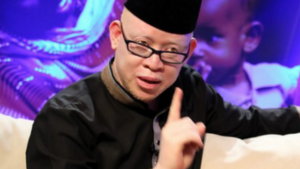
In September 2016, Isaac Mwaura, a Kenyan Parliamentarian, wanted the Kenyan Parliament to pass the option of a third gender into Kenyan law in order to legally recognise intersex people. Mwaura also asked for public funding for gender-affirming surgeries and a public awareness campaign to end the stigmatisation of intersex people. Read more here.
September 2016 — Parliamentarian Pushes for Third Gender, Kenya In September 2016, Isaac Mwaura, a Kenyan Parliamentarian, wanted the Kenyan Parliament to pass the option of a third gender into Kenyan law in order to legally recognise intersex people. Mwaura also asked for public funding for gender-affirming surgeries and a public awareness campaign to end […]
Trans Hope was founded in 2017 by Sazi Jali. Trans Hope was formally registered on 6 June 2019, making it the first trans-led organisation in the province of Kwa-Zulu Natal in South Africa. Trans Hope seeks to raise awareness about gender and gender identity and create an environment that is safe and inclusive for gender-diverse people. Sazi Jali saw a need within the community to not just help the members of the support group but to provide support and services to the transgender and gender-diverse community in the KwaZulu-Natal province as a whole. In 2019, with the encouragement of Prof. Zanele Muholi and Dr Chris McLachlan, Trans Hope was registered as a Non-Profit Organisation,
The dream was to mainstream gender diversity in the community through providing safe spaces within both public and private institutions, and to give trans and gender-diverse communities access to education and advocacy. Part of the aim of Trans Hope was to not isolate trans people, so the board and working team included a number of cisgender individuals to assist in the fight for the mutual understanding of diversity within the greater community, to ensure the acceptance of trans and gender-diverse people through creating awareness, and to provide education about trans and gender-diverse issues and to advocate for their human rights.
“We empower our community by providing knowledge about LGBTQIA+ issues and health care. We educate schools, clinics, hospitals and churches in order to provide a safer place for transgender and gender diverse people. We also provide training and conduct workshops.”
Vision
To advance the constitutional rights for the LGBTQIA+ community, ensuring they have a safer space within but not limited to the Republic of South Africa.
Mission
Trans Hope seeks to:
Increase knowledge about gender identity and sexual orientation expression as well as sexual characteristics (SOGIESC).
Create safe spaces for people who are gender diverse, through killing stigma against LGBTQIA+ people by building our community and empowering them with understanding about the diversity of humankind.
Objectives
Create a safe space for queer people within the cishetoronormative spaces.
Fight the anti-gender group to ensure communities are empowered with knowledge.
Trans Hope informally started in 2017 and two years later, on June 2019 received their registration papers. Prof. Muholi played an important role in the beginning years, encouraging and facilitating group members to meet and work towards forming Trans Hope
Action Santé Trans* Bénin (ENVOL) is a human rights organisation founded in 2017 in Benin. It was officially registered in 2019. ENVOL is committed to creating an enabling environment for the health and well-being of discriminated against and marginalised trans people in order to fight for the respect of their human rights through the organisation’s actions, service offerings of education, prevention and care related to STI and HIV/AIDS advocacy.
Vision
ENVOL aspires to a more egalitarian world, creating and shaping a world where all people regardless of sexual identity or orientation are fulfilled and empowered. It aims to develop better actions and supportive policies that promote the health, well-being, education, leadership and collective power, respect, dignity and equality of trans and gender non-conforming people in all their diversity, and to change and impact the world.
Mission
Accompanying, helping and supporting trans people, young people and in order to contribute to their well-being and fulfillment, ENVOL works to end gender-based violence, fight inequality and respect human rights while promoting empowerment, dynamism, collective power in the community and greater participation through new approaches to inclusive intervention, equality and solidarity, while also promoting behavioural change.
Some of the members of the board of directors and executive board of ENVOL
Goals
To fight for the respect of human rights through:
Fighting transphobia (discrimination, marginalisation and all kinds of violence and other forms of oppression against Trans* people.
Fighting against STIs and HIV/AIDS.
Fighting for the full development of Trans* and marginalised people within the general population.
Enabling the community to access a safe space.
Promoting solidarity and support within the trans community, and between this community and the cisgender community in Benin.
From the integration and awareness-raising football match between the trans and intersex communities and civil society organisations
Some of the members of the board of directors and executive board of ENVOL
Self-defense and community-based first aid workshop
Well-being and expression workshop
Economic Empowerment & Leadership Workshop
Empowerment through photography workshop
Miss Intelligentsia Queen Bénin: Running since 2017, the Miss Intelligensia Pageant is aimed at promoting a trans- and intersex-inclusive society, sustainable social and personal change, and it also raises awareness. The candidates debate the anti-gender movement, all sensitive issues to the community Benin, human rights and how to fight against gender-based violence and access to justice to assert one’s rights. The pageant is also aimed at creating role-models for young trans and intersex people in the country.
2017 — Action Santé Trans* Bénin / ENVOL Association Founded, Benin Action Santé Trans* Bénin (ENVOL) is a human rights organisation founded in 2017 in Benin. It was officially registered in 2019. ENVOL is committed to creating an enabling environment for the health and well-being of discriminated against and marginalised trans people in order to […]
2017 — Trans and Intersex Rising Zimbabwe (TIRZ) Founded, Zimbabwe
Trans and Intersex Rising Zimbabwe (TIRZ) was founded in 2017 by Q Bee Chihera Meki and Tinoashira Chukuni. TIRZ was registered on 4 May 2021.
Vision
TIRZ envisions a Zimbabwean society that treats trans-diverse and intersex people equally, and empowers trans and intersex persons to live to their full potential.
Mission
Fulfilling this vision through activism, service- provision, advocacy, and community development and empowerment.
Objectives
Providing various forms of support to meet the needs of the sex- and gender-diverse community of Zimbabwe
Increasing awareness, and advocating for the rights and identities of the sex- and gender-diverse community of Zimbabwe.
Advocating for the equitable access for the sex- and gender-diverse community of Zimbabwe to socio-economic services.
Focus Areas
Activism and sensitisation work in the health sector around the needs of trans and intersex persons.
Developing trans and intersex leadership and entrepreneurial skills.
Grassroots-level research on the needs of the trans and intersex communities.
Sharing the narratives of trans and intersex persons.
HIV-related services for the trans and intersex community.
Fostering relationships between the various trans and intersex communities and organisations in Zimbabwe.
2017 — Trans and Intersex Rising Zimbabwe (TIRZ) Founded, Zimbabwe Trans and Intersex Rising Zimbabwe (TIRZ) was founded in 2017 by Q Bee Chihera Meki and Tinoashira Chukuni. TIRZ was registered on 4 May 2021. Vision TIRZ envisions a Zimbabwean society that treats trans-diverse and intersex people equally, and empowers trans and intersex persons to […]
2017 — Publication of ‘Southern Africa Trans Diverse Situational Analysis’, Southern Africa
In 2016, the Southern African Trans Forum, with the aid of Accountability International, undertook a situational analysis of the barriers faced by trans diverse people in Africa in accessing healthcare. The specific focus of the analysis was the intersections between legal and policy frameworks that create these barriers for people in 5 Southern African countries: Botswana, Namibia, Swaziland, Zambia and Zimbabwe. The report, ‘Southern Africa Trans Diverse Situational Analysis: Accountability to Reduce Barriers to Accessing Health-Care | 2016’, took place during 2016 and was published in 2017.
Survey Results
Barriers faced by trans diverse Southern Africans (Source: page 5 of the Report)
Lacking identity documentation aligned to their preferred gender, trans-diverse persons experience extreme discrimination at school, at church, and in other social settings at the hands of their peers who are ignorant of and uncomfortable with their gender identity;
Facing active discrimination from family and church leaders – who are likely to sexually molest many trans diverse people – their experience finally drives trans diverse people out of school before completion of their studies, and also out of home (another key site of sexual abuse);
Trans diverse people are at a permanent disadvantage against former peers in seeking work in that we are underage, underqualified, can’t progress further in their studies, and cannot secure basic documents such as a driver’s license (a significant minority of those few that manage to secure work are likely to experience sexual harassment at work, or to lose their jobs as a result of their gender identity) so most of them wind up unemployed;
Lack of education, employment, plus official and societal discrimination against the trans diverse usually means we cannot access housing and wind up on the street, which drives them into underground subsistence activities including petty criminality and especially sex-work in order to survive;
That demi-monde existence in turn makes them even more vulnerable to abuse by members of the public and the police (including arbitrary assault, arrest, and detention), to substance abuse and self-harming behaviour including suicide attempts, and to disease including but not limited to STIs, HIV/Aids, TB and viral hepatitis;
so ill and in desperate need of medical attention and psychological assistance (not to mention hard-to get hormones and almost unreachable transitional surgery), the trans diverse turn to the healthcare system – but encounter yet more ignorance, prejudice and even abuse.
Lived experiences of trans diverse Southern Africans
The Survey documented the following results in a period of 12 months relating to the lived experiences of trans diverse Southern Africans:
34% (1 in 3) experienced sexual violence, including attempted or completed rape.
Of these, only 19% (1 in 5) received the necessary medical attention.
22% experienced attempted or completed rape by an intimate partner.
Of these, only 14% reported intimate partner sexual violence.
18% reported physical abuse by a religious or faith healer.
Only 11% of these reported the sexual abuse by a religious or faith healer.
53% experienced violence.
Of these only 30% received the medical attention they required.
Only 24% of these experiences of violence were reported.
53% avoided healthcare because of stigmatisation by staff.
Only 45% taught their healthcare provider about trans diverse issues.
Key findings of the situational analysis
The summary of the Report is as follows:
“The trans diverse communities in the five countries studied (Botswana, Namibia, Zambia, Zimbabwe, and Swaziland) represent a remarkable constellation of communities characterised by extreme vulnerability because of their intersectional location as among their countries’ most excluded – unemployed or criminalised, susceptible to disease and despair, targeted for sexual assault and hate crimes, and cut off from education, housing, health-care, sports and social activities, and many the basic benefits of citizenship and amenities of society.
And yet trans diverse people are possessed of remarkable strengths in terms of their survival skills and tenacity in overtly hostile environments were because of having to either face social erasure or are actively persecuted as a group that “should not” exist.
The power of trans diverse agency should not be underestimated, as two remarkable examples will make clear: a) although many members of the trans* community who answered this survey have experienced prejudice in, including expulsion from, their childhood homes, 38% of those surveyed started their own families; and b) although many trans diverse persons experienced prejudice in, including expulsion from, school, fully 18% of those surveyed completed tertiary education – higher than the national average in at least three of the countries surveyed.
However, a total policy vacuum regarding the existence, nature and needs of the trans diverse community mars all the countries studied. This invisibility not only allows for blanket ignorance to reign among officialdom and the broader populace, on the one hand disabling trans persons’ ability to access ordinary (and specialised) health-care and legal remedies, while on the other hand enabling casually vicious discrimination up to and including violent hate crimes and police home invasions (the latter experience restricted to Zambia). Even the protections that the trans diverse supposedly possess under constitutional equality/human rights legislation appears to fall away in most real-life circumstances.” Source: https://accountability.international/projects/trans-diverse-africans-situational-analysis-2016-2019/
2017 — Publication of ‘Southern Africa Trans Diverse Situational Analysis’, Southern Africa In 2016, the Southern African Trans Forum, with the aid of Accountability International, undertook a situational analysis of the barriers faced by trans diverse people in Africa in accessing healthcare. The specific focus of the analysis was the intersections between legal and policy […]
2017 — Trans Support Organization (TSO) Founded, Kenya
Trans Support Organization (TSO) was formed as a community-based organisation (CBO) in 2017 by a group of three transgender, intersex, and gender-non-conforming (ITGNC) individuals from Western Kenya who met during the Human Rights and Advocacy Programme by ASTRAEA Lesbian Foundation for Justice through the NYARWEK Network (Nyanza Rift Valley and Western Kenya Network). TSO was founded with a focus on human rights and sexual reproductive health and rights to respond to the needs of ITGNC individuals, as well as to create visibility, increase opportunities for and enhance the well-being of these individuals in rural areas of Western Kenya. TSO was registered in November 2019.
Vision
A vibrant and radically inclusive society that supports intersecting identities, where all community members can thrive as their authentic selves, liberated from stigma, violence and oppression.
“Above all TSO consists of trans folks brought together by collective experiences and a deep desire to change the landscape so that ITGNC persons joining us may lead more dignified lives. We address scars of discrimination and first-hand experience of what it means to be invisible in our community and country. Our bodies bear testimonies to the worst that can happen to a trans person including being raped, locked in jails, beaten to a pulp by a mob and mocked everywhere. We exist to provide hope that all can be well and that being trans is not an abnormality. TSO is committed to embodying the values of diversity, equity, and inclusion.”
2017 — Trans Support Organization (TSO) Founded, Kenya Trans Support Organization (TSO) was formed as a community-based organisation (CBO) in 2017 by a group of three transgender, intersex, and gender-non-conforming (ITGNC) individuals from Western Kenya who met during the Human Rights and Advocacy Programme by ASTRAEA Lesbian Foundation for Justice through the NYARWEK Network (Nyanza […]
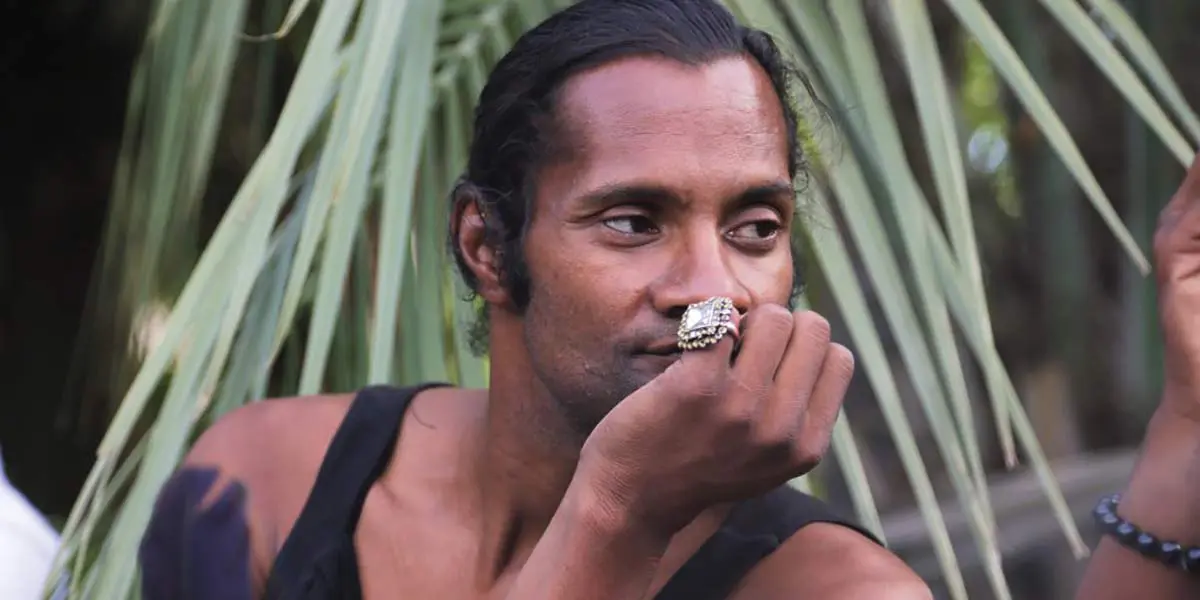
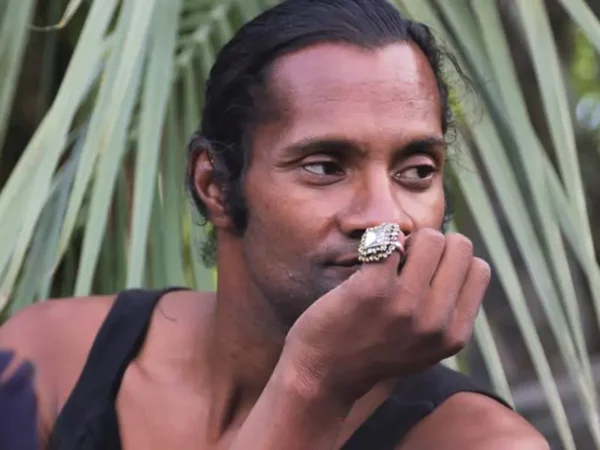
March 2017 — SistaazHood’s Leigh Davids Makes Famous “Trans Violent Exclusion” Speech, South Africa
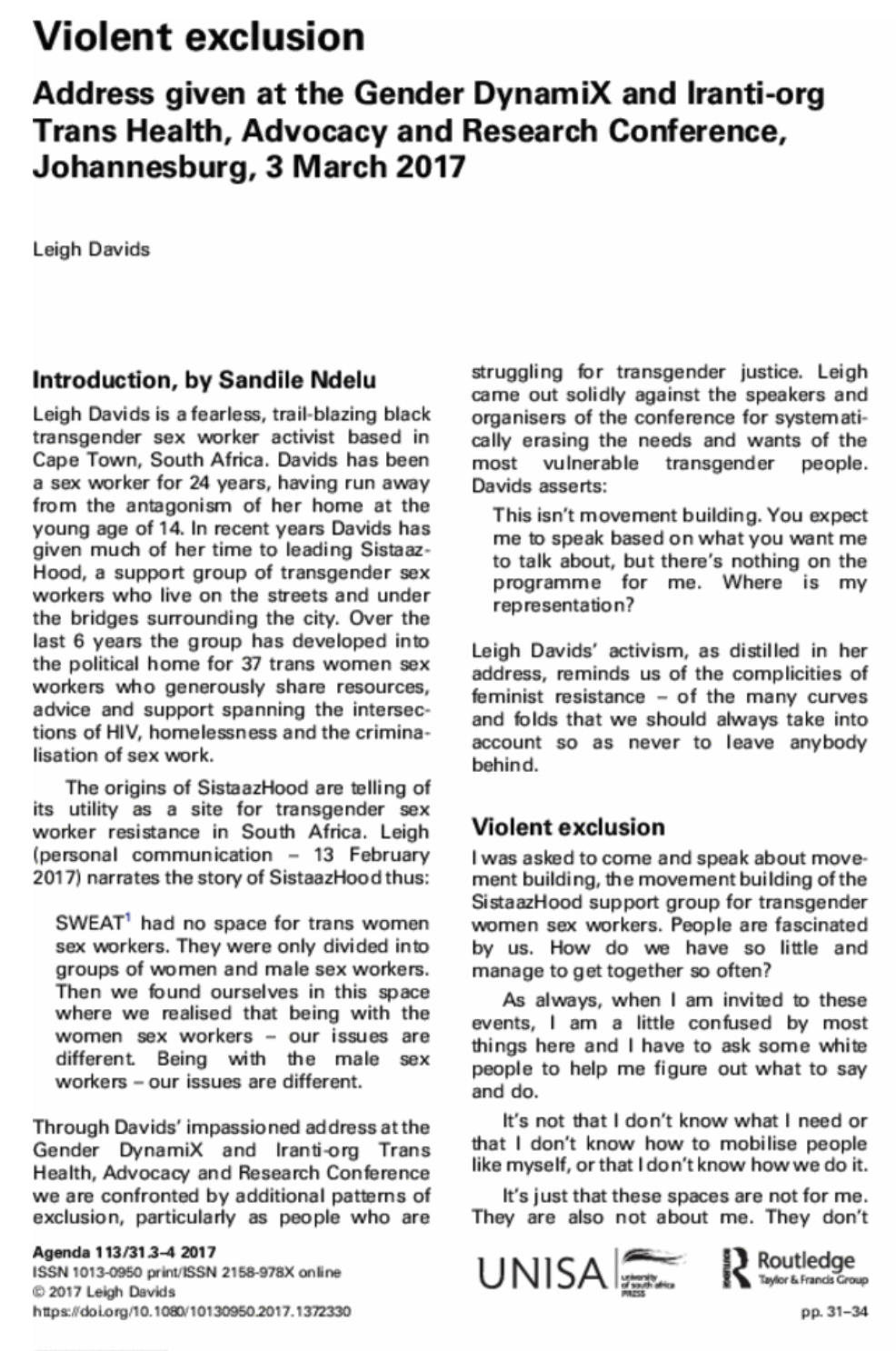
In March 2017, trans sex worker activist, Leigh Davids from SistaazHood, made the now famous “Trans Violent Exclusion” speech at the 3rd Trans Health, Advocacy and Research Conference, hosted by Gender DynamiX (GDX) and Iranti.
Under the Conference theme, “Decolonising and Depathologising Transgender Identities”, Leigh delivered a powerful critique, which was published afterwards.
The speech highlighted the different income and social classes and levels of access within trans organisations and among trans women and activists. She spoke about living on the street, and she challenged the audience to think about what it means being a trans woman sex worker and how this Conference (or any other) is at all meaningful for trans women sex workers. In the speech Leigh mentioned that trans women sex workers do not live to be older than 40 years.
Leigh passed away two weeks before her 40th birthday, on 27 February 2019. Read the tributes to Leigh after her passing.
Transcript of snippets from a speech Leigh made in 2018 at the Kewpie Heritage Day
“Thank you for coming to the place where we live. We do not often invite people here. Like anybody else we enjoy our privacy and as you might imagine we don’t have a lot of that here. This is what NOT PRIVACY looks like. This is what NOT HOME looks like. This is what parents threaten their children with if they don’t do their homework. This is what Capitalism imprints in your mind to make you work harder, to spend your money, to make you work for the man. This is……. THE STREETS.
The human mind and will is amazing. Even when it is hungry. Even when it is in pain all the time. Even when it’s spirit has been attacked all it’s life. It will find and make community, under the worst stress. The SistaazHood and our allies have been living on this spot for decades. Over there is our lounge and our kitchen. Over here is where we sleep together. This is home for us. Well it was until the part of apartheid that never died came and evicted us last week, evicted us yet again from District 6. The first time was because of philosophy called apartheid. Ooh and we hate that word hey? All of us! Black white poor rich. Say it with all the hate in yourself, all the disgust, feel appalled! Wasnt it terrible? It was so terrible that once upon a time a government, a city could throw poor black people out of their homes, demolish them, send the people to the outskirts of the city. What terrible prejudice, human rights violation. That one could lose your home because of the colour of your skin, your culture, how you were born. Shocking hey? But let me tell you that Big Brother Apartheid might be dead but his father is still with us. We never killed his father. His father’s name is the CLASS SYSTEM and his father’s job is GENTRIFICATION. In the name of gentrification the father of apartheid is still chasing poor black people from District Six.
And so? How many of you are working class? How many of you are middle class? Do you occupy the street to walk to work or do you occupy the street when you go for a jog or do you drive in it? If you answer yes to any of those you are more or less safe from the father of apartheid and his job – gentrification. But me and my sisters. He is coming for us. He came for us last week on his first round through Woodstock. He chased us around the corner. Next week he will take us to a concentration camp in a place called Wolwehoek. What is this? It sounds like a TV drama. But it is not. It is my life. It is our life. And maybe you wonder why I can sleep in the street, how can sleep on a piece of property I don’t own, how I can complain when I am evicted from a space I don’t own. Are you wondering that? Are you wondering if I am a nuisance to people here? Do I make a noise? Do I use drugs, sell sex, urinate on the street? And isn;t it time for me to get my act together, find a job? First of all – I HAVE A JOB. Sex work is work. You made it illegal. Second of all. I don’t live here by accident. I am not poor by accident. I am not without a home by accident.
There are places in the world where democracy does it’s job, nobody sleeps on tar and cardboard there. There are places in the world where Capitalism works, does it’s job – people don’t sleep under plastic on cement there. There are places in the world where dynamic communities with all the classes are designed by city planners. People from every class is together in one neighbourhood, diversity makes them thrive! Believe it! Those neighbourhoods work! And the most vulnerable? There are shelters for them…..right there in the same neighbourhood where one guy jogs on the street, the other one walks on it to work and the one with mental health challenges sits on a bench under a beautiful tree, protected, maybe even healing. There are places like that in the world.
And do you know how they happened? They did not happen because poor people got their act together. They did not happen because poor people got themselves jobs. They did not happen because poor people got organised. They happened because people with power started doing their job. They built a society for everybody with their power. The middle class agreed to it. Insisted on it. That’s how it happened.
So please leave us now and go do you job. Use your power. Get us off the street without evicting us. Gentrify with us in our heart and mind, not like we are trash that needs to be taken out…..of town.”
March 2017 — SistaazHood’s Leigh Davids Makes Famous “Trans Violent Exclusion” Speech, South Africa In March 2017, trans sex worker activist, Leigh Davids from SistaazHood, made the now famous “Trans Violent Exclusion” speech at the 3rd Trans Health, Advocacy and Research Conference, hosted by Gender DynamiX (GDX) and Iranti. Under the Conference theme, “Decolonising and Depathologising […]
8 March 2017 — Founding of Alliance for Dynamics Initiative (ADI), Ghana
Founded on 8 March 2017, the Alliance for Dynamics Initiative (ADI), is a trans-specific NGO which addresses the needs of trans persons in Ghana. ADI is a member organisation of AFED, the Alliance for Equality and Diversity.
Vision
A Ghana where trans persons have equal rights, free from stigmatisation and discrimination and regarded as human beings.
Mission
To address stigmatisation and discrimination, violence, extortion and blackmailing of trans persons in Ghana through education and empowerment to build the capacity of individuals, improve health care services and human rights for trans persons.
From the organisation’s Facebook page
Areas of Work
Human rights and advocacy training.
Self-acceptance, self-awareness and identity training.
8 March 2017 — Founding of Alliance for Dynamics Initiative (ADI), Ghana Founded on 8 March 2017, the Alliance for Dynamics Initiative (ADI), is a trans-specific NGO which addresses the needs of trans persons in Ghana. ADI is a member organisation of AFED, the Alliance for Equality and Diversity. Vision A Ghana where trans persons […]
17 March 2017 — Equal Shiners Initiative Uganda Founded, Uganda
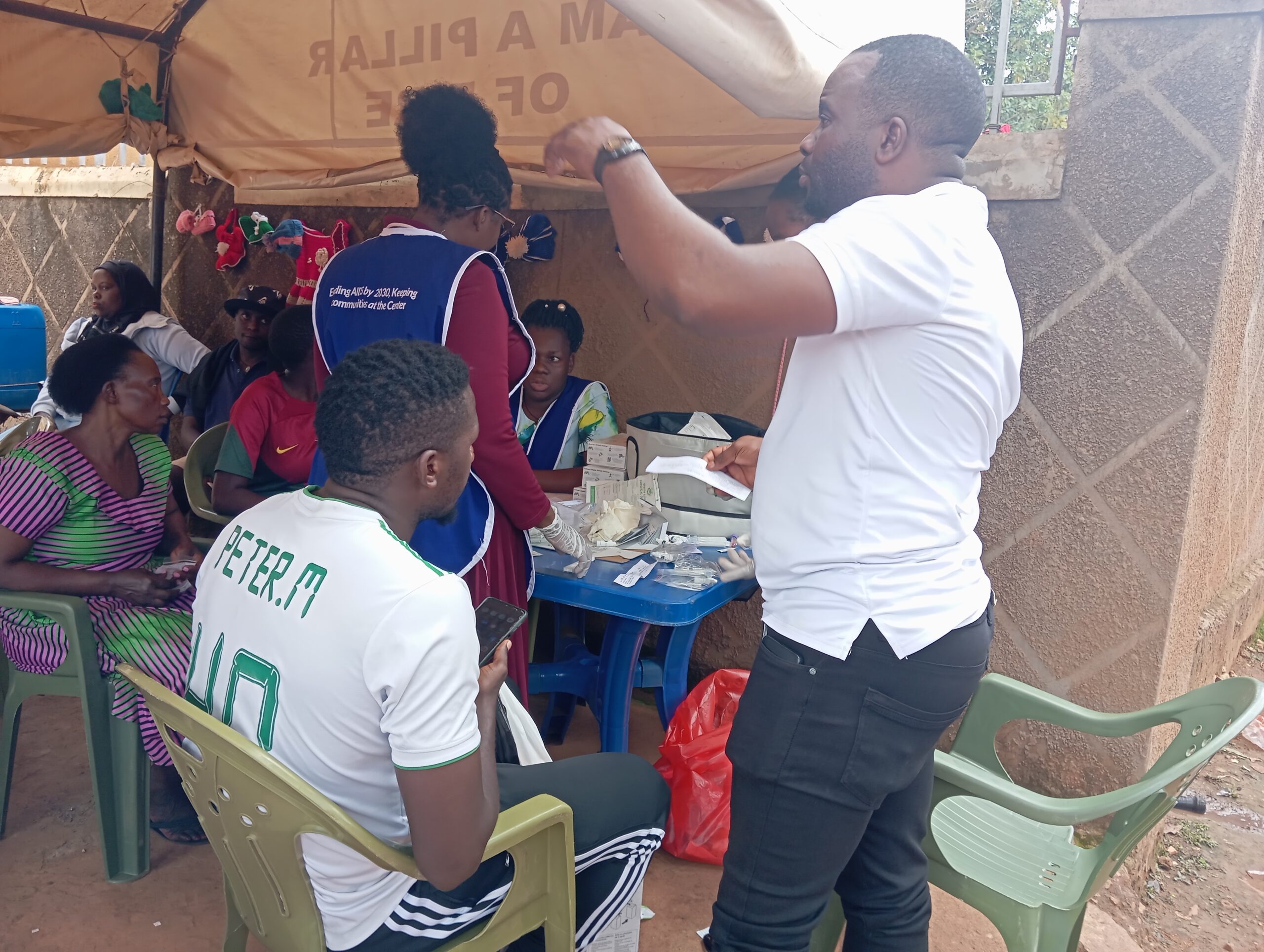
Founded on 17 March 2017 by Bukenya Musa, Equal Shiners Initiative Uganda works with LGBTQIA+ individuals, with a specific focus on trans, intersex, sex workers and other vulnerable community members, particularly those affected by stigma, discrimination, homelessness, and HIV/AIDS. The organisation provides community support, awareness, advocacy, and access to essential services. Their organisational approach is
Community-led and peer-driven advocacy and programming
Rights-based, gender-affirming, and sex-worker-inclusive approaches
Evidence-informed advocacy grounded in lived experience
Strong referral, coalition, and partnership systems
Accountability to the communities served
The organisation was registered as an NGO in 2017. The NGO was formerly a CBO named Kuchu Shiners.
Vision
A safe, inclusive and equal society where everyone is respected and empowered.
Mission
To support and empower LGBTQIA+ communities through advocacy, education and inclusive programs.
Goals/Objectives
Promote equality and human rights.
Provide safe spaces and support services.
Raise awareness and reduce stigma.
Empower community members.
Areas of Work
The organisation’s work focuses on human rights advocacy, mental health support, community empowerment and programmes specifically supporting trans and intersex individuals. Advocacy, human rights and policy engagement is the central pillar of the organisation’s work, addressing structural inequalities, criminalization, violence, and exclusion faced by trans women sex workers by amplifying community voices and engaging duty bearers, policymakers, institutions, and the public.
Key advocacy interventions
Documentation and reporting of human rights violations affecting trans women sex workers
Engagement with policymakers, local authorities, health institutions, and human rights bodies.
Coalition-building and participation in national and regional advocacy networks
Strategic communications, storytelling, and media engagement grounded in lived experience
Advocacy for trans-affirming, sex-worker-inclusive health, legal, and policy frameworks
HIV, sexual and reproductive health and rights (SRHR)
Equal Shiners Uganda strengthens access to HIV and SRHR services through peerled outreach, referrals, and follow-up systems that ensure trans women sex workers access respectful, confidential, and affirming care. Services include:
HIV testing and counselling referrals
PrEP screening, initiation, refills, and adherence support
PEP administration referrals
STI screening and treatment referrals
Psychosocial and adherence support
Client follow-ups and continuity of care
Community outreach, prevention and empowerment
The organisation conducts peer-led outreach and empowerment initiatives that prioritize harm reduction, informed decision-making, safety, and dignity. Activities include:
Distribution of condoms and lubricants
Distribution of HIV self-testing kits
Health education, HIV prevention, and SRHR sensitization
Rights awareness and community dialogues
Peer-to-peer mobilisation and support
Humanitarian and economic support
The organisation has a well-established shelter space to provide accommodation to the homeless or wrongly evicted trans women. It comes with home care and security. All the shelter occupants are enrolled in economic skilling activities like poultry to prepare them to survive economically once they have exited the organisation.
Legal support and crisis response
Equal Shiners Uganda responds to rights violations and emergencies affecting trans women sex workers through referrals, accompaniment, and partnerships with legal and human rights institutions. Interventions include:
Legal aid referrals and case follow-up
Support during arrests, harassment, extortion, and violence
Emergency response and documentation of abuse cases
Specific trans and intersex programmes
The organisation’s trans and intersex focused programmes are designed and led with direct involvement from trans women and intersex individuals to ensure they are inclusive, safe, and responsive to their needs. Equal Shiners use a peer-to-peer approach, community outreach, and safe spaces to build trust and ensure meaningful participation.
Health Awareness and Access to Services: They conduct community outreaches and sensitisation sessions on HIV prevention, sexual and reproductive health, and mental health. The organisation also link trans and intersex individuals to friendly health facilities for testing, treatment, and counseling services.
Safe Shelter and Emergency Support: Equal Shiners provides temporary shelter and emergency assistance to trans women and intersex individuals who are homeless, displaced, or facing violence and family rejection.
Advocacy and Human Rights Awareness: The organisation engages in advocacy to promote the rights, dignity, and inclusion of trans and intersex people. This includes community dialogues, awareness campaigns, and working with local stakeholders to reduce stigma and discrimination.
Psychosocial Support: They offer peer support groups and counseling to address trauma, mental health challenges, and social isolation experienced by our beneficiaries.
Economic Empowerment: The organisation supports skills development and small income-generating activities to help individuals achieve independence and improve their livelihoods.
17 March 2017 — Equal Shiners Initiative Uganda Founded, Uganda Founded on 17 March 2017 by Bukenya Musa, Equal Shiners Initiative Uganda works with LGBTQIA+ individuals, with a specific focus on trans, intersex, sex workers and other vulnerable community members, particularly those affected by stigma, discrimination, homelessness, and HIV/AIDS. The organisation provides community support, awareness, […]
23 April 2017 — Fourth International Intersex Forum
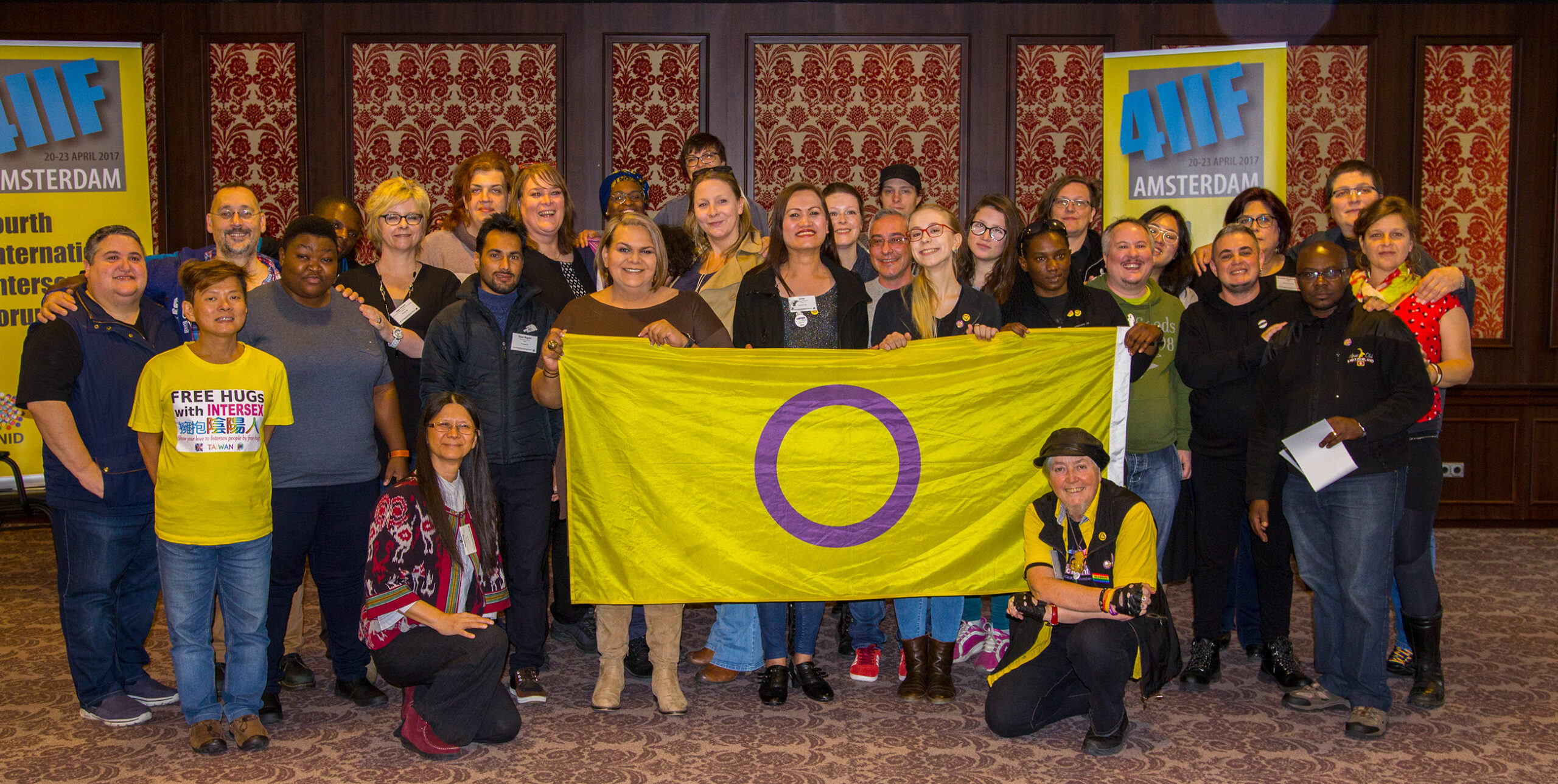
The Fourth International Intersex Forum was held between the 20th and 23rd of April 2017 in Amsterdam in the Netherlands. It was the largest intersex human rights meeting up to that date, with 40 representatives across all regions, including Africa.
Intersex human rights issues such as infanticide, intersex genital mutilation and other harmful medical practices, lack of appropriate and consented health care as well as discrimination in access to education, other services and employment were discussed. Read more. The Third International Intersex Forum resulted in the Malta Declaration.
23 April 2017 — Fourth International Intersex Forum The Fourth International Intersex Forum was held between the 20th and 23rd of April 2017 in Amsterdam in the Netherlands. It was the largest intersex human rights meeting up to that date, with 40 representatives across all regions, including Africa. Intersex human rights issues such as infanticide, intersex […]
June 2017 — Founding of West Africa Trans Forum (WATF), Liberia
West Africa Trans Forum (WATF) was founded in June 2017. It is a network of trans people and/or groups from West Africa led by trans, intersex and non-conforming people whose work requires a strong movement both nationally and regionally because they face a great threat in issues of violations and discrimination. Their membership currently includes 18 member association organisations. WATF aims to combat violence, stigma and discrimination against trans people in West Africa through regional advocacy and awareness raising. Their aim is also to enhance the capacity of trans-led organisations in the region through capacity building initiatives.
combat violence, stigma and discrimination against trans people in West Africa through regional advocacy and awareness raising;
to ensure the provision of specific health and HIV treatment services through sensitisation of health providers and key state and non-state actors;
and, to enhance the capacity of individuals and organisations through capacity building initiatives.
Strategic Objectives
Support the creation of new trans organisations and strengthen the capacity of existing and new member organisations.
Strengthen the capacity of healthcare providers in the region to offer trans-specific health and HIV services.
Conduct local, regional and international advocacy with member organisations to improve understanding of the rights and needs of trans people in West Africa.
Create and maintain research and documentation of trans people in West Africa.
Values and Principles
Zero stigmatisation and discrimination.
Visibility of trans people.
Commitment to the support and respect of members’ rights.
Mutual respect for the diversity of our trans identities.
June 2017 — Founding of West Africa Trans Forum (WATF), Liberia West Africa Trans Forum (WATF) was founded in June 2017. It is a network of trans people and/or groups from West Africa led by trans, intersex and non-conforming people whose work requires a strong movement both nationally and regionally because they face a great threat in issues […]
On 26 July 2017, Key Watch Ghana was founded by Lawrence Shone Edem Adjei. Key Watch is registered as an NGO, but not as a trans/intersex/LGBTQIA+ organisation due to legal issues in Ghana about registering organisations that work with gender diversity and sexual orientation. The organisation is an intersex-led and focus organisation that has been actively involved in raising awareness and advocating for the rights of intersex individuals in Ghana.
Founded as a support group in 2015 and formally registered as an NGO in 2017, Key Watch Ghana was created to offer solidarity, protection, and peer support for intersex individuals facing stigma, violence, and erasure. Today, the organisation leads national efforts in advocacy, empowerment, visibility, and research. From an initial baseline of just six (6) intersex identifying members, Key Watch now serves 133 intersex persons directly through tailored support programs and outreach efforts. With operational presence across all 16 regions of Ghana, Key Watch engages in community mobilisation, public education, and policy dialogue at all levels.
On February 17, 2022, during a parliamentary hearing, Shone Adjei and Key Watch Ghana made a historic appeal to remove intersex persons from Ghana’s anti-LGBTQI+ bill, affirming that intersex variations are biological traits, not sexual identities. The organisation also condemned any clauses that would legalise forced surgeries on intersex infants or criminalise advocacy.
Shone Adjei is the Founder and Executive Director of Key Watch Ghana (also known as Intersex Ghana) and also serves as Chairperson of the Intersex Movement Ghana. With over a decade of experience advocating for the rights of marginalised communities, Shone has become a leading voice in the fight for equality and justice for intersex and gender-diverse persons. As a passionate human rights defender and expert in HIV prevention and treatment services, they have played a key role in designing and implementing life changing programmes for vulnerable populations in Ghana and beyond.
More about the organisation from their Executive Director, Lawrence Adjei:
“Through a multifaceted approach, the organization has made significant strides in promoting understanding and acceptance of intersex issues within various sectors of society.
At the grassroots level, Key Watch Ghana has engaged directly with intersex persons, providing them with support and empowering them to speak out about their experiences. Additionally, the organization has reached out to traditional leaders, recognizing their influential role in shaping attitudes and perceptions within their communities. By fostering dialogue and education at the grassroots level, Key Watch Ghana has worked towards creating a more inclusive and supportive environment for intersex individuals.
Recognizing the importance of involving key stakeholders in advocacy efforts, Key Watch Ghana has also collaborated with the National Queen Mothers Platform. By sensitizing and mobilizing this influential group of leaders, the organization has leveraged their collective voice to champion the rights of intersex persons across the country.
This strategic partnership has enabled Key Watch Ghana to extend its reach into traditional areas and rural communities, where awareness and education about intersex issues may be limited.
In addition to grassroots engagement, Key Watch Ghana has been proactive in influencing policy at the national level. The Executive Director spearheaded a petition to the Parliament of Ghana, urging lawmakers to reject the inclusion of intersex persons in the Anti-LGBTQI bill. As a result of these advocacy efforts, intersex individuals were successfully removed from the bill during the second reading, safeguarding their rights and dignity.
Furthermore, Key Watch Ghana has utilized community engagement and social media platforms to disseminate information and raise awareness about intersex issues among healthcare workers and the general public. By fostering dialogue, challenging stigma, and promoting understanding, the organization continues to make strides in advancing the rights and well-being of intersex individuals in Ghana.
Overall, Key Watch Ghana’s comprehensive approach to advocacy and awareness-raising has been instrumental in driving positive change and creating a more inclusive society for intersex persons in Ghana.”
Image from the organisation’s website
Vision
A society that is empowered to attain and protect the fundamental human rights of all irrespective of gender, sex characteristics or intersex variations, and beliefs.
Mission
To change attitudes and foster acceptance and respect for intersex persons as well as all humanity through empowerment, education, advocacy, data collection and dissemination.
Watch our interview with team members from Key Watch Ghana
We interviewed Shone Adjei and Salamatu Yakubu on the 25th of July. Watch it here:
Salamatu Yakubu serves as Management Lead of Key Watch Ghana and is an Executive Council Member of the Intersex Movement Ghana. With more than five years of advocacy experience, Salamatu has helped shape the organisation’s national strategy and built strong networks across traditional leadership, government institutions, and civil society. Her work continues to inspire action and inclusivity in the ongoing struggle for intersex recognition and protection.
26 July 2017 — Key Watch Ghana Founded, Ghana On 26 July 2017, Key Watch Ghana was founded by Lawrence Shone Edem Adjei. Key Watch is registered as an NGO, but not as a trans/intersex/LGBTQIA+ organisation due to legal issues in Ghana about registering organisations that work with gender diversity and sexual orientation. The organisation […]
201620165 January 2016April 20162016July 20162016August 20161 September 201620172017201720172017March 20178 March 201717 March 201723 April 2017June 201726 July 2017
You can include information about your African Organisation/Group
There are many African organisations and individuals who over the years have contributed in invaluable ways to the story of the trans, gender diverse and intersex movements who are not yet included on our Timeline.
We want to acknowledge and include all verifiable contributions.
The Timeline is about your stories and voices. You can find out more about how to contribute by visiting our Contact Us page here.