

June 2021 — Global Attitudes Toward Transgender People survey report, South Africa
The June 2021 report, Global Attitudes Toward Transgender People, is based on a survey conducted in 2017 by the University of California (UCLA)’s Williams Institute, School of Law. It was the first study of public opinion about transgender people and their rights in South Africa. South Africa was the first country to adopt a constitution that explicitly prohibits discrimination on the basis of sexual orientation. This Report analyses data collected in the 2017 Global Attitudes Toward Transgender People survey to examine public opinion of transgender rights and status in South Africa.
Excerpts from the Report
Familiarity with transgender people
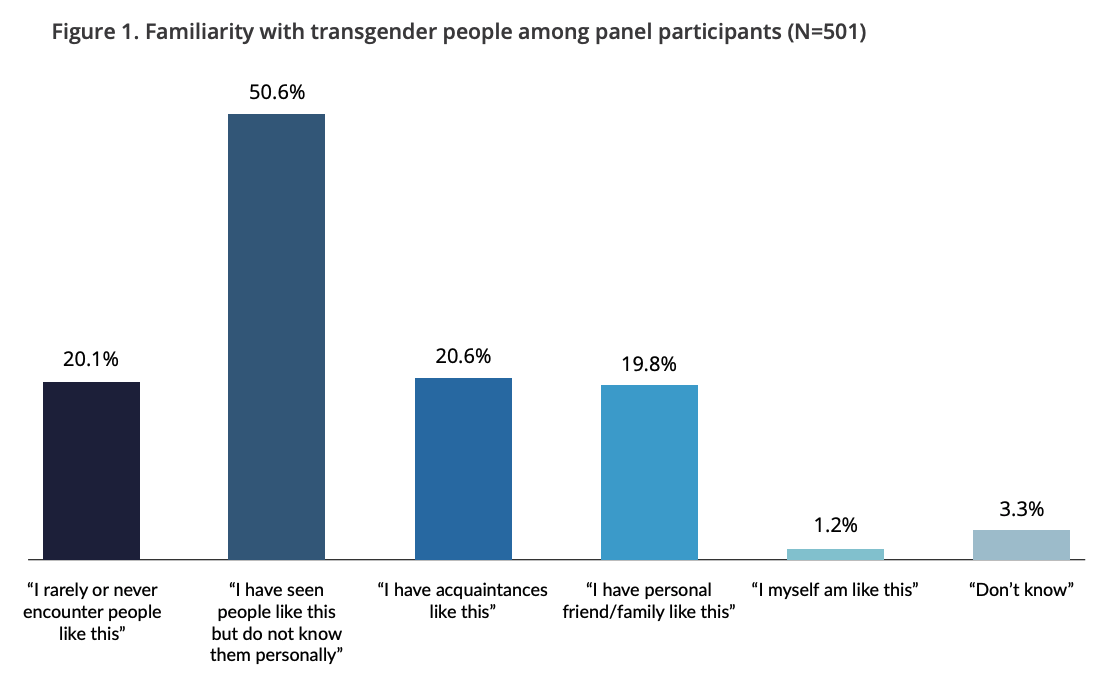
Almost half of participants reported having seen transgender people before but not knowing them personally (49.4%) (Figure 1). Similar proportions of participants, approximately one in five, reported having transgender acquaintances (20.6%), rarely or never encountering transgender people (20.1%), or having personal friends or family members who are transgender (19.8%). Few participants (1.2%) reported being transgender according to the definition provided. Some (3.3%) participants reported “don’t know” in response to this question.
Attitudes towards the rights of transgender people
Participants exhibited favorable attitudes towards the rights of transgender people (Figure 2). Nearly three in four (72.2% vs. 21.9%) participants agreed that transgender people should be protected from discrimination. A majority of participants also agreed that transgender people should be allowed to serve in the military (62.8% vs. 28.4%), conceive or give birth to children (62.3% vs. 30.7%), adopt children (58.9% vs. 33.0%), have gender-affirming surgery (57.7% vs. 33.2%), and marry a person of their birth sex (57.2% vs. 33.1%). Slightly more participants disagreed (47.5%) than agreed (45.0%) that
transgender people should be allowed to use a restroom consistent with their gender identity. Across all seven items, between 5.9% and 11.7% of participants indicated a response of “don’t know.”

Attitudes towards transgender people in society
A majority (69.4% vs. 21.2%) of participants agreed that South Africa is becoming more tolerant of transgender people (Figure 4). A majority (54.7% vs. 35.1%) of participants also agreed that they want South Africa to do more to support and protect transgender people. Furthermore, more participants disagreed than agreed that South African society has gone too far in allowing transgender people [to live openly] (55.4% vs. 36.5%) and that transgender people are violating their culture (47.6% vs. 41.5%). At the same time, slightly more than half (50.1% vs. 44.4%) of participants agreed that they worry about exposing children to transgender people. Also, fewer participants agreed than disagreed (38.3% vs. 48.4%) that transgender people have a special place in society. Across six items, between 5.4% and 13.3% of participants indicated a response of “don’t know.”

Conclusion of the Report
We believe this survey is the first study of public opinion about transgender people and their rights among adults in South Africa. Overall, the findings suggest that South Africans are generally accepting of transgender people. Nearly three in four (72.2% vs. 21.9%) participants agreed that transgender people should be protected from discrimination. Majorities of participants also agreed that transgender people should be allowed to serve in the military (62.8% vs. 28.4%), conceive or give birth to children (62.3% vs. 30.7%), adopt children (58.9% vs. 33.0%), have gender-affirming surgery (57.7% vs. 33.2%), and marry a person of their birth sex (57.2% vs. 33.1%). Thus, in many respects public opinion accords with the values outlined in the Constitution.
At the same time, 47.6% of respondents believe that transgender people are violating the traditions of their culture, and a slight majority (50.1%) agreed that they worry about exposing children to transgender people. This suggests that many South Africans still see transgender people as deviating from societal norms. Public opinion towards the usage of bathrooms was particularly illuminating given the intersecting threads of race, class, and gender identity in South Africa. We found that almost half of participants disagreed (47.5%) that transgender people should be allowed to use a restroom
consistent with their gender identity. Such viewpoints often lead to violence towards people who are gender variant, as they are seen as eroding culture and traditions.19 Meanwhile, the finding that 72% respondents believed that transgender people should be protected from discrimination seems to contrast with the fact that transgender people in South Africa experience discrimination almost daily. This high level of support in the survey is surprising considering the lived experiences of transgender people in South Africa.20 For example, on Monday, 6 July 2020, a trans woman named Ayanda
Gwentse was harassed at a shopping mall by a woman who attempted to pull Ayanda’s skirt up as if she was trying to disrobe Ayanda.
This aligns with the work of student activist Nigel Patel, who argues that transgender people in South Africa face problems with safe access to spaces that have been shaped and gendered by colonization and apartheid. As Patel writes, under late colonialism and formal apartheid, the racially and sex-segregated English water closet toilet became pervasive. The separation of toilet spaces during apartheid was central to the logic of complete separation of races in all aspects of public and private life, and the designation of people of color as inferior. Hence, to more fully reflect on the history of gender
discrimination in South Africa, it must be considered alongside race and its close connection to class.
