An archive of histories/herstories/theirstories affecting and influencing the trans, gender diverse and intersex movements in Africa
This Timeline of our archive of histories/herstories/theirstories of the trans, gender diverse and intersex movements in Africa and in the Diaspora emerged through the grassroots experiences and memories of the contributing African activists and organisations.
It is often updated with new stories and the Timeline is continually growing.
How to navigate the Timeline
Categories are displayed alphabetically at the top of the Timeline and can be used to filter the results to focus on the research theme chosen. For example, ‘All’ will show you all topics, while ‘Intersex’ will display all entries related to intersex movements and moments.
Alternatively, use the search bar in the menu at the top and bottom of screen to find more specific information.
Categories relating to gender, sex characteristics and sexual orientation have flag icons and colour groups to visually distinguish them from one another:
All
Activistas
Todos
Arte
Requerentes de asilo/Migrantes/Refugiados
Áudio e vídeo
Ballroom
Comunidade
Conferências
Travesti
Depathologisation
Diáspora
Drag
Films
Diversidade de género
Não-conformidade de género
Gender-Affirming Healthcare
Healthcare
HIV/AIDS
Homeless people
In Memoriam
Intersexo
Entrevistas
LBQ
LBTI
LBTQ
Legislação
LGBTQIA+
Media
Não binário
Organizações
People living with HIV
Persons with Disabilities
Publicações
Trabalho sexual
Desporto
SRHR
TIHA Articles
Trans
Trans e intersexo
Transfeminista
Transmasculine
Transsexual
Transvestite
Youth
Anos 50 a finais dos anos 70 - Carnavais: Um espaço seguro para travestis, travestis e artistas queer, Moçambique
While cross-dressing, queerness, homosexuality, and all forms of LGBTIQ+ identities as known today were not widely accepted in day-to-day life in Mozambique, during the 1950s through to the mid-1970s, the annual Carnival provided an opportunity for ‘male’ femininity, cross-dressing, and queer performances.
There was no explicit link to what we now recognise as trans or transgender-identifying individuals during this period. The carnivals, or “Carnivalesque”, held particularly on Carnival Tuesdays (just before Ash Wednesday), served as a platform for individuals identifying as gay and others who wished to explore gender identity and cross-gender experiences.
Although the Carnival did not appeal to all gay-identifying or queer men interested in experimenting with gender, it undeniably opened the door for those who would identify, as we describe today, as trans. Additionally, it was a joyful and festive time when freedom abounded, and movement was less restricted without societal disapproval. Carnival parties were predominantly hosted in hotels and exclusive venues catering to the middle-income and upper-class, including tourist spaces.
“The city of Lourenço Marques (today’s Maputo), a carnival festival was held almost every year. From the 1950s to the 1970s, the event was more than just a street parade. It also became a space of queer expression and joy. The Mozambique festival opened up a space of freedom to the marginalised. Especially women of colour and queer people, black and white. It also built on and activated transnational networks in the wider Lusophone (Portuguese-speaking) world. Brazilian musicians and cross-dressing performers, for example, travelled across borders to become important presences in late colonial African society. Besides Brazilian musicians, Lourenço Marques also received travestis, cross-dressing queer performers. Travestiswere becoming increasingly successful in entertainment culture in Brazil and elsewhere, in theatre and film and nightlife. Brazilian travestis, such as the iconic Rogéria, held artistic residencies in Mozambique in the late 1960s and early 1970s. In Lourenço Marques and Beira, they performed regularly in clubs and cabarets, helping spur an emerging queer subculture.”
“In 2015, after 40 years of independence, Mozambique joined the growing list of countries to put an end to colonial era “anti-sodomy” laws. Despite this legal landmark and the country’s relative tolerance towards LGBTIQ+ people, a recent report suggests that Mozambique still needs to more effectively fight discrimination and violence against sexual and gender minorities. Spaces of queer self-expression and joy exist more visibly now, but they have also flourished in the not so distant past. In remembering the carnival, we are invited to bring joy back to the centre of our collective memory. Not for the sake of history writing alone, but also to undertake the transformative labour of queer liberation – as the queer icons and dancing queens in Mozambique remind us.”
These carnivals continued until 1975 when colonialism ended in Mozambique and the new ruling party, the Liberation Front of Mozambique (FRELIMO), banned the carnivals.
While cross-dressing, queerness, homosexuality, and all forms of LGBTIQ+ identities as known today were not widely accepted in day-to-day life in Mozambique, during the 1950s through to the mid-1970s, the annual Carnival provided an opportunity for ‘male’ femininity, cross-dressing, and queer performances. There was no explicit link to what we now recognise as trans or […]
In the early 1970s, Mozambique was still under colonial rule. In April 1974, political upheaval in Lisbon, Portugal resulted in a coup within the Portuguese military and the dictatorship in Portugal was overthrown. This had a ripple effect on the colonies, including Angola and Mozambique. The Lusaka Accord was signed in September of that same year, marking the first steps towards decolonisation.
A few months later, on 10 February 1975, the Liberation Front of Mozambique (FRELIMO), still in charge today, made an official announcement through its Ministries of Information, Internal Administration, and Labour. They declared that carnival Tuesdays would no longer be a holiday, and any “carnivalesque” displays in public were banned. This rule brought an end to an era where people could freely explore their sexuality and gender identity. It had been a time when sexual and gender experimentation was common, providing a platform for a diverse queer community and offering a safe space for those identifying as gender-diverse and trans.
In the early 1970s, Mozambique was still under colonial rule. In April 1974, political upheaval in Lisbon, Portugal resulted in a coup within the Portuguese military and the dictatorship in Portugal was overthrown. This had a ripple effect on the colonies, including Angola and Mozambique. The Lusaka Accord was signed in September of that same […]
1982 — Founding of the Phoenix Society, An Underground Network of Trans Women, Transsexuals, Transvestites and Crossdressers During Apartheid, South Africa
South Africa’s first gender-focused group, the Phoenix Society, was established in 1982 in the Apartheid era in South Africa. The Society was an underground network of transvestites, transsexuals, crossdressers and trans women. The Society was founded by Marlene, a white trans woman, and Mike, a white trans person. The organisation relied on secrecy, with members using pseudonyms, calling one another from public telephones, and opening secret postboxes to receive their trans-related correspondence, including the magazine, ‘FanFare‘, the Society self-published.
FanFare, Issue No. 28, May 1987
FanFare, Issue No. 25, November 1986, Christmas Edition
FanFare, Issue No. 31, November 1987, Christmas Edition
Because of this secrecy, the Society was compelled to use creative means to reach members. Strategies included sending postage, such as newsletters (which the state considered “elicit communication” owing to the contents) with a self-addressed envelope for ongoing communication of the placement of small advertisements in the classified sections of South African print media. This strategy was undertaken to find and connect transvestites, transsexuals, crossdressers and trans women across South Africa, and even, internationally.
As Joy Wellbeloved, the oldest known surviving member of the Phoenix Society, recalls:
“In 1985, I was sitting in the reception of my divorce lawyer’s office reading letters to the editor of ‘Fair Lady’ magazine. A wife was looking for help for her husband who liked to dress up as a woman. The editor suggested that she contacted the Phoenix Society and provided a post-office box address in Parow. This was just what I needed! Through this, I met another person like me for the first time. Her name was Marlene.”
This quotation is an excerpt from the chapter “Phoenix Rising Above Isolation”, from the book ‘Beyond the Mountain – Queer Life in “Africa’s Gay Capital”’ (Edited by Dr B Camminga, Zethu Matebani; Unisa Press | DALRO; 2023).
FanFare, Issue No. 22, May 1986
FanFare, Issue No. 23, July 1986
Fanfare, Issue No. 27, March 1987
Interview with Joy Wellbeloved, oldest known remaining member of the Phoenix Society
In an audio interview with TIHA’s Liesl Theron in 2016, Joy Wellbeloved, speaks about the creation of the Phoenix Society, the ‘FanFare’ magazine, and the context for transvestites, transsexuals, crossdressers and trans women during Apartheid South Africa. Years later, Joy co-edited ‘TRANS — Transgender Life Stories from South Africa’(Edited by Ruth Morgan, Charl Marais and Joy Wellbeloved; Fanele, an imprint of Jacana; 2009). Marlene, who was one of the two co-founders of the Phoenix Society, has a chapter contribution in the same book.
The interview was conducted in preparation for the chapter “Phoenix Rising Above Isolation”. This chapter elaborates on how an underground network was formed during the era of apartheid in South Africa, when not only race and cross-racial relationships were policed, but sex, gender, and what was those years only defined as “homosexual” relationships, were severely policed too. The Phoenix Society formed this clandestine network, not only to avoid apartheid policing, but to provide people with a community, as there was no accessibility to online spaces before widespread internet use. The Phoenix Society organised by using mail boxes and “tickey boxes” (pay phones using coins on street corners; “tickey” refers to the nickname for the coin used). Download the chapter and read more about this fascinating era.
Joy Wellbeloved. Photo by Robert Hamblin (2009).
Excerpts from the 20 January 1986, Issue No. 20 edition of ‘FanFare’ magazine
South Africa’s first gender-focused group, the Phoenix Society, was established in 1982 in the Apartheid era in South Africa. The Society was an underground network of transvestites, transsexuals, crossdressers and trans women. The Society was founded by Marlene, a white trans woman, and Mike, a white trans person. The organisation relied on secrecy, with members […]
The Births and Deaths Registration Act, Act 51 of 1992 prohibited transsexual* people from having their sex status amended in the Births and Deaths Register unless they could provide proof that they were in their transition process prior to 1992. As such, from 1992, no new transitions were legally allowed.
Transsexuals’ sex transitions** were encouraged under Apartheid and became illegal during the political transition to democracy. This topic, and the reasons behind it, is extensively examined in the publication Sex in Transition: Remaking Gender and Race in South Africa,by Amanda Lock Swarr. In the book, Swarr writes:
“Also significant was the 1992 repeal of the Births, Deaths and Marriages Act, which increased difficulties for transsexuals attempting to change sex on their birth certificates. This decision may have been based in a backlash against equal rights campaigns that accompanied the political transition to democracy in South Africa…“.
* “Transsexual” is the language used in the Births and Deaths Registration Act. Updated terminology is “trans” or “transgender”.
** The term “sex transitions” is the language used in the Act. Updated terminology is “transition”, “gender-affirming treatment” or “gender-affirming surgery”. A transition also does not need to be medical, it can be social as well (living as your self-defined gender).
The Births and Deaths Registration Act, Act 51 of 1992 prohibited transsexual* people from having their sex status amended in the Births and Deaths Register unless they could provide proof that they were in their transition process prior to 1992. As such, from 1992, no new transitions were legally allowed. Transsexuals’ sex transitions** were encouraged […]
1994 - Primeira referência impressa nos media ao Travesti, Costa do Marfim
In the Ivory Coast, the Travesti* was a prominent group, recognised and documented from the early 1990s, but they were most likely active before the 90s**. They formedL’association des Travestis de Côte d’Ivoire (Ivory Coast Transvestites Association), under the leadership of Barbara (full name withheld for safety reasons).
The first record of the group is from printed media in 1994, where journalists were quite sarcastic in their attitude towards the travestis and the group, using disrespectful, critical language and tone, which was harmful to the travestis population. A militant group of travesti activists stormed the building where the newspaper’s offices were located, broke some windows, and assaulted some of the journalists. According to the research document Violence, Exclusion and Resilience among Ivoirian Travestis by Matthew Thomann and Robbie Corey-Boulet, this 1994 incident and similar occurrences during the same time led to the formation of the Ivory Coast Transvestites Association.
Ler mais here and here about travesti and other gender variant identities from the Ivory Coast.
* “Travestis” is the French word for “transvestites”.
** The exact founding date is not clear, but according to different sources, the Association has existed since the early 1990s.
1994 — First Printed Media Reference to The Travesti, Côte d’Ivoire / Ivory Coast In the Ivory Coast, the Travesti* was a prominent group, recognised and documented from the early 1990s, but they were most likely active before the 90s**. They formed L’association des Travestis de Côte d’Ivoire (Ivory Coast Transvestites Association), under the leadership […]
1998 - Documentário centrado na diversidade de género, "Woubi Chéri", apresentado em festivais internacionais de cinema, Costa do Marfim / Costa do Marfim
Featured in international film festivals in 1998, the documentary, Woubi Chéri, directed by Laurent Bocahut and Philip Brooks, focused on the lives of Woubis*, Yossis**, and other members of the Branché*** community in Ivory Coast. The award-winning documentary was featured globally in various film festivals and on a number of documentary platforms. The film won Best Documentary awards at the New York Lesbian, Gay, Bisexual, & Transgender Film Festival, the Turin International Lesbian & Gay Film Festival, and the Transgender Festival in London.
Shortly after Woubi Chéri’s release, Barbara (full name withheld for safety reasons) from L’Association des Travestis de Côte d’Ivoire (Ivory Coast Transvestites Association), who was one of the people interviewed in the film, emigrated to France. Slowly the energetic drive for the Association decreased and no more signs of their militant activism were seen. It is speculated that the reason for this is the nonprofit industrial complex, which saw funding for activism increasingly moving towards HIV/AIDS in the context of MSM (men who have sex with men), which erased all the efforts made by the Woubis.
Woubis (and cross-dressers or transvestites/travestis) cannot automatically be assumed to be transgender or to specifically claim Western terminology. Woubis existed long before any information about gender diversity or gender nonconformity was available on the internet and social media. Through research and the documentary Woubi Chéri, it became quite evident and very clear that the Branché community and the Woubi community have a much wider and larger range of genders and sexualities than the Western binary system. They are gender outlaws, so to speak.
“Among sexual and gender minorities in Côte d’Ivoire, travestis are defined as individuals born anatomically male who live as women on a full- or part-time basis. Travestis encounter harsher stigmatization and violence than sexual minorities whose gender normativity allows them to avoid unwanted attention. Moreover, they have traditionally been underserved by Ivoirian sexual minority rights groups, who have worked to distance themselves from travestis, framing them as recklessly indiscreet. In this paper, we examine the extent to which travestis’ isolation has lessened in the wake of the post-election violence that followed Côte d’Ivoire’s 2010 presidential election. We trace how Ivoirian travestis became increasingly vulnerable following the installation of a new national army that proved more hostile to them. And we show how, as a result of anti-travesti abuses committed by the army, non-travesti sexual minority activists became increasingly aware of the plight of travestis, and took steps to include them in their programming. These activists may have also been motivated by an increasing interest in transgender issues on the part of international donors. Finally, we explore the extent to which emerging human rights and HIV/AIDS programming has resulted in newly embodied positions for travestis as they confront identifications reflecting Western trans-spectrum identities.”
* Woubis are effeminate boys who play the role of women or wife in the relationship. ** Yossis are the men or the husbands in the relationship. They can be bisexual and/or married with a family while in a relationship with a Woubi. ** Branché is a local term whose meaning is not widely understood by heterosexual and cisgender people in Ivory Coast and is used by sexual and gender minorities to describe themselves and one another.
Featured in international film festivals in 1998, the documentary, Woubi Chéri, directed by Laurent Bocahut and Philip Brooks, focused on the lives of Woubis*, Yossis**, and other members of the Branché*** community in Ivory Coast. The award-winning documentary was featured globally in various film festivals and on a number of documentary platforms. The film won Best […]
Anti-Apartheid and intersex activist, Sally Gross founded the Intersex Society of South Africa (ISOSA) in 2000. Sally worked with a reporter from the Mail & Guardian to populate and provide information to the public to educate about Intersex and to create awareness around the formation of the Intersex Society of South Africa (ISOSA), a name modelled on theIntersex Society of North America, as Sally had close ties with intersex activists in that group.
The article explains:
“While there are some support groups in countries like the United States and Britain, there is currently no network for intersexed people in South Africa, says Gross. She hopes that publicity about intersexuality will bring the issue out into the open, help to remove the stigma attached to it, and help intersexed South Africans to make contact with one another for mutual support”.
Sally’s initial goals for ISOSA included offering advice and psychological support to its members, educational outreach in schools, and legislative advocacy.
ISOSA was initially affiliated with the health-orientedTriangle Project. Gross thought this partnership would help intersex people like herself to discover their own medical histories and to navigate treatment protocols, but ISOSA later became independent. She continued her efforts to promote ISOSA by sharing her own story in the publications, Natal Witness and Challenge, as well as being interviewed on the popular Cape Town station, Radio Bush.
To reflect the group’s independence from the U.S. organisation, Sally changed the name from ISOSA to Intersex South Africa (ISSA) in 2008. After Sally’s death in 2014, ISSA was housed by Iranti, founded in 2012 until it became a separate organisation in May 2023.
To read more about Sally Gross, here are three articles published by the Natal Witness:
Anti-Apartheid and intersex activist, Sally Gross founded the Intersex Society of South Africa (ISOSA) in 2000. Sally worked with a reporter from the Mail & Guardian to populate and provide information to the public to educate about Intersex and to create awareness around the formation of the Intersex Society of South Africa (ISOSA), a name […]
2000 to 2007 — Creation of Trans Support and Social Groups, South Africa
Between 2000 and 2007, before Dinâmica de Género (South Africa’s first trans advocacy group) was founded in 2005, the need for support groups for trans people led to the creation of support groups, which at the time were advertised as transsexual, transgender and transvestite people.*
The first support group was founded in Johannesburg in around 2000. These groups followed the Phoenix Society, an underground group that existed between 1982 and 1990 during the apartheid era.
2002 — Budding Roses support group founded
The Budding Roses support group was a monthly get together rotating at members’ houses.
News24, a popular South African newspaper, had a LifeStyle section in which they had a moderator answering questions in the style of an “Agony Aunt”, in which the support groups were referenced.
Circa 2002—2006 — Triangle Project support group
Started in around 2002, the support group hosted by the Triangle Project gathered momentum in 2006 when Ronald Addinall, a psychotherapist, joined the group as a facilitator. In the quote below from Ronald, he shares about the collaboration between the Triangle Project and Gender DynamiX (GDX):
“On the 3rd of May 2013 the TG Support group had invited GDX as the speakers for the guest speaker session. The TG support group has grown significantly in the last year and many of the newer members had not yet had the opportunity to engage with GDX and there was a need on the part of members to get a better understanding of the role of GDX as an NGO acting in the interests of Transgender persons as well as the scope of their services. There has also for some time been of our longer standing members, especially members who engaged with GDX when it was initially established, who felt that GDX appeared to be losing touch with the constituency locally and on the ground and they were questioning what role today, GDX played for them.
The aim and intention of inviting GDX to the TG support group meeting at Triangle Project was to have an opportunity of reconnecting and connecting between Transgender persons locally and GDX. An opportunity for new members to get better acquainted and longer standing members to get re-acquainted with GDX. It would also serve as an opportunity for GDX to present to the members how the organisation as evolved since its establishment until presently. To inform members of the programmes and projects GDX is actively involved in and how the focus and prioritised goals and objectives of GDX as an advocacy organisation has developed.
The group, Liesl and S’bu engaged actively, constructively and very positively during the session. Liesl shared the history, evolution and the primary goals and objectives of GDX as it is presently, with the emphasis being on advocacy and activism on behalf of the Transgender community at the broader societal level and nationally. She shared how GDX realised that they needed to prioritise the limited resources the organisation had to its maximum impact for the broader Transgender community. S’bu supported Liesl in sharing the overview and also shared particularly the ongoing challenges they are facing and engaging in at a national level with the DHA. The issue of DHA clearly a collective and very contentious issue for all became a particular point of discussion. As the facilitator I found myself observing and was heartened by hearing and seeing the collective camaraderie between Liesl, S’bu and the group members as they passionately engaged and shared on the topic of DHA.
The group session was truly successful in that the aim and intention was achieved. The different roles and services of Triangle Project, the TG Clinic at GSH and GDX were clarified. GDX also made it clear, that even though their focus is primarily at addressing the more macro and national issues of advocacy and activism on behalf of the Transgender community, that members are always welcome to make contact with GDX, be it visiting the offices, calling, e-mailing, messaging on Facebook, etc.”
— Ronald Addinall; facilitator of the Triangle Project support group
2004 — Creation of the T-Junction support group
The T-Junction support group was created by the founders to be (2005) of Gender DynamiX, Lex Kirsten and Liesl Theron. The group met on a monthly basis in the form of a braai (barbecue) and board games at members’ homes. To ensure as wide as possible representation and attendance, both Liesl and Lex would drive across the Cape Peninsula (from Muizenberg, Kenilworth, Mowbray, and Tableview) to pick up and drop members. Initially T-Junctions were held on Friday evenings once a month, but when the need arose to fetch community members from across the Peninsula, it was moved to Saturday afternoons. T-Junction and Ronald additional from Triangle Project ensured on their annual calendar’s to not have clashing dates, which gave members two opportunities per month to socialise. The peak years of the T-Junction support group were around 2006 and 2007, with the largest attendance of around 15—18 people.
* The TIHA Digital Archive reports on events as accurately as possible to give justice to the language of the day, as this in itself shows progress and opportunity for reflection. The TIHA Digital Archive does not assume a position other than neutrality in this regard – only reporting.
2000 to 2007 — Creation of Trans Support and Social Groups, South Africa Between 2000 and 2007, before Gender DynamiX (South Africa’s first trans advocacy group) was founded in 2005, the need for support groups for trans people led to the creation of support groups, which at the time were advertised as transsexual, transgender and […]
2003 — Founding of Horizon Community Association (HOCA), Rwanda
Founded in 2003 in Rwanda by, Horizon Community Association (HOCA) is an unregistered group focusing on serving trans and intersex people, trans sex workers, and sexual minorities. Their main work is advocating for equal rights, health promotion, and economic empowerment for these groups. Although HOCA was founded in 2003, the organisation did not start as an exclusively trans/intersex-focused organisation. In its emerging years HOCA had gender non-conforming leadership, and their projects and programs were always trans inclusive. Today HOCA has trans leadership. HOCA was also one of the signatories of the Nairobi Trans Declaration at the Changing Faces, Changing Spaced Conference in Nairobi, Kenya, in 2007.
Visão
Central to HOCA’s vision is the aspiration for an inclusive society where every individual, regardless of sexual orientation, gender identity, or employment status, can fully realise their human rights, experience freedom, gender equality, mental well-being, and equitable economic empowerment.
Missão
HOCA’s core mission revolves around nurturing the movement and enhancing the capabilities of its community members. Its overarching goal is to foster equality and champion the rights of gender and sexual minorities, and sex workers, both within Rwanda and across the region.
Goals
Advocacy aiming to decriminalise sex work
Fighting for social justice for sexual minorities and sex workers
Raising awareness and follow-up on the security and well-being of minorities, especially trans and intersex people.
2003 — Founding of Horizon Community Association (HOCA), Rwanda Founded in 2003 in Rwanda by, Horizon Community Association (HOCA) is an unregistered group focusing on serving trans and intersex people, trans sex workers, and sexual minorities. Their main work is advocating for equal rights, health promotion, and economic empowerment for these groups. Although HOCA was […]
South Africa hosted the 2003 Cricket World Cup, and on 9 February 2003. During the Parade of Nations and as part of the opening ceremony, the event’s organisers appointed models to walk in the parade, holding banners to represent each participating country. Senegalese-born model, Barbara Diop, had done modelling work in South Africa (she moved to Cape Town) and on international runways in Italy prior to this event, and she was appointed to carry the Zimbabwean banner. A few days later rumours started circulating that Barbara was a trans woman. She initially denied the rumours but eventually admitted that the claims were correct.
Zimbabwe’s President, Robert Mugabe, responded with anger and said that choosing Barbara as Zimbabwe’s banner bearer was done deliberately to embarrass Zimbabwe. This sentiment by President Mugabe was just one of the many homophobic statements he made about LGBTIQ+ persons throughout his public life, including publicly expressing the following in July 2002: “When I said gays are worse than dogs and pigs, I really meant it because pigs and dogs do not do unnatural things.”He threatened to withdraw the Zimbabwean team from the Cricket World Cup but did not have to follow through with his threat as Zimbabwe was eliminated from the competition early.
In an academic article entitled “The 2003 Cricket World Cup and its Implications for Identity Formation and Democracy in Zimbabwe”, J. Van der Merwe et. al. wrote:
“Sports mega-events have the potential to provide a focal point for strengthening national unity and reinforcing national identity. They are also said to be able to provide a catalyst for democratisation and an incentive for human rights observance if hosted by authoritarian or democratically weak regimes. However, the outcomes for host nations are not always pre-determinable. An analysis of South Africa and Zimbabwe’s co-hosting of the 2003 Cricket World Cup illustrates this point. A racially charged discourse informed much of the exchanges about Zimbabwe’s co-host status, both transnationally within the racial and ethnic contours of the cricket-playing Commonwealth and domestically within the host nations. Instead of the event having a generally liberalising effect on Zimbabwean politics it ultimately aided in further entrenching the regime.”
South Africa hosted the 2003 Cricket World Cup, and on 9 February 2003. During the Parade of Nations and as part of the opening ceremony, the event’s organisers appointed models to walk in the parade, holding banners to represent each participating country. Senegalese-born model, Barbara Diop, had done modelling work in South Africa (she moved […]
As gazetted at this point, The Sex Description and Sex Status Act made no provision for trans people without genital surgery or for intersexed and other persons who did not wish to have any medical/surgical procedures, but who may want to change the gender identity/sex description assigned to them at birth.
TheCape Town Transsexual/Transgender Support Group only heard about the hearings at short notice, about 10 days before the hearings. Due to this short amount of time, they requested an extension of two months, to better prepare. The request was denied. The Group then went ahead and prepared and delivered their oral presentation on 9 September 2003.
A quick overview of Act 49 of 2003:
“The Act applies to:
Persons having gender reassignment.
Intersexed persons.
Requirements:
For gender reassignment, reports by two medical practitioners.
For intersexed persons, reports by a medical practitioner and a psychologist/social worker.
Who may apply?
Any person whose sexual characteristics have been altered by:
i) surgical treatment
ii) or medical treatment
iii) or by evolvement through natural development resulting from gender reassignment, or any person who is intersexed may apply to the Director-General of the National Department of Home Affairs for the alteration of the sex description on his or her birth register.”
Note: “Evolvement through natural development” is not defined in the Act, so it could be interpreted as changes in biological development, or as changes in psychological/social development.
Critical comment: The Act assumes and therefore demands that applicants must undergo some kind of change before they qualify for an alteration of sex description.
On the 9th of September 2003, a group of organisations and interested individuals, including Sally Gross, Simone Heradien, Estian Smit, members of the Cape Town Transsexual/Transgender Support Group, the South African Human Rights Commission, and the Commission on Gender Equality, made oral presentations during the parliamentary hearings to advocate for amendments to the Sex Description […]
3 de março de 2004 - Fundação da Sexual Minorities Uganda (SMUG), Uganda
On 3 March 2004, Sexual Minorities Uganda (SMUG), now known as SMUG International, was founded by trans man and activist, Victor Mukasa, along with Sylvia Tamale. The earliest members included Val Kalende, Kamuhangire E. and David Kato, who were among the first board members. SMUG is an umbrella non-governmental organisation (NGO) based in Kampala, Uganda, advocating for the protection and promotion of human rights of lesbian, gay, bisexual, trans, intersex and queer Ugandans. It currently has 18 LGBTQIA+ organisations within its umbrella.
One of SMUG’s greatest achievements include the then Director of Programmes, Pepe Onziema, a trans man, who has advocated for LGBTQIA+ rights in Uganda for over 20 years, leading a coalition of 55 civil society organisations to overturn the Anti-Homosexuality Act of 2014.
“a clear witch hunt rooted in systematic homophobia, fuelled by anti-gay and anti-gender movements.”
Due to the these extreme obstacles, SMUG is now based in the USA.
SMUG hosts the Regional Exchange Programme participants at their offices in Kampala, Uganda
Missão
SMUG is dedicated to protecting the civil rights of all individuals, regardless of race, gender, or sexual orientation. SMUG believes that everyone deserves equal rights and opportunities, and the organisation works tirelessly to ensure that these rights are protected.
Áreas de incidência
SMUG provides support to the LGBT community through fundraising, grant writing and administration, strategic planning, networking, linkages and contracting with like USA organisations, along with advising and coaching SMUG membership organisation leadership.
Sítio Web Email: onziema@sexualminoritiesuganda.com; djcurley@smuginternational.org Facebook LinkedIn (Profile of Daniel J. Curley, SMUG Board Member and Treasurer)
Watch our interview with Pepe Onziema
Watch our live interview with Pepe from the 21st of February 2025:
Watch our interview with Victor Mukasa
Watch our live interview with Victor from the 6th of June 2025:
3 March 2004 — Founding of Sexual Minorities Uganda (SMUG), Uganda On 3 March 2004, Sexual Minorities Uganda (SMUG), now known as SMUG International, was founded by trans man and activist, Victor Mukasa, along with Sylvia Tamale. The earliest members included Val Kalende, Kamuhangire E. and David Kato, who were among the first board members. SMUG […]
The Act was amended in 2004 to address the concerns that arose after the Act was enacted in 2003. The Act originally allowed individuals to apply to have the sex designation on their birth certificate changed if they had undergone gender reassignment surgery. However, concerns were raised that this requirement was overly restrictive, as not all individuals who identify as a different gender undergo such surgery.
The 2004 amendment expanded the criteria for changing the sex designation on a birth certificate to include individuals who had undergone other medical treatments or procedures related to gender reassignment, as well as those who had received a diagnosis of gender dysphoria from a medical professional. The amendment was aimed at ensuring that the law reflected the experiences of trans individuals and provided them with greater access to legal recognition of their gender identity.
Estian Smit, one of the individuals who made the oral presentation to Parliament in 2003, created a presentation para Género DynamiX (GDX) to explain a summary of the process of altering the Act including points about its history, parliamentarian lobbying, an explanation of the Act, oral presentations, parliament decisions, inadequacies, obstacles, impact, and a way forward.
Following on from the parliamentary hearings on 9 September 2003, the Sex Description and Sex Status Act, Act 49 of 2003 was altered, signed by the President of South Africa and circulated in the Government Gazette, on 15 March 2004. The Act was amended in 2004 to address the concerns that arose after the Act was enacted in […]
The Promotion of Equality and Prevention of Unfair Discrimination Act, Act 4 of 2000 (PEPUDA), which is sometimes referred to as The Equality Act, was passed by the South African government in 2000 to protect its citizens from discrimination, hate speech, and harassment. Following the work of LGBTIQ+ activists, PEPUDA was amended in 2005 and became the first legislation in the world to include “intersex” within the legal definition of ‘sex’ as
“a congenital sexual differentiation which is atypical, to whatever degree.”
This definition of intersex reflects the work of activists as it is almost identical to the recommendation submitted to the court by Intersex South Africa (ISSA). ISSA’s founder, Sally Gross, advocated for and worked passionately towards this inclusion. One of the major accomplishments by activists in the amendment to PEPUDA was to insist that ‘intersex’ be self-defined, removing it from medical definitions and interventions or the forced surgeries that often accompany legal definitions of ‘sex.’
The Promotion of Equality and Prevention of Unfair Discrimination Act, Act 4 of 2000 (PEPUDA), which is sometimes referred to as The Equality Act, was passed by the South African government in 2000 to protect its citizens from discrimination, hate speech, and harassment. Following the work of LGBTIQ+ activists, PEPUDA was amended in 2005 and […]
2005 — Fondation du Collectif Arc-En-Ciel (CAEC), Maurice / Collectif Arc-En-Ciel (CAEC) (The Rainbow Collective) Founded, Mauritius
Fondé en 2005 par Nathalie Germain, Nicolas Ritter, Thierry De Ravel et Jean-Luc Ahnee, le Collectif Arc-En-Ciel (CAEC) est une ONG de défense des droits LGBTQIA+. Son action se concentre principalement sur la gestion des dossiers au sein de la communauté queer et la promotion juridique des droits LGBTQIA+. L’association lutte contre l’homophobie et les diverses formes de discrimination fondées sur l’identité de genre et l’orientation sexuelle. L’organisation a été enregistrée en 2005 et a fêté ses 20 ans en 2025. Annie Osawaru en est la directrice actuelle et Dimitri Ah-Yu le président.
Founded in 2005 by Nathalie Germain, Nicolas Ritter, Thierry De Ravel, and Jean Luc Ahnee, Collectif Arc-En-Ciel (CAEC), translated as ‘The Rainbow Collective’, is an NGO focusing on LGBTQIA+ rights. CAEC’s work primarily focuses on case management within the queer community and the legal advancement of LGBTQIA+ rights. The association campaigns against homophobia and various forms of discrimination based on gender identity and sexual orientation. The organisation was registered in 2005. They celebrated their 20th anniversary in 2025. Annie Osawaru is the current Director and Dimitri Ah-Yuis the NGO’s current President.
Selon CAEC, leur
“Notre travail se concentre principalement sur la gestion des dossiers au sein de la communauté queer et sur la promotion juridique des droits LGBTQIA+. Nous proposons des services de conseil aux membres de la communauté, aux couples queer et aux parents de personnes queer. Au CAEC, nous étendons également nos actions de plaidoyer à divers secteurs en organisant des séances de sensibilisation auprès des entreprises de l’île Maurice. Outre nos services de plaidoyer et de soutien, nous organisons des événements sociaux inclusifs tels que des karaokés queer, des soirées clubbing, des séances d’art-thérapie, etc., favorisant ainsi un espace de convivialité et de convivialité pour la communauté.”
According to CAEC, their
“work primarily focuses on case management within the queer community and the legal advancement of LGBTQIA+ rights. We provide counselling services to community members, queer couples, and the parents of queer individuals. At CAEC, we also extend our advocacy efforts across various sectors by delivering awareness and sensitization sessions to corporate organizations throughout Mauritius. In addition to our advocacy and support services, we organize inclusive social events such as queer karaoke, club nights, art therapy sessions, and more, fostering a safe and celebratory space for the community.”
La Vision / Visão
Une société mauricienne qui favorise l’émancipation, qui est exempte de stigmatisation, de discrimination et de violence liées à l’orientation sexuelle, à l’identité et à l’expression de genre, où les droits de tous les citoyens sont respectés de manière égale.
A Mauritian society that promotes emancipation, that is free from stigma, discrimination and violence related to sexual orientation, gender identity and expression, where the rights of all citizens are equally respected.
Missão
Faire entendre la voix de la communauté LGBTQIA+ à Maurice et mobiliser le soutien à l’égalité des droits et des opportunités pour tous ses membres.
To make the voice of the LGBTQIA+ community heard in Mauritius and to mobilise support for equal rights and opportunities for all its members.
Membres du conseil d’administration et du personnel du CAEC / CAEC Board Members and Staff
Objetivos / Objectivos
Les objectifs du Collectif Arc-En-Ciel sont généralement axés sur la promotion des droits et de l’inclusion des personnes LGBTQIA+ à Maurice. Leurs principaux objectifs sont :
Promouvoir l’égalité des droits : défendre la reconnaissance juridique et la protection des personnes LGBTQIA+, notamment en luttant contre la discrimination et en promouvant l’égalité de traitement devant la loi.
Soutenir la communauté LGBTQIA+ : Fournir un soutien psychologique, juridique et social aux personnes, aux couples et aux familles homosexuels, notamment par le biais de la gestion de cas et du conseil.
Sensibiliser et éduquer : Mener des séances de sensibilisation et de formation dans les écoles, les lieux de travail et les institutions pour lutter contre la stigmatisation, la désinformation et l’homophobie/transphobie.
Renforcez la communauté : créez des espaces et des plateformes sûrs — par le biais d’événements comme la Pride, des soirées karaoké queer et l’art-thérapie — pour que les personnes LGBTQIA+ puissent s’exprimer, renforcer la solidarité et célébrer leur identité.
Influencer les politiques et le changement social : travailler avec les décideurs politiques, la société civile et les partenaires internationaux pour influencer les réformes qui favorisent une société plus inclusive et plus juste.
Visibilité et représentation : veiller à ce que les voix et les expériences des personnes LGBTQIA+ soient visibles dans le discours public, les médias et les espaces culturels.
The goals of Collectif Arc-En-Ciel typically revolve around the advancement of LGBTQIA+ rights and inclusion in Mauritius. Their core goals are:
Promote equal rights: Advocate for the legal recognition and protection of LGBTQIA+ individuals, including the fight against discrimination and the promotion of equal treatment under the law.
Support the LGBTQIA+ community: Provide psychological, legal, and social support to queer individuals, couples, and families, especially through case management and counselling.
Raise awareness and educate: Conduct sensitisation and training sessions in schools, workplaces, and institutions to combat stigma, misinformation, and homophobia/transphobia.
Empower the community: Create safe spaces and platforms — through events like Pride, queer karaoke nights, and art therapy — for LGBTQIA+ people to express themselves, build solidarity, and celebrate their identities.
Influence policy and social change: Work with policymakers, civil society, and international partners to influence reforms that foster a more inclusive and just society.
Visibility and representation: Ensure the voices and experiences of LGBTQIA+ individuals are visible in public discourse, media, and cultural spaces.
Projets / Projects
Projet Trans : Analyse de la reconnaissance juridique du genre et stratégie de lobbying / Trans Project: Legal Gender Recognition Analysis and Lobbying Strategy
Un projet en cours (2025) mené par le CAEC plaide en faveur de la reconnaissance juridique des changements de marqueurs de genre pour la communauté trans à Maurice. En collaboration avec ses partenaires, Young Queer Alliance et Gender Links, le CAEC a récemment mené une analyse juridique comparative des droits des personnes trans. S’appuyant sur cette recherche, l’organisation et ses partenaires se préparent à mettre en œuvre une stratégie de lobbying structurée.
A current (2025) project undertaken by CAEC is advocating for the legal recognition of gender marker changes for the trans community in Mauritius. In collaboration with their partners, Young Queer Alliance, and Gender Links, CAEC recently conducted a comparative legal analysis on the rights of trans individuals. Building on this research, the organisation and its partners are preparing to implement a structured lobbying strategy.
“Au-delà du plaidoyer juridique, nous nous engageons à faire évoluer les perceptions sociétales de la communauté LGBTQIA+ en sensibilisant aux réalités socio-juridiques auxquelles sont confrontées les personnes queer à Maurice. Si le CAEC a joué un rôle essentiel dans la promotion des droits des personnes queer, il reste encore beaucoup à faire pour parvenir à une égalité et une inclusion complètes. La communauté est encore confrontée à une forte stigmatisation et à l’exclusion dans certains espaces. Aujourd’hui, sous l’administration Trump, les discours qui circulent au sein de la communauté encouragent davantage de violence et de discours haineux. Au niveau du CAEC, nous souhaitons lutter contre ces commentaires stéréotypés en encourageant davantage de discussions autour des personnes queer et en fournissant des ressources éducatives adéquates.”
“Beyond legal advocacy, we are committed to shifting societal perceptions of the LGBTQIA+ community by raising awareness of the socio-legal realities faced by queer individuals in Mauritius. While CAEC has played a pivotal role in advancing queer rights, significant work remains to achieve full equality and inclusion. The community still faces a lot of stigma and exclusion in certain spaces. Today, with the Trump Administration, the rhetorics around the community are encouraging more violence and hate speeches. At the level of CAEC, we aim to tackle these stereotypical comments by encouraging more conversations around queer people and by providing the adequate educational resources.”
Regardez notre entretien avec Brooklyn Huët du CAEC / Watch our interview with Brooklyn Huët from CAEC
Cette interview avec la coordinatrice de la communication et des événements du CAEC, Brooklyn Huët, a été enregistrée le 8 août 2025.
This interview with CAEC’s Communication and Events Coordinator, Brooklyn Huët, was recorded on the 8th of August 2025.
CAEC dans les médias / CAEC in the Media
Entretien avec la réalisatrice, Annie Osawaru / Interview with Director, Annie Osawaru
2005 — Fondation du Collectif Arc-En-Ciel (CAEC), Maurice / Collectif Arc-En-Ciel (CAEC) (The Rainbow Collective) Founded, Mauritius Fondé en 2005 par Nathalie Germain, Nicolas Ritter, Thierry De Ravel et Jean-Luc Ahnee, le Collectif Arc-En-Ciel (CAEC) est une ONG de défense des droits LGBTQIA+. Son action se concentre principalement sur la gestion des dossiers au sein […]
In May 2005, Liesl Theron, then a member of the Good Hope Metropolitan Community Church (GHMCC), coordinated a full-day workshop for its members under the title, “Gender Diversity Awareness”. This came about due to Liesl’s personal involvement with trans and gender-diverse people.
Liesl and her partner at the time, Lex Kirsten, were introduced to each other by a mutual friend from GHMCC. When it became known to Lex that Liesl had previously been in a relationship with a trans man (1997–2000), Lex wanted to find more information about transitioning and related topics. This and Liesl’s previous relationship became known by members of GHMCC, so Liesl, a member of GHMCC’s council, offered to put together a workshop so that church members and other interested people could learn and understand more about the then “nearly unheard of” topics of transgender and intersex people, and gender diversity.
Liesl invited guest speakers who included, among others, Estian Smit, Sally Gross and Dr Marlene Wasserman, also known as Dr Eve. The workshop held at the church was a landmark event, as not only was it attended by more than double the number of people expected, but it was hosted for three more years on the anniversary of the first workshop. Looking back, the first Gender Diversity Awareness workshop and the interest demonstrated by the attendance was one of the factors that encouraged Liesl to continue her trans awareness-raising work, which led to the founding of Género DynamiX (GDX) later in the same year. Before the founding, and during the first two years of the existence of Gender DynamiX, GHMCC supported Liesl and Lex tremendously in their efforts to raise awareness about gender diversity.
In May 2005, Liesl Theron, then a member of the Good Hope Metropolitan Community Church (GHMCC), coordinated a full-day workshop for its members under the title, “Gender Diversity Awareness”. This came about due to Liesl’s personal involvement with trans and gender-diverse people. Liesl and her partner at the time, Lex Kirsten, were introduced to each […]
July 2005 — Founding of First South African Trans Rights Organisation, Gender DynamiX (GDX), South Africa
Género DynamiX (GDX), a primeira organização registada com sede na África do Sul e uma das primeiras organizações africanas centradas exclusivamente na comunidade trans, foi fundada na África do Sul por uma mulher cis, Liesl Therone o seu parceiro trans, Lex Kirsten in July 2005. Due to work insecurity and a lack of knowledge about the employment rights of trans persons, the cis-trans couple decided that Liesl would, during the beginning years of GDX’s existence, be known as the ‘founder’ in order to allow Lex employment security. The Conselho de Administração inaugural A reunião teve lugar em julho de 2006.
Visão
A Gender DynamiX procura ser um ator-chave para a realização de todos os direitos humanos das pessoas transgénero e não conformes ao género dentro e fora das fronteiras da África do Sul.
Missão
Utilizando um quadro de direitos humanos, a Gender DynamiX compromete-se a avançar, promover e defender os direitos das pessoas trans e não conformes ao género na África do Sul, em África e a nível mundial.
Indaba Workshop, 2025
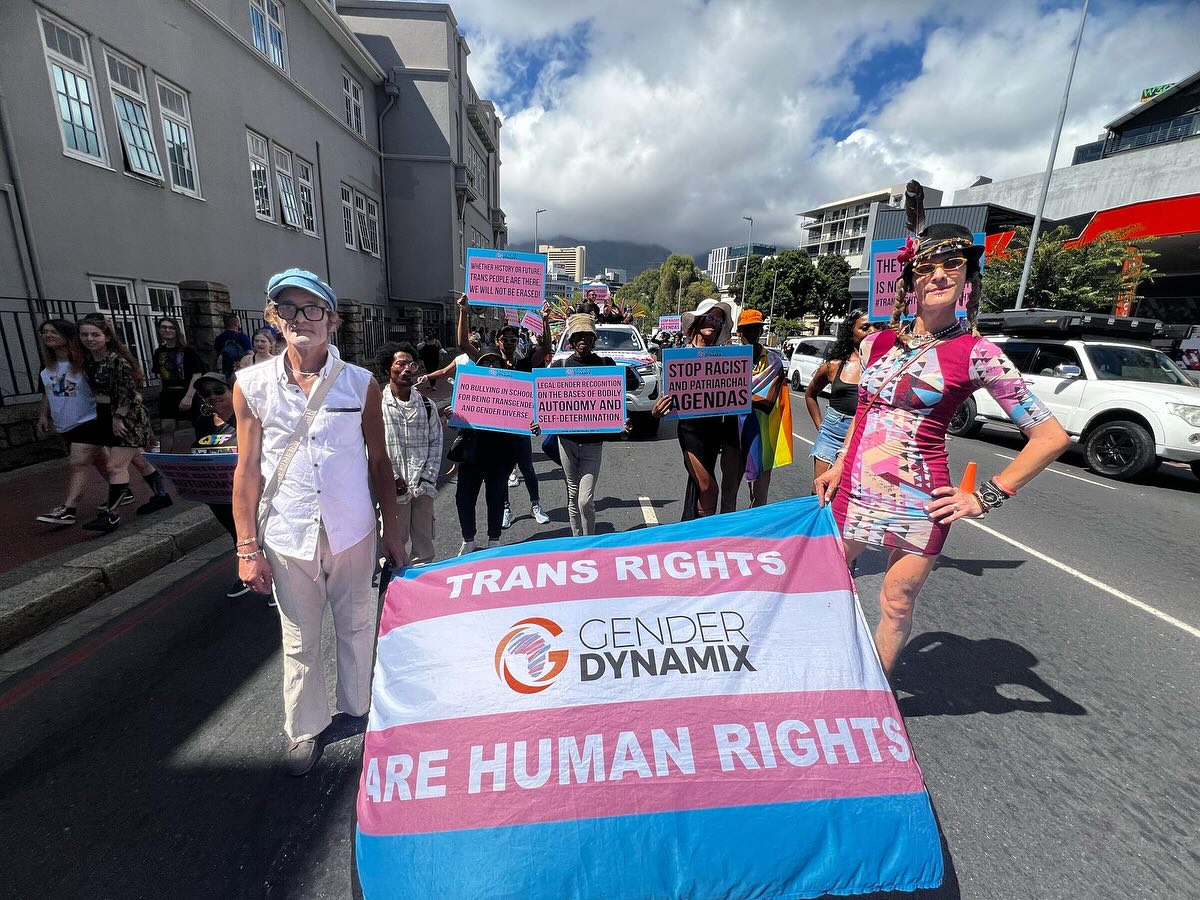
Cape Town Pride March, 2025
Objectivos
Aumentar a visibilidade e a aceitação de pessoas trans e de pessoas com diversidade de género.
Defender uma sociedade em que todos sejam livres de expressar o seu género, dentro, através e para além do binário masculino-feminino, sem medo de discriminação e promover a auto-identificação.
Proporcionar formação e educação às principais partes interessadas, incluindo, mas não se limitando a, profissionais de saúde, agentes da autoridade, educadores, funcionários públicos e líderes religiosos, a fim de desenvolver a sensibilidade em relação às pessoas transgénero, não conformes ao género e com dúvidas sobre o seu género.
Desafiar e ajudar as pessoas a reexaminar a sua compreensão da diversidade de género.
Ajudar as pessoas próximas, a família, os amigos e os colegas de pessoas transgénero, não conformes e com dúvidas sobre o seu género a obter informações e formação sobre identidade e expressão de género.
Utilizar um quadro de direitos humanos para apoiar as pessoas trans e de género diverso a acederem aos seus direitos e a defenderem-nos.
Aumentar a consciencialização e a aceitação das pessoas trans e de género diverso na África Austral através de trabalho de sensibilização nos municípios e nas zonas rurais.
Participar e realizar investigação no domínio da diversidade transgénero e de género.
Desempenhar um papel integral no ativismo trans na África do Sul, em África e a nível mundial, participando em redes relevantes de direitos humanos.
Formar parcerias estratégicas para concretizar a prestação de serviços a pessoas transgénero e com diversidade de género, e estabelecer ligações com outras organizações que também estejam a trabalhar para a concretização dos direitos humanos.
Promover os direitos humanos, exercendo pressão sobre o governo, a sociedade civil, os decisores nacionais e internacionais e os meios de comunicação social para que combatam o preconceito, a discriminação, a violência e a intimidação das pessoas transgénero, não conformes ao género e com dúvidas sobre o seu género.
Liesl in a meeting with then Chair of the GDX Board, Sally-Jean Shackleton
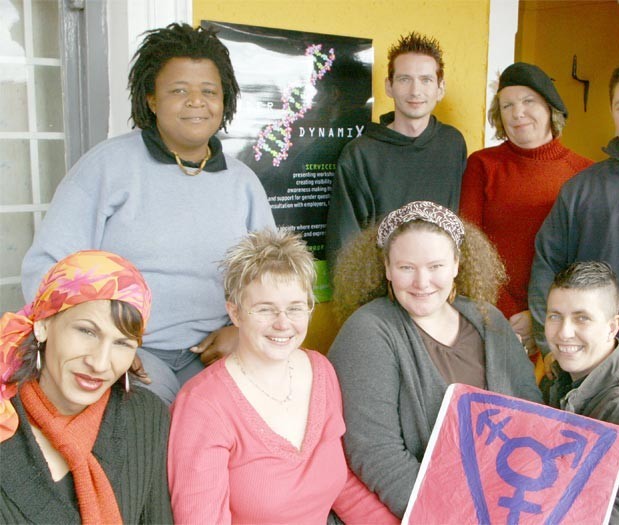
Some of the members of the first GDX Board Back, from left to right: Bulewa Panda, Robert Bayer and Natalie Front, from left to right: Nazmah Achmat, Liesl Theron, Sally-Jean Shackleton and Robert Hamblin
Watch: Video about Lex Kirsten and the founding of GDX
Liesl Theron reflecte sobre os primórdios do GDX
"Não posso separar a história da fundação da Gender DynamiX da minha própria história. A minha primeira relação com um homem trans foi em meados da década de 1990. Eu não sabia nada sobre transgénero, ativismo, feminismo ou mesmo sobre o movimento LGBT. Em 2003, treze anos mais tarde, e depois de me ter mudado para longe, para a Cidade do Cabo, um amigo que sabia do meu anterior parceiro trans entrou em contacto comigo para me dizer que tinha um amigo que estava a pensar fazer a transição mas não tinha qualquer informação ou ideia de como avançar com o processo. O meu amigo esperava que eu pudesse partilhar informações ou conselhos com essa pessoa porque, na altura, a África do Sul não tinha uma organização que se ocupasse de pessoas transgénero e não havia nenhum grupo ou organização a que essa pessoa pudesse recorrer para obter informações ou ajuda médica ou jurídica.
Também é importante lembrar que nessa altura existia a Internet, mas era bastante limitada. Poucas pessoas na África do Sul tinham um computador em casa, quanto mais um que estivesse ligado à Internet. Era um verdadeiro privilégio ter isso. Os telemóveis e as redes sociais também não estavam tão desenvolvidos como hoje. Não havia smartphones que permitissem fazer pesquisas em linha. Apercebi-me de que poderia ter algumas respostas e concordei em encontrar-me com ele. Começámos a conversar e demo-nos muito bem. Tão bem, de facto, que o Lex se tornou o meu segundo parceiro trans.
Assim que tentámos obter informações dos departamentos estatais sobre o processo de transição, apercebi-me das diferenças na prestação de serviços e nos pontos de acesso no país. Não havia diretrizes no sistema de saúde pública. Também não havia orientações ou procedimentos no Departamento de Assuntos Internos, que é onde os cidadãos têm de registar toda a informação pessoal e obter certidões de nascimento e documentos de identidade. Descobrimos que a informação sobre a transição estava escondida tão longe, que era como se fosse um grande segredo do qual não se podia falar. Lex sentiu-se isolado, mas sabia que devia haver outras pessoas trans no país que estavam a lidar com as mesmas questões. Eu sabia que havia mais pessoas, porque não só tive uma relação trans anterior, como me lembro de o meu ex falar de outras pessoas trans na sala de espera do hospital durante o seu período de transição em Pretória.
Comecei a pesquisar na Internet para obter mais informações, sobre transgéneros em geral, sobre ativismo e sobre a situação noutros países. O Lex fazia turnos noturnos de 15 em 15 dias e havia um cibercafé no nosso bairro que tinha uma promoção nocturna entre as 20h00 e as 8h00, em que só era preciso pagar as primeiras 3 horas. Por isso, aproveitei essa oferta especial e, quando ele ia para o seu trabalho noturno, eu ia para o meu próprio "trabalho noturno", procurando informação online, durante toda a noite.
Fiquei a saber que, entre meados dos anos 70 e os anos 80, a orientação internacional dada por psicólogos e psiquiatras a pessoas trans era que, após a transição médica e cirúrgica da pessoa, seria melhor para todos se ela pudesse "desaparecer". O conselho era que apenas os membros da família deveriam saber e que seria melhor se a pessoa pudesse começar com novos amigos, um novo emprego, numa nova cidade - se pudesse emigrar seria ainda melhor. Finalmente percebi porque é que era tão difícil encontrar informações em primeira mão de outras pessoas trans que já fizeram a transição. Todas as pessoas trans desapareceram literalmente juntamente com a sua informação. Todas as pessoas trans que quisessem fazer a transição tinham basicamente de começar o caminho sozinhas, como se fossem a primeira pessoa a passar pelo processo. Isto também significa que não existia qualquer sistema de apoio.
Após dois anos de recolha de informação, decidimos iniciar um sistema de partilha de informação. Entrámos em contacto com todas as redes e organizações LGBT possíveis e começámos a divulgar a informação através delas para chegar às pessoas trans. A mensagem era simples: Entrem em contacto comigo se precisarem de informações e ajudem-me a criar uma base de dados de informações para ajudar outros.Inicialmente, pensámos apenas na criação de uma base de dados, ou de um serviço de dados, e nem sequer sabíamos que o que estávamos a fazer iria transformar-se na primeira organização trans sem fins lucrativos em África!
Pouco depois de termos começado a espalhar a palavra, as pessoas começaram a contactar-me com pedidos de informação em geral, ou como ter acesso a médicos, psicólogos, ou como alterar o género nos seus documentos legais. Fiquei surpreendida quando recebemos telefonemas de pais sobre os seus filhos transgéneros. Também recebemos pedidos de aconselhamento jurídico, uma vez que muitas pessoas trans foram injustamente despedidas do trabalho quando se assumiram ou decidiram assumir-se. Eu dirigia-me a advogados do trabalho para lhes pedir ajuda. Eles respondiam-me: "Lamento, mas não sou especialista nessa área, não o posso ajudar". Ao que eu respondia: "O senhor é um especialista em direito do trabalho. Conheço toda a terminologia e informações relacionadas com a transexualidade que precisa de saber. Tenho listas de exemplos de jurisprudência noutros países, de como os casos laborais foram ganhos nos tribunais, juntos podemos fazê-lo. Pode tornar-se um perito na África do Sul sobre este assunto. Precisamos que aplique o seu senso comum ao Direito do Trabalho que já conhece e que o combine com a Constituição e os Direitos Humanos da África do Sul". Naquela altura, não aceitei um "não" como resposta.
Apercebemo-nos de que a nossa "base de dados" era muito mais do que isso e, depois, organizei o "Workshop de Sensibilização para a Diversidade de Género" no GHMCC, que levou à formação da Gender DynamiX. Desde o início que me envolvi pessoalmente na assistência aos requerentes de asilo trans de outros países africanos que fogem para a África do Sul, por várias razões: acesso à transição ou uma situação insuportável no seu próprio país, uma vez que em muitos países africanos qualquer pessoa LGBT pode ir para a prisão e, em alguns casos, receber a sentença de morte.
Outros vieram para a África do Sul na esperança da promessa da "Nação Arco-Íris" de Nelson Mandela e da nossa Constituição liberal, a primeira do mundo a estipular que não haverá discriminação com base na orientação sexual ou no género. Demos workshops, como acções de sensibilização geral para o público, família, amigos e até jornalistas. Como na altura havia muito secretismo e estigma público, Lex não queria envolver-se publicamente nem que se soubesse publicamente que ele fazia parte do projeto - tinha medo de perder o emprego.
E foi assim que a história do início do movimento trans africano se baseou no facto de ter sido uma pessoa cisgénero a iniciá-lo - apesar de, na verdade, termos sido nós os dois a começar. Eu com coragem e perseverança, e o Lex a financiar o nosso trabalho inicial, pelo qual acabou por ser reconhecido publicamente quando recebeu o prémioPrémio de Filantropia Inyathelo.
Nos primeiros anos da Gender DynamiX, a linguagem ainda era "FTM" e "MTF" e era realmente considerada em termos de um binário estrito. Não era como é atualmente".
6th Biennial Regional Trans Health, Advocacy and Research Conference, 2023. An annual conference organised by GDX.
4th Regional Trans Health, Advocacy and Research Conference, 2019
Community engagement with students at Fort Hare University, 2019
Watch: Celebration of GDX’s 20th Anniversary — We interviewed the current Executive Director, Liberty Matthyse, inaugural Executive Director, Liesl Theron, and other stakeholders (4 July 2025)
July 2005 — Founding of First South African Trans Rights Organisation, Gender DynamiX (GDX), South Africa Gender DynamiX (GDX), the first registered South African-based organisation and one of the first African-based organisations focusing solely on the trans community, was founded in South Africa by cis woman, Liesl Theron, and her trans partner, Lex Kirsten in […]
julho de 2005 - Ativista trans e LGBTQIA+, Victor Mukasa, processa o Governo, Uganda
On 20 July 2005, trans man and LGBTQIA+ activist Victor Mukasa’s house was raided by the police without a search warrant. They were looking for documents relating to the activities of SMUG. Victor was not home at the time of the raid and the police confiscated documents and arbitrarily arrested Yvonne Oyhoo, who happened to be at Victor’s house at the time. After suffering humiliating and degrading treatment from the police, Yvonne was released on the condition that she had to return the following morning with the chairperson of SMUG.
Uganda is known to have a zero-tolerance policy towards homosexuality and on 5 July 2005, the Ugandan government voted for a constitutional amendment to the effect that “marriage is lawful only if entered into between a man and woman” and that it was “unlawful for same-sex couples to marry.” During this time, when mainstream media and many AIDS activists articulated homophobic viewpoints, Victor continued to speak out as an individual and as co-founder and chairperson of Sexual Minorities Uganda (SMUG).
Following the raid, Mukasa publicly declared his intent to sue the Ugandan government for violation of his and Yvonne’s human rights. Soon after this, he started getting threats from government officials to withdraw the case. He went into hiding with the help of Amnesty International and several other regional and international human rights organisations, first within Uganda and eventually in South Africa until the trial started. Mukasa won the court case on 22 December 2008.
Victor Mukasa, human rights defender, and activist from Uganda claimed his identity as a transgender lesbian and started speaking out in the local media about the oppression of LGBTIQ+ people in Uganda in around 2002.
July 2005 — Trans and LGBTQIA+ Activist, Victor Mukasa, Sues Government, Uganda On 20 July 2005, trans man and LGBTQIA+ activist Victor Mukasa’s house was raided by the police without a search warrant. They were looking for documents relating to the activities of SMUG. Victor was not home at the time of the raid and […]
On 25 February 2006, Kenyan-born Biko Beauttah arrived in Canada to seek asylum because being considered homosexual is a criminal offence in her home country. Biko left Kenya a few years prior to attend college in the USA. Having come from a background where her entire being was against the law, and where there was no language or terms around non-heterosexual and non-cisgender sexuality or gender, Biko only realised while studying in America that she identified as transgender and not gay.
Fearing for her life if she returned to Kenya, she arrived at Toronto’s airport on 25 February 2006. Here she was put in handcuffs and detained by officials who humiliated her for 36 hours before she was granted asylum in Canada. She spent a further 6 months in a refugee shelter before a landlord agreed to rent an apartment to her.
After Biko received asylum, she became a human rights activist championing the rights of trans people. Some of her achievements include being the founder of Trans Workforce in 2014, the world’s firstjob fair aimed at creating work opportunities for people who identify as trans or gender nonconforming, and becoming a board member ofThe 519 in 2015, a Toronto-based agency serving the trans community of Toronto by assisting with refugees, counselling, and training. Asked in an interview why she became an activist, Biko answered:
“I like to think that I have always been a compassionate person. However, it wasn’t until I became a refugee and also transitioned that I became aware of all the routine humiliations that marginalized and displaced people face. It’s our society’s dirty little secret that we like to sweep under the rug. I am not a dirty secret, and neither are others like me; I refuse to be swept under the rug. In the fight for my dignity, others will benefit as well because it is not just for me, but for all our dignity and humanity that I fight. It’s my fuel.”
A champion of refugee and sexual minority rights, she has spread her message of tolerance and equality through various platforms such as the Canadian Council for Refugees and the Refugee Pride Convention. Biko was also the first person to give a lecture on gender studies upon the inception of such a course at a high school in Canada. At George Brown, Biko also served as the Women and Trans Persons representative, bridging the gap between her constituents, the college administration, and the Student Association. Through the Student Union, Biko was also part of a panel to discuss issues faced by racialised students, and sexual minorities on college campuses at The Canadian Federation of Students Convention. She was also the first queer person of African descent to open the Toronto Stock Exchange.
One of the highlights in Biko’s personal life was her appearance on ‘America’s Next Top Model’, as part of the Tyra Banks Show, in itself raising awareness of trans equality and tolerance.
Photograph of Biko Beauttah from an article by her on the UNHCR Canada website.Photograph of Biko Beauttah by Bushira Nakitende. Source: Jayu
On 25 February 2006, Kenyan-born Biko Beauttah arrived in Canada to seek asylum because being considered homosexual is a criminal offence in her home country. Biko left Kenya a few years prior to attend college in the USA. Having come from a background where her entire being was against the law, and where there was […]
On 31 October 2006, Alexandra Rubera was granted asylum in South Africa. Rubera, a trans woman from Burundi, faced arrest and death threats from private citizens and the police in her native country on an ongoing basis. Alexandra moved between Burundi and Rwanda as she had a parent from each country, making access easier to both countries. When life became too difficult for her, Alexandra had no permanent home and became fully nomadic, also moving between Kenya and Tanzania.
Alexandra self-describes as Travesti and she lived a fully independent life, but her gender identity led to constant harassment, public humiliation, and police arrests. When she was sitting in a coffee shop in an upper-class shopping mall in Nairobi, Kenya, police clamped down on her and arrested her under the guise of “public nuisance” and “imposter identity” (fraud). She was further humiliated in the police cells when the police removed from her everything they considered to be “female” and therefore fraudulent – her clothing, wig, and make-up – and then allowed a journalist to take photos of her and publish the “scandal” in local newspapers.
Eventually, she was deported back to Burundi from Kenya, but the police confiscated her passport and all her documents and in doing so turned her into an undocumented citizen in her own country. She got into contact with people from Amnesty International and was also in contact with IGLHRC (the International Gay and Lesbian Human Rights Commission — IGLHRC, today known as OutRight International).
Cary Alan Johnson (senior specialist for Africa, IGLHRC), struggled to find any established LGBTIQ+ organisations based in South Africa with experience in asylum matters who would agree to assist in the matter. Cary eventually contacted Liesl Theron from the newly established Género DynamiX (GDX) to enquire about the possibility of GDX assisting and supporting Alexandra with her application for asylum in South Africa if Alexandra were able to make her own way into the country. With little experience in asylum matters, Liesl replied: “She is a trans person in need, we will help her. I have no idea what I’m actually saying yes to – but we will help her, and we will need your guidance in the matter”. Cary and Liesl remained in contact and introduced Liesl to Judge Edwin Cameron and Advocate William Kerfoot from the Legal Resources Centre (LRC) in Cape Town, who would be able to provide GDX with legal assistance. Liesl personally assisted Alexandra in preparing her motivational letters and her legal case and accompanied her on numerous trips to the offices of South Africa’s Department of Home Affairs.
Because Liesl and GDX were inexperienced in asylum matters and because there were no other types of guidance or best practice examples outside of the legal assistance provided, Liesl prepared the information which would serve as motivation about the difficulty of living as a trans person in Kenya, where she had been arrested, as well as in Burundi, her native country which she was seeking asylum from.
On 31 October 2006, Alexandra Rubera was granted asylum in South Africa. Rubera, a trans woman from Burundi, faced arrest and death threats from private citizens and the police in her native country on an ongoing basis. Alexandra moved between Burundi and Rwanda as she had a parent from each country, making access easier to […]
1950197519821992199419982000200020039 de fevereiro de 20039 de setembro de 20033 de março de 200415 de março de 200420052005maio de 2005julho de 2005julho de 200525 de fevereiro de 200631 de outubro de 2006
You can include information about your African Organisation/Group
There are many African organisations and individuals who over the years have contributed in invaluable ways to the story of the trans, gender diverse and intersex movements who are not yet included on our Timeline.
Queremos reconhecer e incluir todas as contribuições verificáveis.
The Timeline is about your stories and voices. You can find out more about how to contribute by visiting our Contact Us page here.