

7 March 2023 — Resolution 552: The Resolution on the Promotion and Protection of the Rights of Intersex Persons in Africa
During the African Commission on Human and Peoples’ Rights (ACHPR) meeting at its 74th Ordinary Session, held virtually from 21 February to 77 March 2023, “Resolution on the Promotion and Protection of the Rights of Intersex Persons in Africa – ACHPR/Res.552 (LXXIV)” (Resolution 552) was adopted on the 7 March.
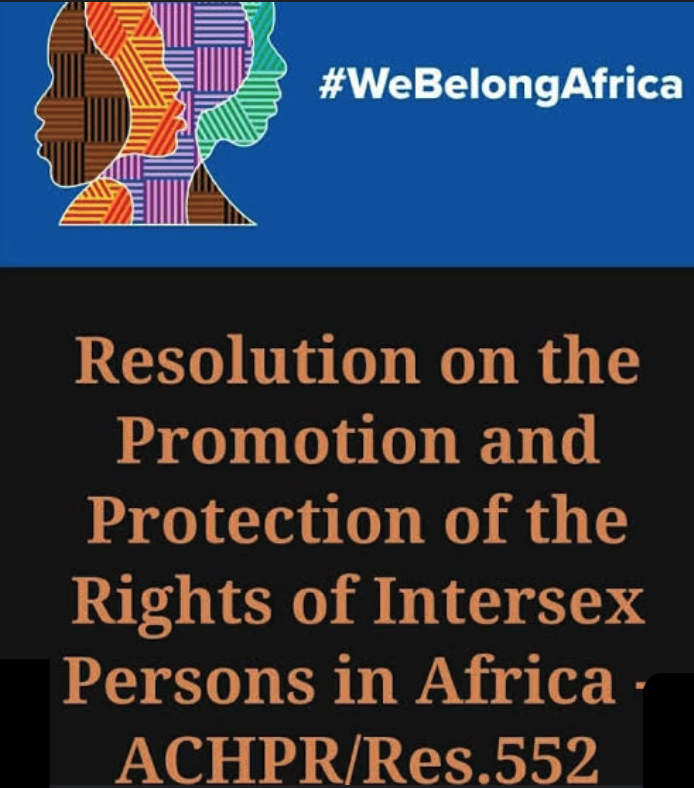
The adoption of this resolution follows the launch of a report on the human rights challenges to intersex persons — “Study on the Human Rights Situation of Intersex Persons in Africa” — at the Commission’s 73rd (public) Ordinary Session, held from 21 October to 10 November 2022 in Banjul, The Gambia. On 23 October 2022, the Centre for Human Rights, in collaboration with the Support Initiative for People with Atypical Sex Development (SIPD) and the Intersex Community of Zimbabwe (ICoZ), launched the Report. The Report acknowledges the lived realities of intersex persons and leverages their voices through interviews and personal testimonies.

“This report set out the results of a study undertaken by the Centre, together with intersex organisations from across Africa (Intersex Persons Society of Kenya (IPSK), SIPD-Uganda, Rainbow Identity Association (Botswana), Intersex Society of Zambia (ISZ) and Intersex Community of Zimbabwe (ICoZ)). In this report, the Commission is encouraged to adopt a resolution on the issue. It also contains a draft resolution with recommendations to states.
The resolution is a positive step towards addressing the significant challenges of intersex people across Africa. Lack of awareness about the existence of intersex persons has contributed to experiences of human rights violations including unnecessary genital ‘normalising’ surgeries on minors, a lack of appropriate legal recognition and poor birth registration processes, discrimination in the justice system, infanticide, baby dumping, and various forms of discrimination in other spheres of life.
This resolution is a guiding measure toward addressing legislative gaps and the lack of representation of intersex persons in law. While this is a significant positive measure, the Centre notes that the diversity of intersex bodies is a naturally occurring congenital development, relating to genitalia, chromosomes and hormones. Each intersex individual’s experience is different, with some not being aware of their intersex status until later in adulthood. It is important to acknowledge that while many struggles are intersectional, intersex identities should not be pathologised as an ‘abnormal’ medical condition or illness as this contributes to invasive procedures done on intersex persons without their consent.” — Centre for Human Rights, University of Pretoria
Key elements of Resolution 552
- Recognition: Acknowledges that intersex persons—born naturally with reproductive or sexual anatomy or chromosomal patterns that do not fit typical binary definitions of male or female—exist across all African societies.
- Prohibition of Non-Consensual Surgeries: Condemns non-consensual and unnecessary genital-normalising surgeries and medical interventions on intersex minors, comparing their irreversible physical and psychological consequences to female genital mutilation (FGM).
- Addressing Human Rights Violations: Expresses deep concern over systemic abuses, including infanticide, child abandonment, societal rejection, and discrimination in schools, healthcare, sports, employment, detention facilities, and public services.
- Legal and Administrative Reform: Calls on African Union Member States to enact national laws, policies, and administrative processes that allow intersex individuals to obtain and correct legal identity documents.
- Protection of Defenders: Urges states to protect intersex human rights defenders and activists from stigma, discrimination, reprisals, and criminal prosecution.
- Critique of Language: Human rights organisations—such as the University of Pretoria’s Centre for Human Rights—have welcomed the resolution as a historic milestone while noting criticism regarding its characterisation of intersexuality as an “inherent handicap,” warning that pathologising language can inadvertently be used to justify medical interference.
The Commission calls on States Parties to:
- Promote and protect the rights of intersex persons on the continent;
- Stop non-consensual genital normalization practices on intersex persons, such as surgical, hormonal and sterilization procedures that alter the sexual characteristics of intersex persons and ensure respect for their rights to make their own decisions regarding their bodily integrity, physical autonomy and self-determination;
- Ensure that any action concerning an intersex minor is carried out with the permission of the parents and after medical analysis, taking strict account of the best interests of the child;
- End human rights violations against intersex persons, such as infanticide and abandonment of intersex children;
- Prohibit discrimination based on intersex traits and characteristics or intersex status, including in education, health, employment, competitive sports, and access to public services, and address such discrimination through appropriate anti-discrimination initiatives;
- Ensure that intersex human rights defenders work in an environment free from stigmatization, retaliation, or criminal prosecution because of their human rights activism;
- Incorporate intersex education into prenatal counselling and support services, and provide training for health care personnel focused on the health needs and human rights of intersex persons, as well as the appropriate counselling and care to be given to intersex parents and children, respecting the autonomy, psychological integritý and sexual characteristics of the intersex person;
- Enact enabling legislation and institutionalize administrative processes that allow intersex persons to change the gender designation on their birth certificates and other official documents, based on decision taken through medical intervention;
- Ensure intersex people’s right to full information, including access to their own medical records and history;
- Ensure that human rights violations against intersex people are investigated, perpetrators are prosecuted, and victims have access to effective remedies, including redress and compensation;
- Raise awareness of intersex issues and the rights of intersex persons in society; and
- Ensure that members of the judiciary, immigration officials, law enforcement officers, health, education and other officials and personnel are sensitized to the respect and equal treatment of intersex persons.
— Source: African Commission on Human and Peoples’ Rights (ACHPR)
