

2026 — Article: Intersex Awareness Day and the African Struggle for Bodily Autonomy
30 years after the Boston protest, African activists’ histories show how the struggle for bodily autonomy has taken shape in Uganda, South Africa, Kenya, Zambia, Zimbabwe and across the continent.
On 26 October 2026, Intersex Awareness Day marked 30 years since the Boston demonstration that gave it its date. Remembering that protest in the context of Africa also means recognising the people who have challenged silence and discrimination on this continent. The records of Ugandan organising, South African activism and African regional meetings show a movement with its own leaders and priorities.
The Boston action took place on 26 October 1996 outside the American Academy of Pediatrics’ annual meeting. Max Beck and Morgan Holmes, representing the Intersex Society of North America, joined allies to challenge medical practices affecting intersex children. Their demonstration is commemorated as the first public intersex protest in North America. The named annual awareness day developed later, through organising by Betsy Driver and Emi Koyama in 2003–2004. The thirtieth anniversary therefore belongs to the protest, rather than thirty years of an established annual observance.
Beck’s account, published in Chrysalis in 1997, draws on recordings made during the journey. It describes protesters distributing leaflets and speaking with doctors, journalists and passers-by outside the Hynes Auditorium. Beck challenged the idea that adults who had undergone childhood treatment were simply lost to follow-up: “Now, I’m back.” Their presence demanded that patients’ experiences become part of the evidence used to assess medical care.
That demand offers a useful connection to African histories. Intersex refers to innate variations in sex characteristics, including anatomy, hormones or chromosomes, that do not fit typical definitions of male or female bodies. Such variations may become apparent at different stages of life. Being intersex does not, by itself, determine someone’s sexual orientation or gender identity. Accurate public understanding begins by keeping these distinctions clear.
African intersex history also requires attention to the ways bodies have been described and studied. In “Envisioning African Intersex“, scholar Amanda Lock Swarr traces the relationship between intersex medicine, colonial ideas and scientific racism in South Africa. Her work centres African activists’ responses to these histories, including Sally Gross’s organising. It provides a reason to read the Boston anniversary alongside African records, while respecting the different circumstances in which advocacy developed.

Kenya
Kenya offers another record of the struggle for recognition. Its 2019 Population and Housing Census counted 1,524 intersex people, a figure reported by the National Council on the Administration of Justice. That count is a record of those enumerated, rather than proof of the total number of intersex Kenyans. The Council’s report also examines barriers within the criminal justice system, showing why recognition must extend into the procedures through which people seek protection and justice. Read more about the rights of intersex people in Kenya:
- Article: Recognition and Protection of Intersex Children Under the Kenyan ‘Children Act of 2022’
- “Intersex Persons & the Law in Kenya” by John Chigiti SC (2021): A Review

South Africa
Gross, an anti-apartheid activist and intersex rights organiser, helped establish a public voice for intersex people in South Africa, and also founded Intersex Society of South Africa. Swarr identifies her as a pioneer of intersex legislation. Her work belongs within African political history as well as the international intersex movement: it connected the experience of exclusion with efforts to change how institutions recognised and treated people born with variations in sex characteristics.
South Africa’s legal recognition also illustrates the distance that can remain between rights on paper and everyday life. Speaking at an intersex health dialogue in February 2024, Deputy Justice Minister John Jeffery acknowledged the country’s inclusion of intersex people within its equality legislation. He nevertheless described continuing prejudice and harmful practices, and argued that legal protection needed to be accompanied by awareness and advocacy. Formal recognition, in his account, had not resolved the problem.

Uganda
Uganda has its own sustained history of intersex organising. Julius Kaggwa founded the Support Initiative for People with Atypical Sex Development (SIPD), known as SIPD, in Kampala in 2008. Its work brought public education, advocacy and support into a setting where families needed reliable information. SIPD’s stated approach involves parents, health workers, school authorities, community leaders and religious leaders in reducing stigma and improving support.
The need for that work appears in Uganda’s documented experiences of education. SIPD’s 2015 violations report, “Uganda Report of Violations to Children and People Born Intersex or with Differences of Sex Development”, recorded reports of 34 intersex children leaving school because of discrimination and stigma. This was an organisation’s documented caseload, not a national dropout estimate. Even with that limitation, it demonstrates why awareness has practical consequences: an uninformed school environment can interrupt a child’s education and restrict opportunities far beyond the classroom.
A 2019 study, “The Impact of the Legal and Policy Framework on the Human Rights of Intersex Persons in Uganda”, by the Human Rights Awareness and Promotion Forum, in collaboration with SIPD, examined the impact of Uganda’s legal and policy framework on intersex people. Its qualitative research included interviews with ten intersex individuals, eight parents and fourteen key informants. It documented bullying, difficulties accessing appropriate healthcare and concerns about treatment without the affected person’s informed consent. These accounts provide evidence of lived experiences; they should not be presented as population-wide prevalence statistics.

Zambia
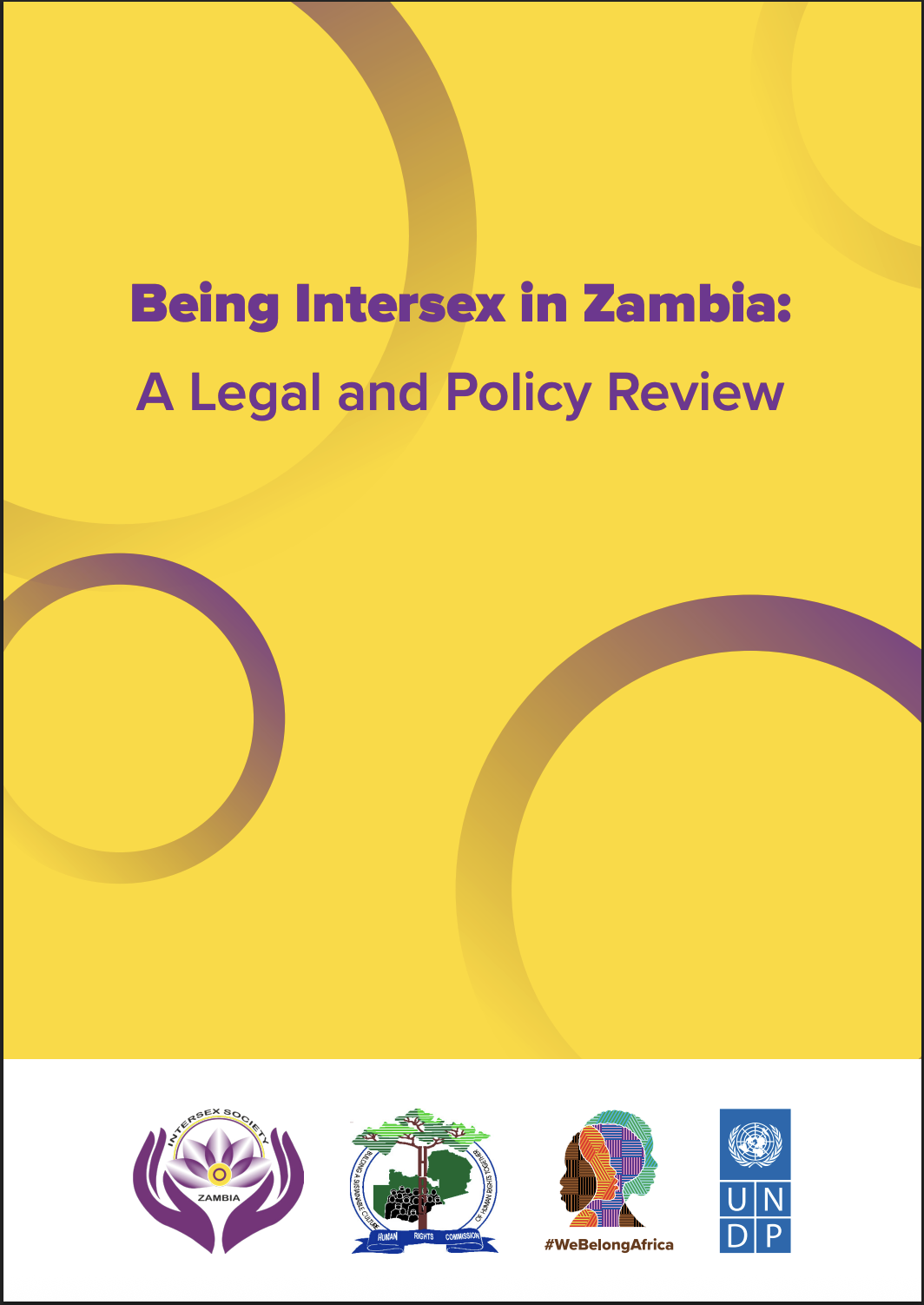
Zambia’s intersex movement has helped bring lived experience into discussions of legal and policy change. In 2020, the Intersex Society of Zambia joined the Human Rights Commission, We Belong Africa and UNDP Zambia in an initiative that led to “Being Intersex in Zambia: A Legal and Policy Review”. The review identified gaps in protection against coercive medical procedures and barriers to healthcare, education and legal recognition. Its findings were shared with parliamentarians, government representatives and civil society, alongside the experiences of intersex people and their families. The review and dialogue provide a foundation for reform; their recommendations do not in themselves change the law.
Zimbabwe
Zimbabwe’s intersex advocates have also brought questions of recognition and bodily autonomy into public and institutional debate. The Zimbabwe Human Rights Commission reports that it worked with the Intersex Community of Zimbabwe and UNDP on a dialogue that produced recommendations for government institutions. In 2025, intersex people and organisations filed a High Court application seeking legal recognition and protection, including safeguards concerning non-consensual procedures on children. In August 2026, the government discussed findings from national consultations on legal and social challenges affecting intersex people. These are significant steps towards reform, although the court application and discussions should not be described as completed legal changes.

African Intersex Meeting
1st African Intersex Movement meeting: 24—26 November 2017
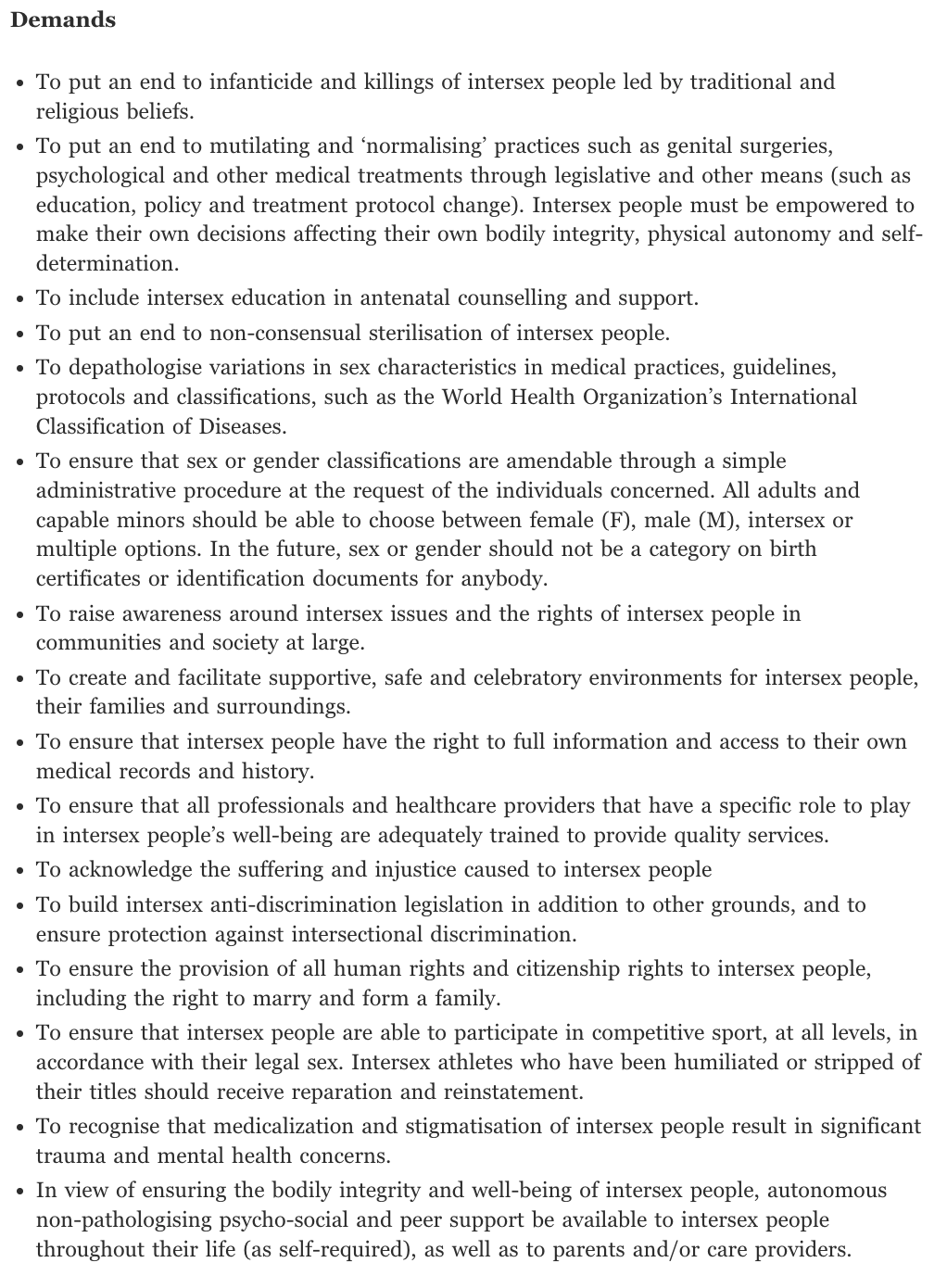
African activists have also set out shared priorities in their own words. From 24 to 26 November 2017, the First African Intersex Meeting, which saw the birth of the African Intersex Movement (AIM) brought together 22 intersex people representing organisations from seven African countries in Johannesburg. Its public statement called for bodily integrity and self-determination, an end to non-consensual sterilisation and harmful normalising procedures, and protection against infanticide and killings. It also demanded access to medical records, informed healthcare and community support. The statement’s breadth matters. It placed medical treatment alongside family safety, education, identity documents and participation in society. These were demands articulated collectively by African intersex people. Their insistence that they should drive the changes affecting their lives is central to understanding the movement’s history. It also guards against treating Africa as a single, uniform experience.


2nd African Intersex Movement meeting: 19—21 June 2019
3rd African Intersex Movement meeting: 30 January to 2 February 2023
At the third African intersex activist meeting, held in Nairobi, Kenya from 30 January to 2 February 2023, 35 activists reconvened to share experiences and shape their work after COVID-19. Their statement recalled the 2017 and 2019 declarations and reaffirmed the importance of African intersex leadership. The record shows continuing organisation across meetings and generations of advocacy. Read more about the meeting.
Adoption of African Commission on Human and Peoples’ Rights Resolution 552
A significant institutional response followed on 7 March 2023, when the African Commission on Human and Peoples’ Rights adopted Resolution 552 on the rights of intersex persons in Africa. It called on states to stop non-consensual genital normalisation practices, combat discrimination, protect human rights defenders and improve access to information and medical records. It also addressed infanticide, abandonment and barriers to identity documents. The resolution is a regional human rights instrument calling for state action; its adoption does not establish that every country has implemented its recommendations. Read more.
Conclusion
By 2026, the 30th anniversary of Intersex Awareness Day, intersex-led organising focused exclusively or primarily on intersex issues in Africa had grown to over 18 countries including Uganda, Kenya, Tanzania, Congo, Cameroon, South Africa, Zambia, Zimbabwe, Botswana, Malawi, Ghana, Nigeria, Burkina Faso, Lethoso, Angola, Cote D’Ivoire, Tunisia and Eswatini.
The Boston protest remains the historical reference point for 26 October. An African account of the day can place it in conversation with Gross’s organising, Kaggwa’s advocacy, Uganda’s documented school experiences, Kenya’s recognition efforts, Zambia’s policy review, Zimbabwe’s advocacy and reform discussions and the African Intersex Movement’s collective statements. These records give the anniversary a concrete local meaning. They ask what changes when intersex people can remain in school, obtain appropriate care and participate in decisions affecting their bodies and lives.
This article was written by our Intersex Content Contributor, Delphine Barigye

